

You're standing in a shop aisle with one hand on a jar of body butter and the other scrolling through conflicting pregnancy skincare advice. The front promises “natural”, “nourishing” or “bump loving”, but the back is a dense list of unfamiliar names. You want something rich enough for dry, stretched skin, yet gentle enough to use without second-guessing every ingredient.
The useful skill isn't memorising one approved shopping list. It's learning how to read body butter ingredients in context, understand what each family does, and spot the details that matter most for pregnancy, sensitive skin and fragrance tolerance.
Table of Contents
- What a Body Butter Label Is Really Telling You
- The Building Blocks Inside Every Body Butter
- Meet the Most Common Butters and Oils
- Why Natural Does Not Always Mean Pregnancy-Safe
- A Pregnancy-Safe Ingredient Checklist
- Comparing a Standard, a Pregnancy and a Bump Formula
- How to Use Body Butter on Your Bump
- Reading Any Future Body Butter With Confidence
What a Body Butter Label Is Really Telling You
The small print on the back is the INCI list, the internationally standardised declaration of cosmetic ingredients. Ingredients are generally listed from the highest amount to the lowest, although ingredients present below one per cent can appear in any order. That means the beginning of the list gives you the clearest picture of what the product mainly is.
Start with the first five ingredients
Scan the first five names before you get distracted by the marketing copy. They usually define most of the product's texture and purpose.
If you see shea butter, cocoa butter and several oils near the beginning, you're probably looking at a rich, oil-heavy formula. If you see aqua, glycerin and lightweight emollients first, it may feel more like a lotion or cream than a traditional water-free butter. Neither structure is automatically better. The right choice depends on whether you want a quick-absorbing moisturiser, a protective layer for very dry skin, or a more concentrated balm.
Marketing names can also hide familiar ingredients. Butyrospermum Parkii Butter is shea butter, while Theobroma Cacao Seed Butter is cocoa butter. Plant ingredients often use their botanical names, so a Latin-looking word doesn't make an ingredient suspicious or unsafe.
Learn to spot separately declared allergens
Fragrance blends may be listed as parfum or fragrance, but certain fragrance allergens must also appear separately when they meet the relevant labelling requirements. Names such as limonene, linalool, citronellol, geraniol, citral and farnesol can therefore appear near the end of a list even when the fragrance itself is listed elsewhere.
UK cosmetic rules require products to be safe, assessed properly and labelled with a full ingredients list on the outer packaging or primary container. The UK cosmetics enforcement guidance also explains restrictions on substances classified as CMR category 1A or 1B in Great Britain, unless a specific annex permission applies.
Practical rule: Read the label as a formula, not as a collection of scary-sounding words. First identify the base, then check fragrance, actives and anything you already know your skin dislikes.
The Building Blocks Inside Every Body Butter
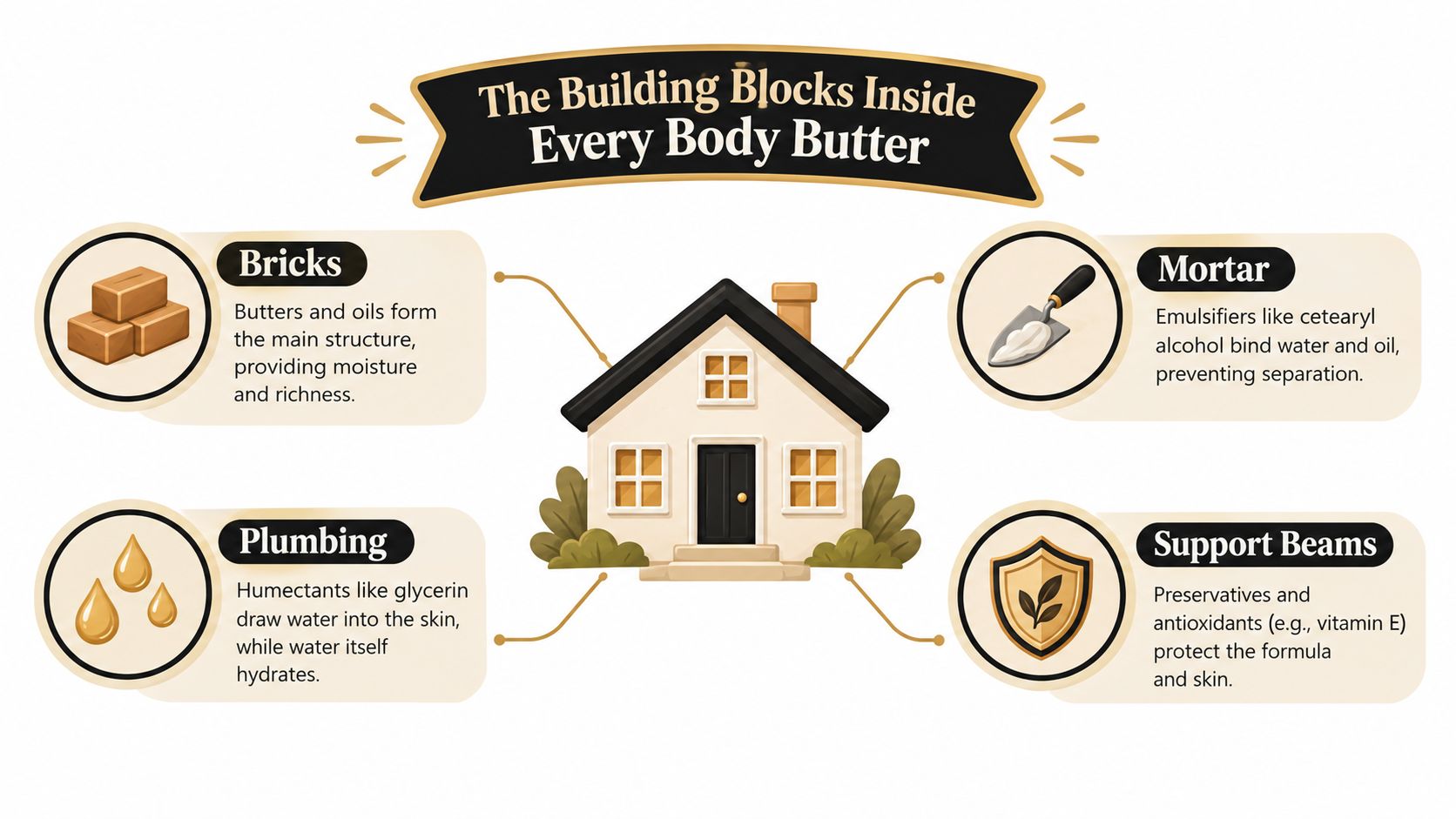
A jar of body butter makes more sense when you treat it like a small house. Each ingredient family has a job, and the formula needs several families working together to feel comfortable and perform well.
The structure starts with bricks
Butters and oils form the main structure. Shea butter, cocoa butter, mango butter, coconut oil, sweet almond oil and jojoba oil soften the skin and give the product its richness, glide and finish. The more substantial these ingredients are near the top, the more likely the formula is to feel dense or protective.
Occlusives act like the roof. Ingredients such as liquid paraffin and related emollients help reduce water loss from the skin's surface. Silicones can also create a smooth, protective film, depending on the formula and the individual ingredient.
Humectants provide the plumbing
Humectants attract and hold water. Glycerin is a familiar example, and water itself may be the main carrier in a cream-based product. Humectants can make skin feel more supple, but they're often most useful when the formula also includes a protective occlusive layer.
That pairing reflects the logic in NHS Somerset's emollient guidance. The guidance discusses occlusive and humectant emollient functions, including formulations containing glycerin and paraffin-type ingredients. In plain English, one part helps bring or hold moisture, while another helps slow its escape.
Mortar keeps the formula together
Water and oil don't naturally stay mixed. Emulsifiers provide the mortar that holds them together, while texture agents help a cream spread evenly. Cetearyl alcohol is a fatty alcohol commonly used for structure and emulsion stability. It isn't the same as drying alcohols such as ethanol.
The finishing layer includes preservatives, antioxidants and fragrance. Preservatives protect water-containing products from microbial contamination, while vitamin E can support formula stability as an antioxidant. Fragrance adds scent, but it's optional from a skin-function perspective and can matter greatly if you're sensitive.
You can often predict a product before trying it. A list led by butters and oils suggests richness. Glycerin near the top points towards a more moisture-drawing cream. A long fragrance section tells you the sensory experience may be a major part of the formula.
Meet the Most Common Butters and Oils
Shea butter is the dependable friend in the group. Listed as Butyrospermum Parkii Butter, it feels creamy, rich and protective, and it's a familiar choice for dry or uncomfortable skin. It can leave a soft layer behind rather than disappearing instantly, which many people appreciate on a growing bump, hips or legs.
Cocoa butter, or Theobroma Cacao Seed Butter, is firmer and more structured. It melts more slowly between the fingers and may give a formula a distinct cocoa-like scent, particularly if the product uses a less deodorised version. If you want a body butter that feels substantial in the jar and stays protective on the skin, cocoa butter often plays that role.
Mango butter, listed as Mangifera Indica Seed Butter, tends to feel silkier and less waxy. It's useful when you like the nourishment of a butter but don't want the heaviest possible finish. The exact sensory result still depends on what surrounds it, including the oils, waxes and emulsifiers in the complete formula.
You can find a more focused discussion of shea in The Happy Bump Co's shea body butter guide, particularly if you're comparing rich formulas for pregnancy.
Oils change the slip
Coconut oil, or Cocos Nucifera Oil, can feel smooth and quick to spread. It may suit dry limbs, but some people find it too rich or prone to causing congestion on breakout-prone areas. Your own skin response matters more than a universal label such as “good” or “bad”.
Sweet almond oil, Prunus Amygdalus Dulcis Oil, usually gives a light, slippery massage feel. Jojoba, Simmondsia Chinensis Seed Oil, has a texture that many people find balanced and silky. Rosehip, often listed as Rosa Canina Seed Oil, adds a conditioning oil component without necessarily making the whole product feel like a heavy balm.
Label clue: If a butter feels greasy, don't blame one ingredient automatically. Look at the combination of rich butters, liquid oils, occlusives and the amount you apply.
Why Natural Does Not Always Mean Pregnancy-Safe
“Natural” describes an origin or marketing position. It doesn't guarantee that an ingredient is suitable for every pregnant person, every body area or every skin condition.
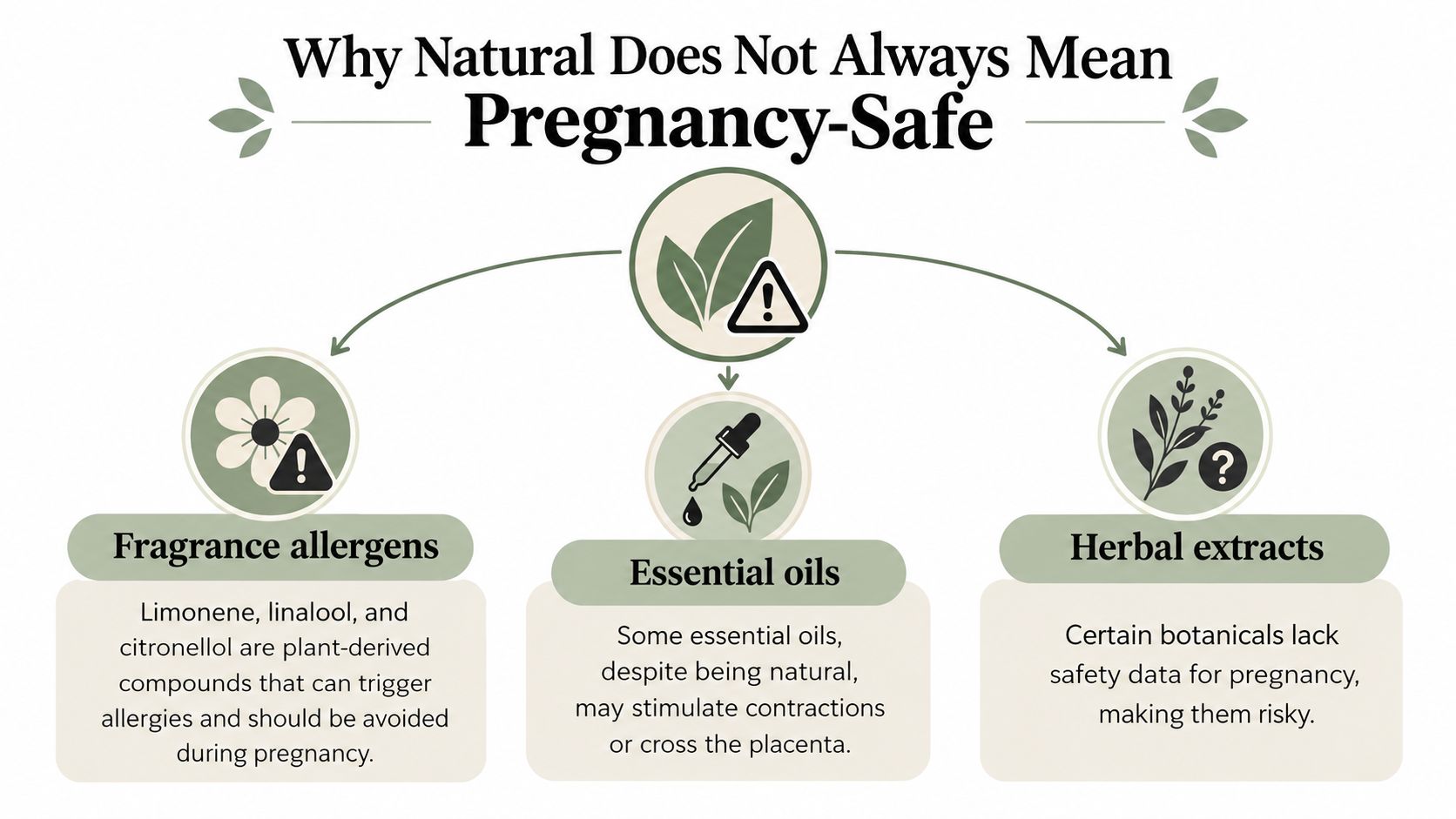
Limonene, linalool and citronellol may come from plants or fragrance materials, but they're still fragrance allergens that can appear on a cosmetic label. UK and European-style cosmetic labelling rules require relevant fragrance allergens to be declared when they reach the applicable thresholds. Their presence doesn't prove that a product is dangerous, but it gives you information about potential irritation or sensitisation.
Stretched skin can be less forgiving
Pregnancy can make the abdominal skin feel tight, itchy or reactive. A formula that was comfortable before pregnancy may feel different when your skin barrier is under more physical stress. Fragrance, essential oils and complex botanical blends can add a sensory benefit while also adding more possible triggers for someone who has become sensitive.
The UK pregnancy skincare guidance from Marie Claire reflects the wider consumer conversation around ingredients such as retinoids, salicylic acid and fragrance-related concerns. The practical lesson is to move beyond a broad avoid-list and inspect the actual declaration.
Essential oils deserve particular care. They're plant-derived and often sold as gentle or soothing, but concentrated aromatic materials can irritate skin. “Natural” doesn't mean fragrance-free, non-reactive or automatically appropriate during pregnancy.
Synthetic preservatives and lab-made emollients also shouldn't be rejected purely because they sound less wholesome. A properly preserved product may be more dependable than a complex botanical formula, especially when the alternative contains water and needs protection from microbial growth.
Read the whole declaration: A transparent label is more useful than a front-of-pack claim such as “clean”, “pure” or “natural”.
A Pregnancy-Safe Ingredient Checklist
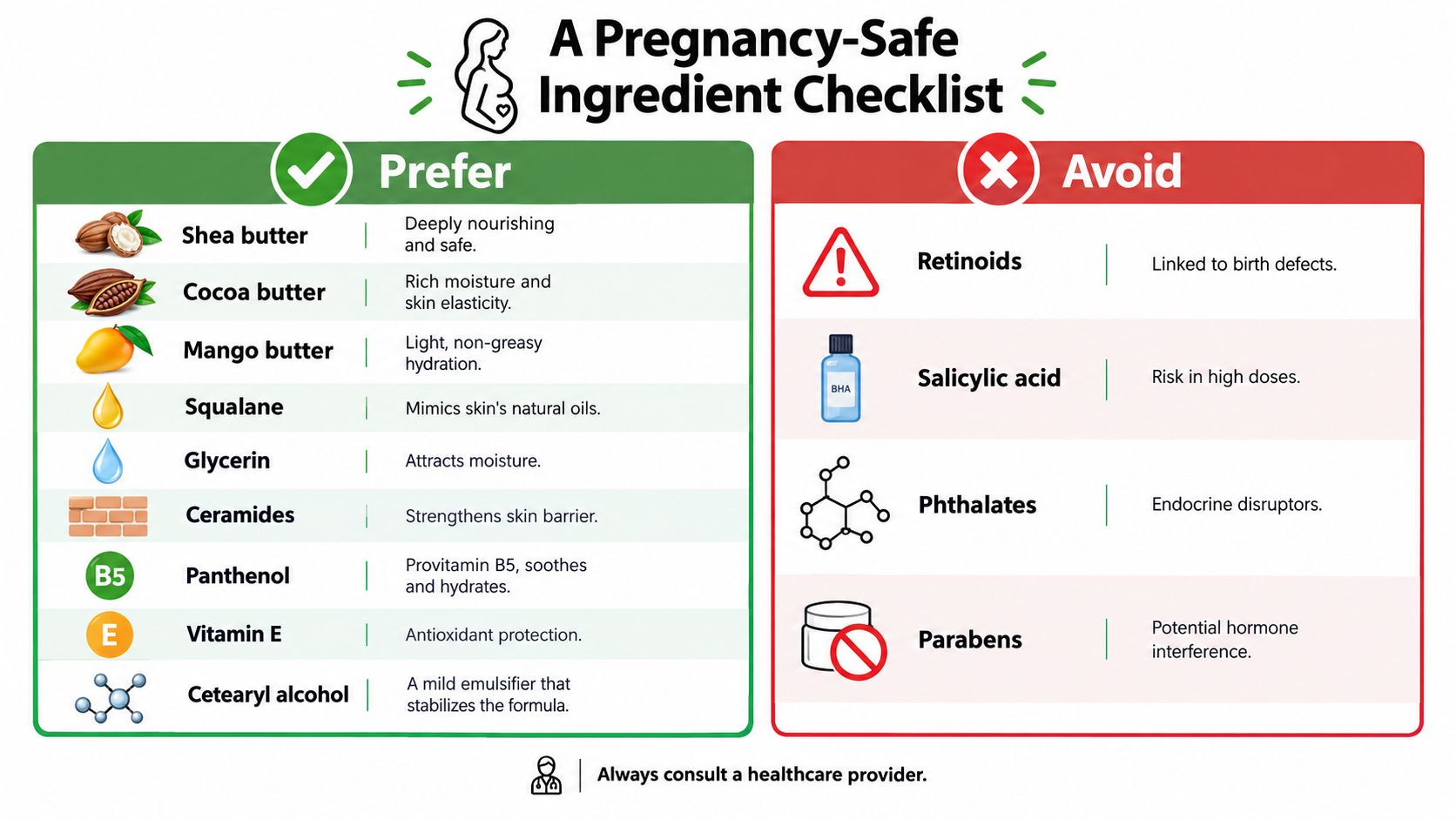
Use a checklist as a reading aid, not as a frightening blacklist. The aim is to understand why an ingredient is present and whether the finished product suits your skin, rather than treating every unfamiliar name as a problem.
Prefer for straightforward barrier support
- Shea, cocoa and mango butter: These are rich emollient bases that can make dry skin feel softer and more protected.
- Glycerin: This humectant helps attract and retain water in the outer skin.
- Squalane: A lightweight emollient that can improve slip without the dense feel of a traditional butter.
- Ceramides: Skin-identical barrier-support ingredients that can complement an emollient-rich formula.
- Panthenol: Provitamin B5, commonly used for conditioning and hydration.
- Vitamin E: An antioxidant that can help support the formula and provide skin-conditioning benefits.
- Cetearyl alcohol: A fatty alcohol used to thicken and stabilise creams. It isn't the same as a drying solvent alcohol.
- Appropriate preservatives: Ingredients such as phenoxyethanol may be used within permitted and assessed conditions. A preservative isn't automatically a flaw.
Avoid or discuss with a midwife or GP
- Retinoids and retinol derivatives: These are ingredients many pregnancy skincare guides advise avoiding, so check products marketed for firming or resurfacing.
- High-strength salicylic acid: High-dose use deserves clinical discussion. A rich body butter usually doesn't need a strong exfoliating active.
- Essential oils such as rosemary or cinnamon leaf: Their natural origin doesn't remove the need to consider concentration, route of exposure and irritation risk.
- Fragrance allergens: Limonene, linalool, citronellol and related declarations may matter if your skin is reactive or itchy.
- Broad-area chemical sunscreen actives: If a body product includes sun filters and you're applying it widely, ask a healthcare professional which option suits you.
For pregnancy-specific moisturising options, The Happy Bump Co's UK pregnancy moisturiser guide offers another way to think about formula choices. Your midwife or GP's advice takes priority, particularly if you have eczema, allergies, intense itching or a complicated pregnancy.
Comparing a Standard, a Pregnancy and a Bump Formula
The words on the front of a jar don't tell you how the formula is assembled. Three products can all be called body butter while offering very different textures, fragrance profiles and ingredient priorities.
| Ingredient Family | Standard Body Butter | Pregnancy-Marketed | Bump-Focused Formula |
|---|---|---|---|
| Butter base | Often led by shea, cocoa or another rich butter | May use shea or mango with a simpler profile | Usually centres on rich butters chosen for a protective feel |
| Oils | Lightweight oils may create easy spread and a fast finish | Often selected for a mild, uncomplicated texture | May combine nourishing oils with a deliberate, low-irritant approach |
| Humectants | Present if the product is an emulsion or cream | Glycerin may support everyday hydration | Often paired with emollients to support dry, stretched skin |
| Occlusives | Silicones or heavier emollients may improve slip and reduce water loss | May still contain occlusive silicones | Used for barrier support without relying on strong exfoliating actives |
| Actives | Could include fragrance-led or skin-smoothing additions | Usually avoids pregnancy-questioned actives | Generally keeps the active profile simple and leaves out retinoids and high-dose acids |
| Fragrance | May be prominent, with several declared allergens | May be fragrance-free, but the label still needs checking | Often deliberately reduced or omitted for sensitive bump skin |
| Preservation | Depends on whether the formula contains water | Mild preservatives may appear in a cream | Chosen to protect the specific formula, not to satisfy a marketing phrase |
A product marketed for pregnancy isn't automatically identical to one designed specifically for the bump. The first may focus on avoiding certain actives, while the second may focus more heavily on barrier comfort, texture and fragrance tolerance.
UK cosmetics rules set a baseline of safety for all compliant products, regardless of whether the front label says “standard”, “pregnancy” or “bump”. Your job as the shopper is to compare the ingredient families and their order, not to assume that a pregnancy claim explains every formula choice.
How to Use Body Butter on Your Bump
A good formula still needs a sensible routine. Apply body butter after a lukewarm shower, while your skin is slightly damp. This helps you spread the product evenly and reduces the temptation to rub hard to cover every area.
Warm a coin-sized amount between your palms, then adjust according to the area and the texture. A dense butter may cover more skin than you expect once it melts. If you like extra slip, apply a belly oil first and use the butter afterwards as the more protective layer. You don't need both every time, especially if the oil already leaves your skin comfortable.
Keep the massage gentle
Use flat palms over the bump and slow sweeping strokes rather than pulling or aggressively stretching the skin. Circular movements can work well over the hips and thighs, where you may want more massage. The purpose is to distribute the product, not to force it into the skin through pressure.
For a practical application routine, The Happy Bump Co's guide to using body butter can help you turn application into a repeatable habit.
Test before committing
Patch-test a new product on the inner forearm or behind the ear. Leave the area alone and watch for redness, itching, stinging or new bumps over the following 24 to 48 hours. A small test doesn't guarantee that your whole body will respond identically, but it can help you avoid immediately covering a sensitive bump with a new fragrance blend.
If your skin becomes persistently irritated, stop using the product and ask a pharmacist, midwife or GP for advice. Intense itching, especially on the palms or soles, needs medical discussion rather than another layer of moisturiser.
Reading Any Future Body Butter With Confidence
You don't need a chemistry degree to assess a body butter. You need a repeatable way to translate the label into four practical questions.
First identify the base
Look at the opening ingredients. Are you seeing a butter-led, oil-rich balm, or a water-based cream with glycerin and emulsifiers? That answer predicts the product's weight, spread and likely finish before you open the jar.
Next, check the oils. If your face or body tends to congest, notice whether the formula relies heavily on richer oils such as coconut. That doesn't make the product unsuitable for everyone. It tells you where to watch for your own skin response.
Then screen the extras
Check the active ingredients against your pregnancy reading list. Retinoids and retinol derivatives, strong exfoliating acids and complicated treatment claims deserve more attention than a simple moisturising formula. A body butter doesn't need a long list of actives to soften dry skin.
Finally, scan fragrance and preservation. Look for parfum or fragrance, separately declared allergens such as limonene and linalool, essential oils, and the preservatives needed to keep the formula safe. If the label is incomplete, difficult to access online or inconsistent between the packaging and product page, choose a product with clearer information.
UK cosmetic regulation gives shoppers an important baseline. Products must be assessed for safety and carry proper ingredient information, while Great Britain's retained cosmetics framework places restrictions on certain hazardous substances. The government cosmetics guidance is the formal reference point, but you can make everyday decisions without reading legislation line by line.
Your shop-floor checklist: What forms the base? Which ingredients provide moisture and protection? Are there actives you'd rather avoid? Is fragrance clearly disclosed? Does the product suit your skin today?
The UK toiletries and beauty market reached £10.3 billion in sales in 2024, up 8.4% year on year, according to the government's cosmetics enforcement publication. That scale gives shoppers plenty of choice, but choice works best when you can read beyond the promise on the front.
The Happy Bump Co offers bump-focused body care, including Belly Butter and Belly Oil for Stretch Marks, with product information designed around changing pregnancy skin. Visit The Happy Bump Co to compare its body butter ingredients and choose a routine that fits your comfort, fragrance preferences and label-reading checklist.