

Yes. Azelaic acid is generally considered one of the safer topical acne options in pregnancy, partly because only about 3% to 8% is systemically absorbed, and one review cites about 4% after a single application. It still deserves thoughtful use, though, and it's sensible to check in with your midwife, GP, or dermatologist before starting or continuing it.
The gap in most advice is this: people are often told either “it's safe” or “just ask your doctor”, but not why azelaic acid is treated differently from other acne ingredients. If you're pregnant and trying to decode labels, that missing explanation matters. It's hard to feel calm when one ingredient is allowed, another is banned, and both happen to be sold in very similar-looking tubes.
Pregnancy skincare decisions rarely come down to a single word like safe or unsafe. They come down to how much of a product gets into the bloodstream, what kind of evidence exists, what the NHS says, and what problem you're trying to treat. Azelaic acid sits in a useful middle ground. It isn't a miracle ingredient and it isn't risk-free in the absolute sense. But it is one of the few acne actives that UK clinicians often keep on the table during pregnancy.
Table of Contents
- Is Azelaic Acid Safe During Pregnancy
- How Azelaic Acid Works on Your Skin
- What the Research Actually Shows
- NHS Guidance and Recommended Concentrations
- Azelaic Acid Compared with Pregnancy-Safe Alternatives
- How to Use Azelaic Acid Safely While Pregnant
- Final Takeaways for Expectant Mums
Is Azelaic Acid Safe During Pregnancy
For most pregnant patients, the short clinical answer is yes, azelaic acid is usually treated as a reasonable topical option. In UK practice, the NHS lists azelaic acid among acne treatments and notes it is usually applied once or twice daily, with improvement typically taking about 1 month in many cases, according to NHS acne treatment guidance.
That doesn't mean “use anything with azelaic acid in it without thinking”. It means azelaic acid tends to sit in a different category from ingredients that are clearly avoided in pregnancy.
Why it's treated differently from retinoids
The main reason people get confused is that many acne treatments are grouped together in casual conversation. Clinically, they aren't the same.
- Topical retinoids are treated very differently. NHS-aligned guidance distinguishes azelaic acid from retinoids, which are contraindicated in pregnancy.
- Azelaic acid is used as a topical cream or gel. That local, skin-level use matters when clinicians weigh risk.
- Finished products vary. A product can contain azelaic acid and still be unsuitable if it also includes a retinoid or another ingredient you've been advised to avoid.
Practical rule: Don't judge a product by the front label. Judge it by the full ingredient list and, if it's prescription treatment, by the whole formula.
Why dermatologists still avoid absolute language
Pregnant readers often hear “safe” and assume that means “proven beyond doubt in large human trials”. That isn't how pregnancy medicine usually works. Controlled pregnancy studies are often limited for obvious ethical reasons, so clinicians lean on pharmacology, longstanding use, animal data, and guideline consensus.
That's why the most accurate answer is more nuanced than a simple yes. Azelaic acid is widely regarded as one of the safer topical options, especially when compared with retinoid-based acne therapy, but doctors still use judgement. They'll think about trimester, skin irritation, how severe the acne is, and whether you even need an active treatment at all.
Where it fits in real life
If your skin changed as soon as you became pregnant, you're not imagining it. Hormones can trigger clogged pores, inflamed spots, redness, and post-breakout marks. Many stronger acne treatments are suddenly off-limits or need review. That leaves a smaller shortlist.
Azelaic acid remains on that shortlist because it's used as a pregnancy-compatible topical alternative, not as a medicine that clinicians routinely avoid outright. For many women, that's the difference between having no useful option and having one treatment that can still be considered carefully.
How Azelaic Acid Works on Your Skin
Azelaic acid helps because it tackles several parts of acne at once. It doesn't just dry spots out. It works more like a steady, local reset for skin that has become overreactive.
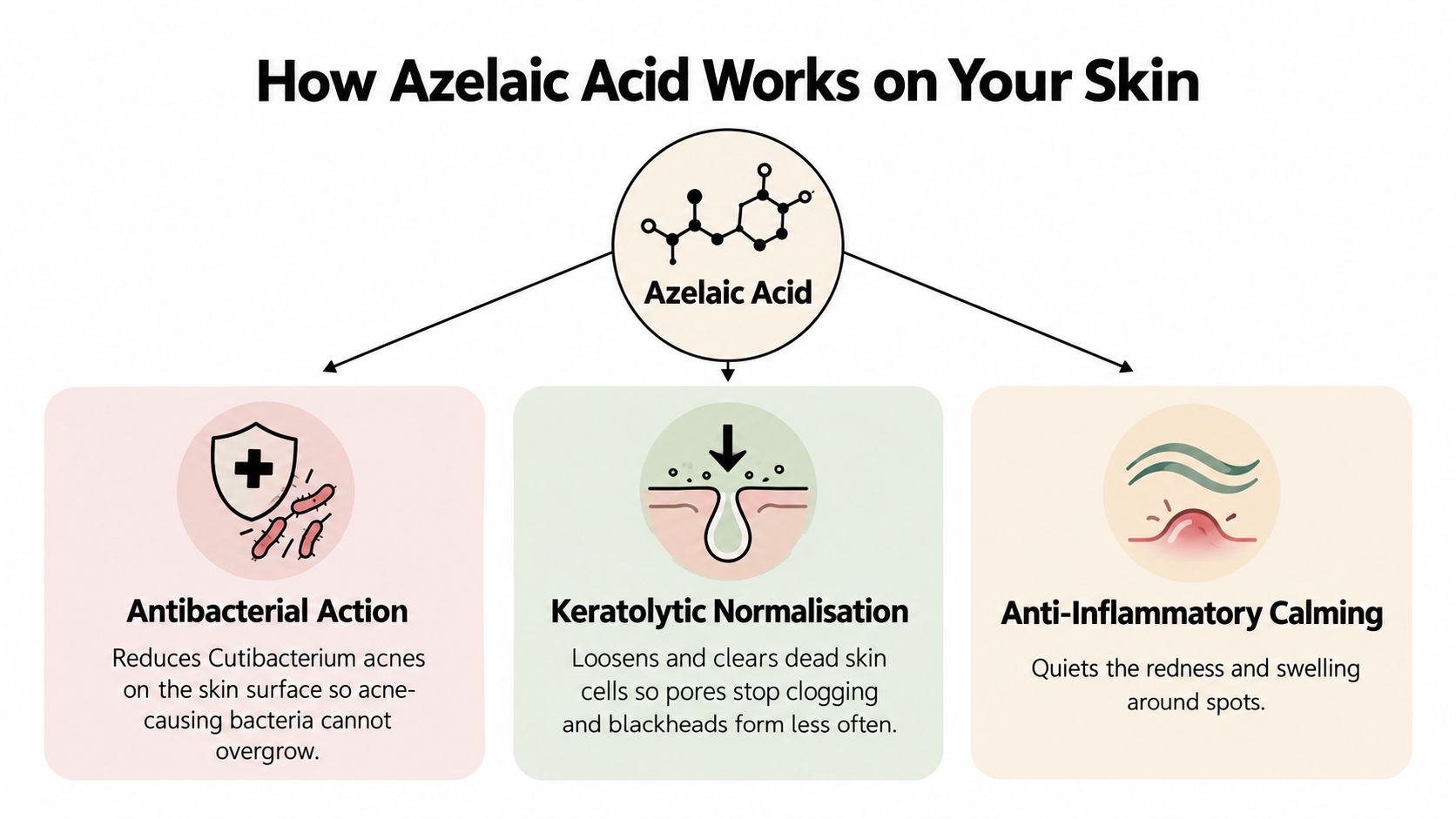
It reduces acne-causing bacteria
One part of acne is bacterial overgrowth in blocked follicles. Azelaic acid helps reduce the conditions that allow acne-related bacteria to thrive. That's useful in pregnancy because hormonal shifts can increase oiliness and make skin feel more congested than usual.
This doesn't mean it behaves like an oral antibiotic. It acts on the skin where you apply it, which is one reason it's often viewed more favourably than systemic medicines during pregnancy.
It helps pores behave more normally
A lot of acne starts before you even see a spot. Dead skin cells stick together, the pore opening gets blocked, and then the inflammation follows. Azelaic acid helps normalise that process.
I often explain it to patients like this. Think of the pore as a narrow road and skin cells as traffic. In acne-prone skin, the traffic bunches up at the entrance and nothing moves properly. Azelaic acid acts like a gentle traffic warden, helping those cells shed in a more orderly way so pores are less likely to clog.
It calms redness and inflammation
Pregnancy acne isn't always just bumps and whiteheads. Many women also get red, angry spots that seem to linger. Azelaic acid has anti-inflammatory effects, which is why it often suits skin that needs calming as much as clearing.
Mild acne in pregnancy often needs a treatment that can do more than one job at once. Azelaic acid is useful because it can address congestion, inflammation, and leftover marks without relying on retinoids.
Why this matters in pregnancy
Hormones can increase oil production and make follicles block more easily. That creates a frustrating cycle. New spots appear, older ones stay red, and your skin may also become more sensitive than it was before pregnancy.
Azelaic acid's appeal is that it works locally. It isn't chosen because it's “strong”. It's chosen because it can improve acne while fitting a more cautious pregnancy approach. For a lot of women, that balance matters more than chasing the fastest possible result.
What the Research Actually Shows
A pregnant reader usually wants a clearer answer than "probably fine" but also more honesty than "completely safe." The evidence for azelaic acid sits in that middle ground. It is commonly treated as a reasonable topical option in pregnancy because there is no clear signal of harm, but that is not the same as having the sort of large, controlled human pregnancy trials that would let any doctor promise zero risk.
That distinction matters.
Much of the reassurance comes from three places. Azelaic acid is used on the skin rather than taken by mouth. Only a small amount passes through the skin into the bloodstream, as noted earlier in the article. Animal studies have also not shown harm at high exposure levels, and UK prescribing practice has reflected that cautious reassurance for years through formulary use rather than blanket warnings.
What low absorption means for fetal exposure
Pregnancy safety is not about whether an ingredient touches your skin. It is about whether enough of it gets into your circulation to create meaningful exposure for the baby.
Azelaic acid tends to stay largely where you put it. For many women, that is the key point to understand. A topical treatment with limited systemic absorption is in a different risk category from tablets or capsules that are designed to circulate through the whole body.
That still leaves room for sensible caution. Absorbed does not mean dangerous, and low absorption does not mean impossible exposure. It means the expected exposure is small, which helps explain why clinicians often view azelaic acid more favourably than oral acne medicines or topical retinoids in pregnancy.
No proven harm and proven safety are not the same thing
This is the part many articles skip, and it is often what makes pregnant patients uneasy.
- No proven harm means the available evidence has not shown a clear pregnancy risk.
- Proven safety would require stronger direct human pregnancy data than we usually have for skincare ingredients.
- Real prescribing decisions rely on the balance of evidence, the amount likely to be absorbed, and whether the treatment benefit is worth it for your symptoms.
A simple way to frame it is this. If safety evidence were a weather forecast, azelaic acid would not be "guaranteed sunshine." It would be "low concern based on what we know, but not studied in every possible condition."
Azelaic Acid Pregnancy Evidence at a Glance
| Evidence Type | Key Finding | Limitation |
|---|---|---|
| Pharmacokinetic data | A limited amount is absorbed through the skin, which keeps whole-body exposure relatively low | Absorption varies with formulation and how it is used |
| Animal pregnancy data | No harmful effects were identified in animal studies at high doses | Animal findings do not replace human pregnancy studies |
| Human clinical experience | Longstanding dermatology use has supported cautious prescribing in pregnancy | Controlled human pregnancy trials remain limited |
| Guideline positioning | UK-aligned prescribing places azelaic acid among practical topical options | Guidance is cautious and pragmatic, not a guarantee of zero risk |
If your main concern is lingering marks or uneven tone rather than active acne, this guide to pregnancy-safe options for hyperpigmentation can help you compare where azelaic acid fits and when a gentler option may be enough.
NHS Guidance and Recommended Concentrations
Does the NHS treat azelaic acid as a realistic pregnancy option, or is that something people repeat online without much detail?
For UK readers, the useful question is not whether azelaic acid is labelled "perfectly safe." Medicines in pregnancy are rarely framed that neatly. The more practical question is how NHS-aligned prescribing handles it when acne or rosacea needs treatment, and what that means for the strength you might be offered.
A helpful clue comes from Scottish NHS prescribing material. It keeps azelaic acid 20% cream (Skinoren) within acne treatment pathways while separating it from treatments that are avoided in pregnancy, such as topical retinoids and oral tetracyclines. You can see that approach in this Scottish formulary document. That does not mean "zero risk." It means clinicians are treating azelaic acid as a practical option when the expected benefit is judged to outweigh the limited uncertainty we always have in pregnancy care.
What strengths you're likely to see
This is often where confusion starts.
Pregnant patients usually come across two broad types of azelaic acid:
- Cosmetic products, often around 10%, bought without a prescription
- Prescription products, commonly 15% to 20%, used when treatment needs to do more work
Higher percentage does not automatically mean "unsafe in pregnancy," and lower percentage does not automatically mean "safe for everyone." Concentration is only one part of the decision. Doctors also look at the condition being treated, whether your skin barrier is already irritated, how large an area you are applying it to, and whether a simpler routine might be enough.
A useful way to view it is like choosing shoe support during pregnancy. The number on the label matters, but so does what problem you are trying to solve and how your body is coping day to day.
How often it's used
NHS-aligned acne guidance commonly uses azelaic acid once or twice daily. In practice, that does not mean you must start at the maximum frequency straight away. If your skin is reactive, a slower start often makes more sense, especially in pregnancy when the skin can become unexpectedly sensitive.
A sensible expectation: azelaic acid tends to work gradually rather than dramatically. Mild dryness or tingling can happen at first, so steady use usually matters more than pushing for fast results.
Azelaic Acid Strengths and NHS-Aligned Use by Trimester
| Concentration | Typical Source | NHS-Aligned Use Across Trimesters |
|---|---|---|
| Around 10% | Cosmetic serum or cream | Often considered a gentler starting point if the rest of the formula is suitable |
| 15% | Prescription product | Used when a clinician wants a more treatment-focused approach for acne or rosacea |
| 20% | Prescription cream such as Skinoren | Included in NHS-aligned acne pathways and often considered when a pregnancy-compatible topical treatment is needed |
If you're putting azelaic acid into a full routine, this guide to pregnancy-safe skincare in the UK can help you check your cleanser, moisturiser, SPF, and other active ingredients.
How trimesters affect decision-making
Trimester advice can sound more dramatic than it really is, so it helps to translate it into plain language.
In the first trimester, many clinicians prefer to keep routines as simple as possible, even with treatments that are commonly used in pregnancy. That caution is about limiting anything non-essential during early development. It is not the same as saying azelaic acid is known to be harmful.
Later in pregnancy, the balance can shift. If acne is painful, persistent, or leaving marks that are upsetting you, azelaic acid is often judged to be a reasonable topical option. The final choice still depends on your symptoms, your skin tolerance, and whether a gentler alternative could do the job with less irritation.
Azelaic Acid Compared with Pregnancy-Safe Alternatives
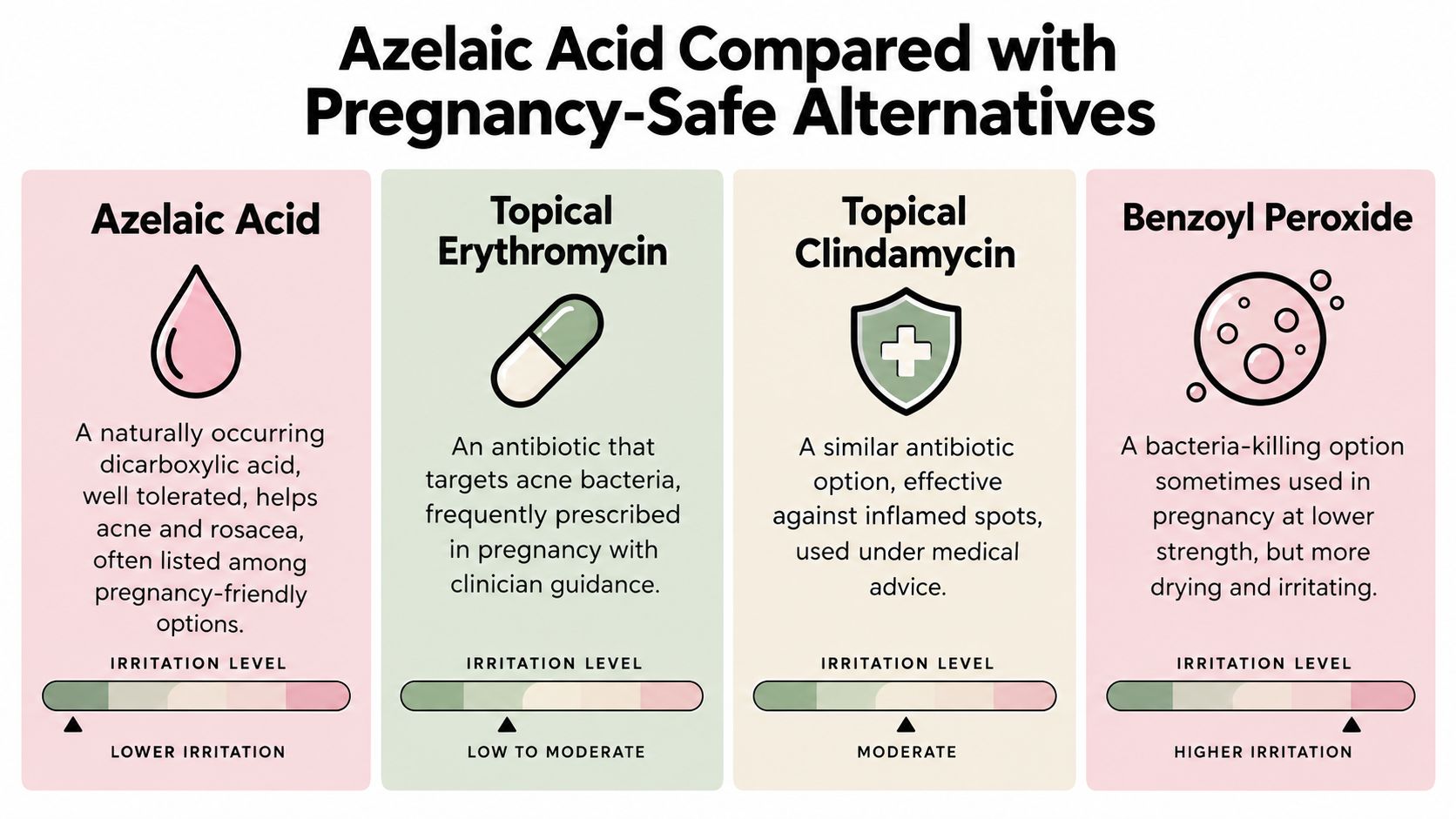
Azelaic acid is not the only option in pregnancy, but it's one of the most versatile. That matters because pregnancy acne doesn't always present in one neat pattern. Some women mainly get inflamed spots. Others get redness, congestion, and dark marks left behind all at once.
Where azelaic acid stands out
Azelaic acid is often favoured when you need one ingredient that can address several concerns at once. It can help with spots, redness, and post-breakout discolouration, which is why it often earns a place in pregnancy routines.
Topical antibiotics such as erythromycin or clindamycin can also be used with clinician guidance, especially for inflamed acne. They can be effective, but they're usually chosen more specifically for acne rather than for the wider mix of redness and marks.
Other gentler options
Some women don't need a prescription-strength route at all.
- Niacinamide can suit barrier-sensitive skin that reacts easily.
- Glycolic acid at low strengths may help with texture and dullness, though it won't fill the same role as azelaic acid for inflamed acne.
- Benzoyl peroxide is another option that clinicians may consider, but many patients find it more drying.
If you're comparing exfoliating ingredients, this guide on salicylic acid and BHA in pregnancy helps clarify why not all “acids” belong in the same bucket.
Ingredients that need more caution or avoidance
Label-reading becomes important. Ingredients commonly avoided or more tightly restricted in pregnancy include:
- Topical retinoids such as tretinoin, adapalene, and tazarotene
- Oral isotretinoin
- Hormonal acne treatments such as spironolactone
- High-strength salicylic acid peels or aggressive exfoliating routines
Azelaic acid often wins not because it's the strongest treatment available, but because it remains usable in a setting where many stronger options drop away.
How to Use Azelaic Acid Safely While Pregnant
Using the right ingredient the wrong way can still leave you miserable. Pregnancy often makes skin more reactive, so the safest approach is a slow, boring one. That's usually the most successful as well.
A simple routine is easier to judge. If your skin becomes red, itchy, or flaky, you want to know what caused it.
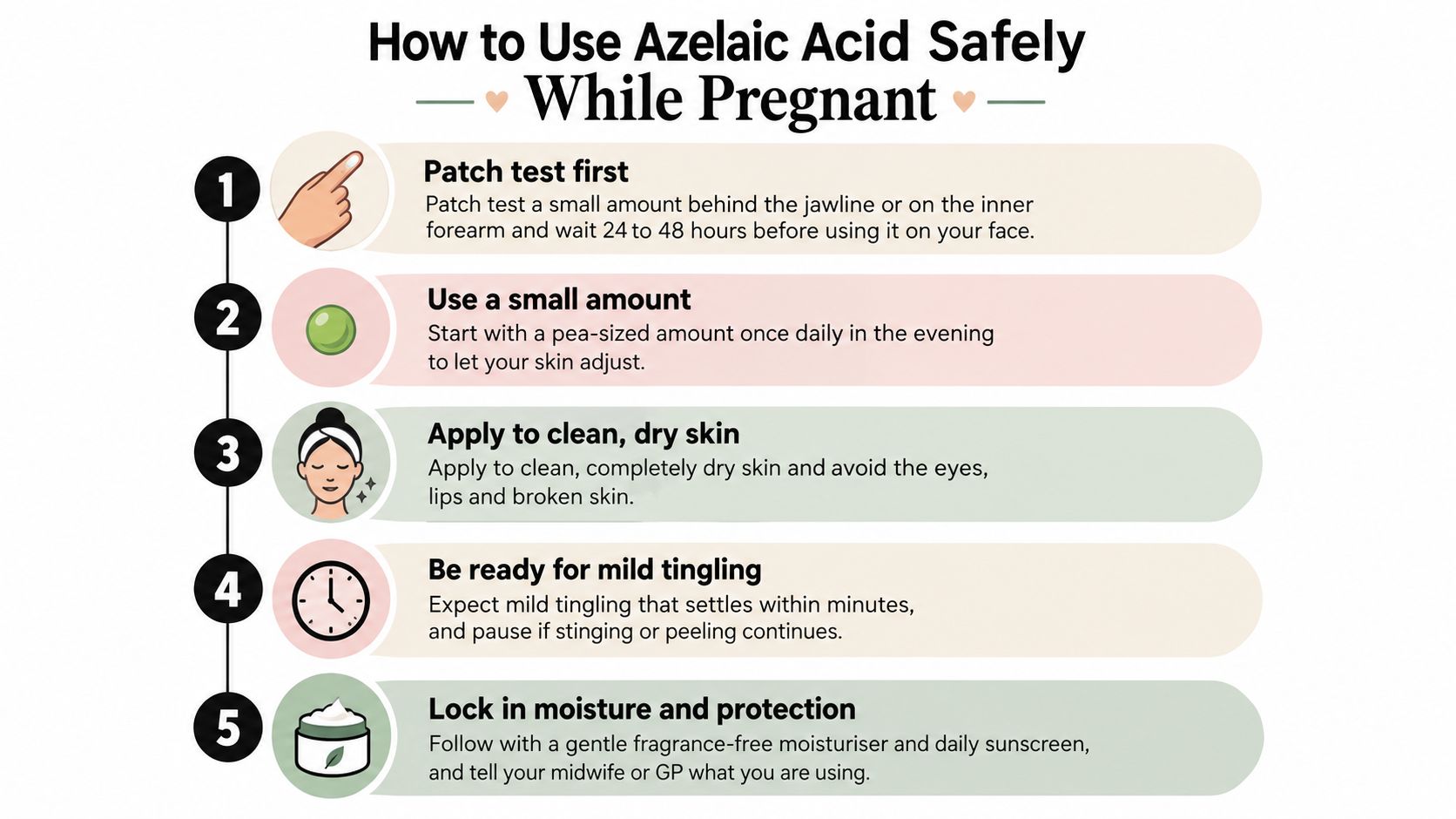
Start with a patch test
Before you put azelaic acid all over your face, test a small amount behind the jawline or on the inner forearm. Leave it and watch the area over the next 24 to 48 hours.
That isn't because azelaic acid is known for major pregnancy-specific reactions. It's because irritation is common enough to matter, especially when pregnancy has already made your skin less predictable.
Build up slowly
Most problems happen when people go in too hard. A cautious routine looks like this:
- Begin on alternate nights if your skin is sensitive or you're restarting after a break.
- Use a small amount on clean, dry skin.
- Increase to once daily if your skin stays comfortable.
- Only move to twice daily if you're tolerating it well and a clinician has advised it.
If your product instructions differ because it's a prescription formula, follow the prescription directions first.
Keep the routine plain
The order matters more than people think.
- Cleanse gently with a fragrance-free cleanser
- Wait until skin is dry
- Apply azelaic acid
- Follow with a simple moisturiser
- Use sunscreen in the morning
This walkthrough may help if you prefer a visual explanation before you start:
What to expect in the first month
A mild tingle can happen at first. Some women also notice dryness or slight roughness while their skin adjusts. That doesn't automatically mean the product is wrong for you.
NHS guidance notes that improvement with azelaic acid typically takes about 1 month in acne treatment, as noted earlier in the linked NHS guidance. That's why patience matters. A product can be useful without producing dramatic early changes.
If azelaic acid stings briefly and then settles, that can happen. If it burns, cracks the skin, or leaves ongoing soreness, stop and get advice.
Layering mistakes to avoid
The biggest error is not azelaic acid itself. It's combining it with too many other active products.
Try not to stack it casually with:
- Prescription retinoids
- High-strength vitamin C if your skin is already reactive
- Strong AHAs
- Rough scrubs
- Unclear “natural” blends with essential oils
Pregnant patients are often trying to solve acne, pigmentation, and sensitivity at the same time. That can lead to over-layering. In practice, calmer routines usually work better.
When to pause and ask for help
Stop and seek review from your GP, midwife, or dermatologist if you develop persistent burning, cracking, swelling, a widespread rash, or worsening pigmentation that doesn't make sense for your usual skin. Also get help if your acne becomes painful, deep, or scarring. At that point, you may need a more structured pregnancy-safe plan rather than another over-the-counter product.
Final Takeaways for Expectant Mums
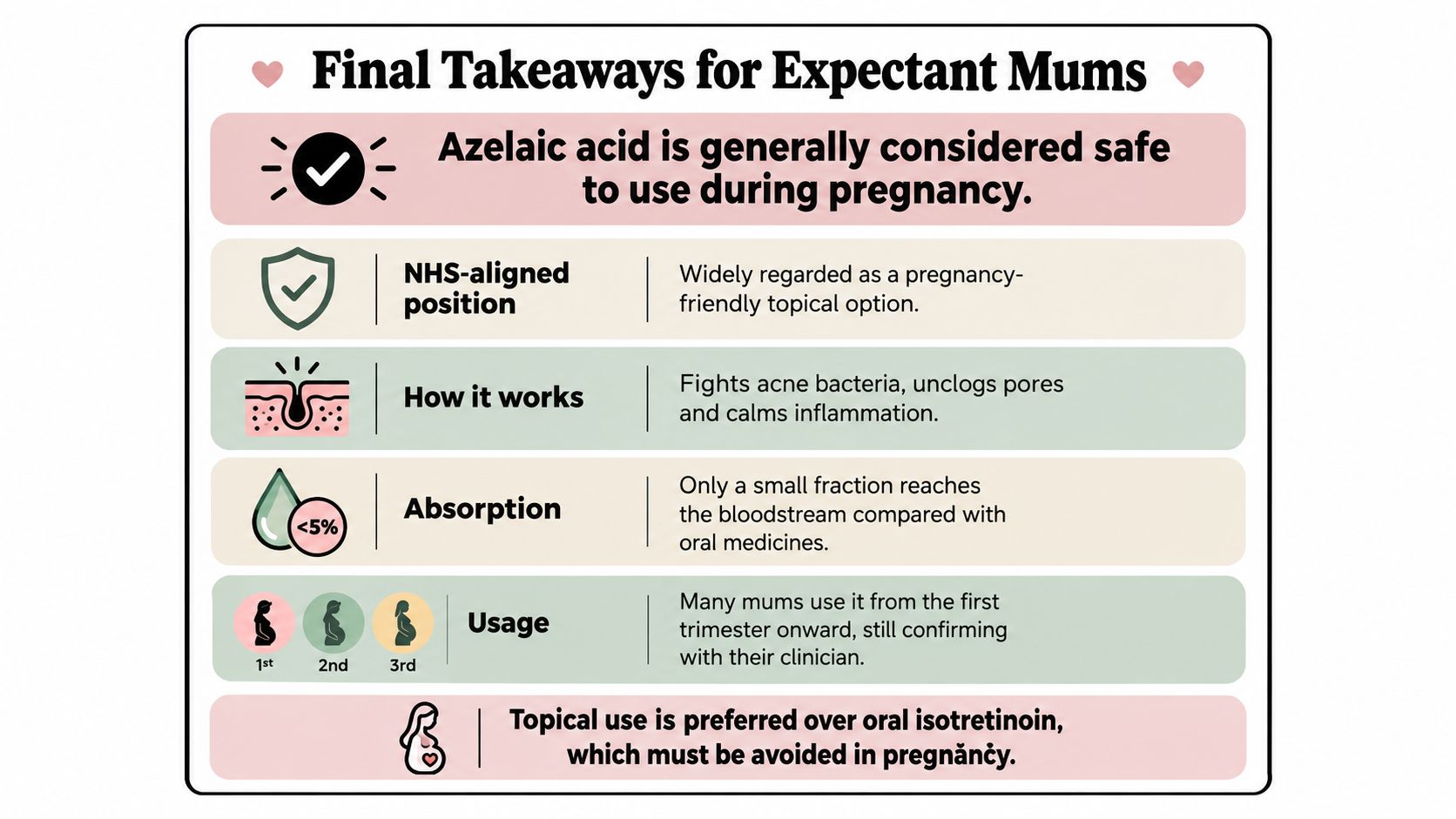
If you've been asking, is Azelaic Acid safe during pregnancy, the most honest answer is this: it is generally considered one of the more acceptable topical options, especially in UK practice, but it should be used deliberately rather than casually.
Its place in pregnancy care isn't built on hype. It comes from a combination of low systemic absorption, reassuring animal data, and repeated inclusion in NHS-aligned acne guidance. That's a strong practical basis for use, even though it isn't the same thing as having large controlled human pregnancy trials.
The points that matter most
- Choose a straightforward formula. The ingredient may be suitable, but combination products can change the answer.
- Introduce it slowly. Patch test first, then build up gradually.
- Keep your routine simple. Gentle cleanser, azelaic acid, moisturiser, and daily sunscreen is often enough.
- Don't ignore irritation. Tingling can happen. Ongoing burning or peeling needs a rethink.
- Keep your clinician in the loop. Midwives, GPs, and dermatologists can help if your skin is worsening or your product list is getting complicated.
A balanced verdict
Azelaic acid often makes sense for acne, redness, or post-breakout marks in pregnancy because it can do several jobs at once without falling into the retinoid category. That said, “pregnancy-friendly” doesn't mean “throw it on and hope for the best”.
A small amount, on dry skin, once daily to start, is usually a sensible pattern. If you're already pregnant and halfway through a product, don't panic. Check the full ingredient list, pause if you're unsure, and ask your GP, midwife, or prescribing clinician to confirm whether the exact formulation is appropriate.
The goal in pregnancy skincare isn't to use the most active products possible. It's to choose the simplest routine that treats the problem without creating a new one.
If breakouts continue past the early hormonal adjustment period, or your skin becomes painful, inflamed, or scarring, book a review. You don't need to guess your way through it.
If you're simplifying your routine during pregnancy, The Happy Bump Co offers UK-made bump and body care designed specifically for changing pregnant skin. Their gentle, pregnancy-focused products can help support dryness, stretch mark care, and everyday comfort while you keep your facial routine calm and uncomplicated.