

At 3am, your baby has finally settled, but you haven't. You're standing in a dressing gown, scratching your forearms and stomach while your skin feels tight, hot and unfamiliar. During pregnancy, you may have expected an itchy bump. Itching skin after pregnancy can feel different, and it's easy to assume every new sensation is dry skin that needs more moisturiser.
Some postpartum itching is part of ordinary skin recovery. Some comes from eczema, contact irritation or a rash that begins around stretch marks after delivery. A smaller but important group of symptoms can point towards a liver-related problem that needs blood tests rather than another balm. The useful question isn't only, “What can I put on it?” It's, “Which pattern am I looking at?”
Table of Contents
- The First Weeks Home and Why Your Skin Still Feels Wrong
- What Is Actually Happening to Your Skin After Birth
- The Main Causes of Postpartum Itching and How to Tell Them Apart
- Safe At-Home Soothing Strategies for New Mums
- Signs Your Itching Needs a GP Appointment
- Your Simple Postpartum Skin Recovery Plan
The First Weeks Home and Why Your Skin Still Feels Wrong
The first weeks with a newborn bring a strange mixture of physical healing and constant sensory change. You may be washing your hands more often, sweating through night feeds, wearing breast pads, changing laundry products and showering at odd times. Each change can irritate skin that's already working to rebuild its protective barrier.
Postpartum itching is its own phase, not just pregnancy discomfort continuing after birth. Hormone levels shift quickly, sleep becomes broken and night sweats can leave the skin damp before it becomes dry again. A warm room, rough towel or fragranced shower gel may then turn a mild itch into a cycle of scratching and irritation.
A practical starting point: If your skin is flaky or tight but there's no significant rash, begin with barrier care. If the itch has a distinctive location, timing or associated symptom, stop treating it as ordinary dryness.
The location can offer an early clue. Dryness often affects exposed areas such as the forearms and shins, particularly after bathing. Irritation from a new product usually follows contact with that product, while a rash around fresh stretch marks suggests a different skin condition. Itching on the palms or soles without a visible rash deserves more caution, particularly when it becomes worse at night.
Many women with pregnancy-related itch improve after delivery. The NHS guidance on itching and intrahepatic cholestasis says pregnancy itching is usually temporary and “usually stops after you've had your baby”. It also advises assessment when itching keeps returning or affects daily life.
That expected improvement matters. A new mum doesn't need to panic over every tingle, but she also shouldn't spend weeks covering a potentially significant pattern with cream. Your skin deserves comfort, and your symptoms deserve the right category.
What Is Actually Happening to Your Skin After Birth
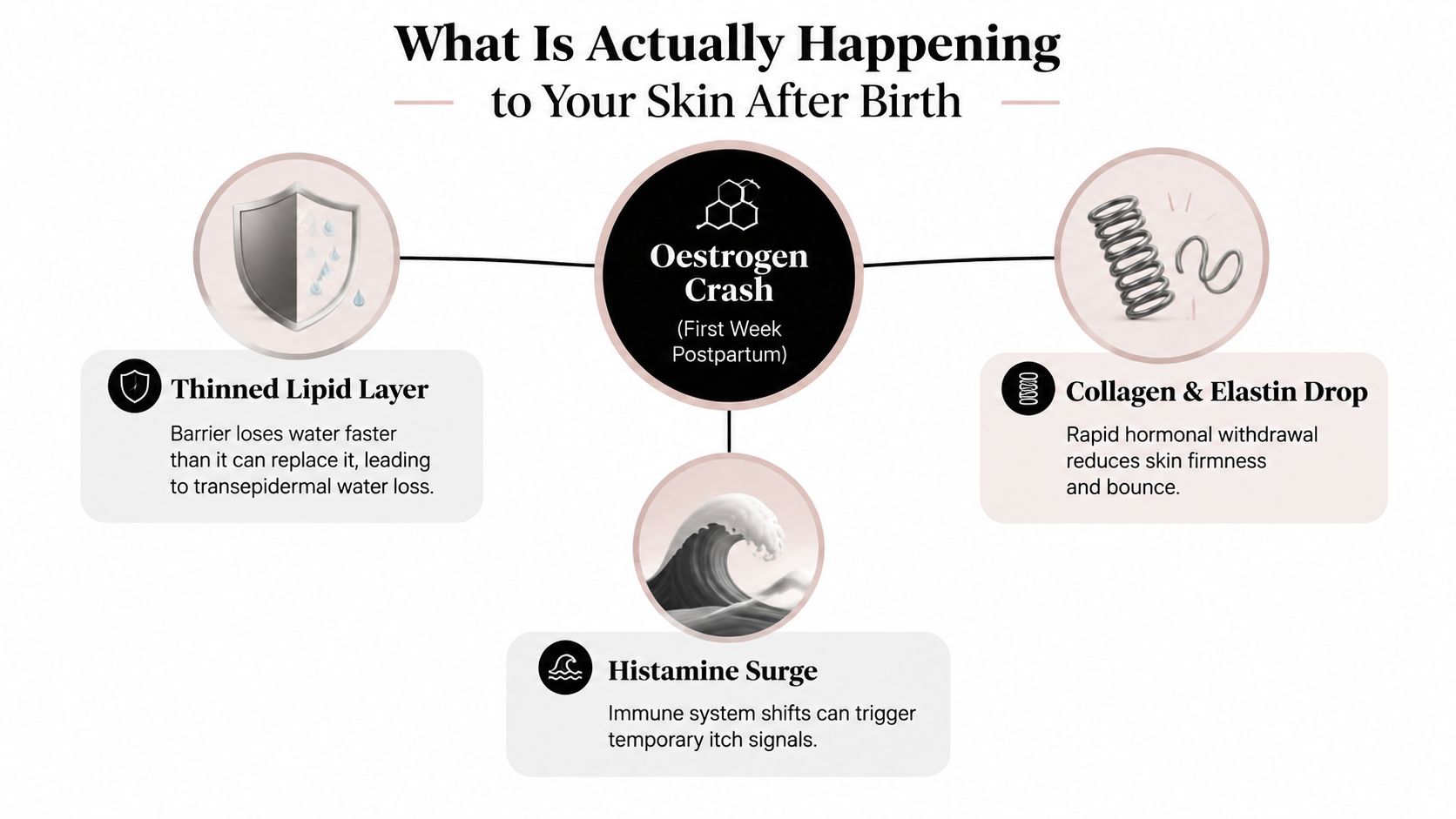
Postpartum skin can become more reactive because several changes arrive together. Hormonal withdrawal, stretching and sweating each affect the way skin holds water and responds to friction. The result may feel like tightness, flaking, prickling or a crawling sensation rather than simple surface dryness.
Hormonal change and the skin barrier
After birth, the hormonal environment changes sharply. Oestrogen supports several aspects of skin structure and hydration, so its sudden reduction can leave the outer barrier less resilient. When that barrier is compromised, water escapes more easily and everyday contact, including clothing and cleansing, can sting or itch.
You'll often recognise this mechanism as tight, papery or flaky skin, especially after a shower. It doesn't necessarily mean your skin needs a complicated routine. It usually needs less stripping and more consistent protection. The distinction between water-depleted skin and dry skin is explained clearly in this guide to dry skin versus dehydrated skin.
Stretching and repair around the abdomen
The dermis, the deeper layer that supports the surface, has spent months adapting to a growing abdomen. As stretched areas remodel after birth, the lower stomach and stretch marks may feel itchy, tight or sensitive. Scratching can create more inflammation and can make the area feel rougher, even when the original trigger was mild.
A useful visual clue is itch concentrated around stretch marks, particularly if the skin also looks raised or pink. That pattern is more suggestive of a local skin eruption than general dehydration.
Sweat, friction and interrupted sleep
Night sweats can remove natural oils from the skin and leave salt and moisture sitting against it. Breastfeeding pads, synthetic nightwear and frequent washing can add friction, while sleep loss makes it harder to notice triggers before you scratch.
This doesn't mean every postpartum itch has one single cause. It means the skin may be less forgiving than usual. A short lukewarm wash, gentle drying and a rich fragrance-free moisturiser can reduce surface irritation, but those measures won't explain itch on the palms and soles or symptoms linked with liver function.
The Main Causes of Postpartum Itching and How to Tell Them Apart
Four patterns cover many of the situations new mums describe. They can overlap, so use the table as a sorting tool rather than a diagnosis. A rash, its location and the time of day can tell you more than the intensity alone.
Four Patterns of Postpartum Itching Compared
| Cause | Where it appears | What it looks like | When it starts | Red flag to watch |
|---|---|---|---|---|
| Dry or dehydrated skin | Shins, forearms, stomach and other exposed areas | Tightness, fine flaking or roughness, usually without raised patches | During the early weeks, often aggravated by bathing or sweating | Itch remains widespread or doesn't improve with consistent barrier care |
| Eczema or polymorphic eruption of pregnancy | Eczema may affect hands, folds, face or previously sensitive areas. Polymorphic eruption often begins on the abdomen | Eczema can look dry, inflamed and patchy. Polymorphic eruption can create itchy raised bumps around stretch marks and may spread to thighs or arms | Polymorphic eruption can begin immediately after birth. Eczema may flare during the postpartum period | Blistering, oozing, spreading inflammation or a rash with fever |
| Contact or allergic irritation | Where a product or material touches the skin, such as under breast pads, around clothing edges or on washed hands | Redness, itching, burning or small patches that match the contact area | After introducing a new detergent, cleanser, pad, fabric or topical product | Rapid swelling, facial involvement, breathing difficulty or a reaction that keeps spreading |
| Liver-related cholestatic itch | Commonly the palms and soles, though it can be more widespread | Usually intense itching without a primary visible rash | It may continue after pregnancy-related cholestasis and should improve after birth rather than persist | Worse at night, dark urine, pale stools, yellowing skin or eyes, nausea or upper-right abdominal pain |
The largest UK study listed in the available clinical evidence found that pruritus affected approximately 23% of pregnancies, 1,521 of 6,532 women, while 1.6% of those women developed obstetric cholestasis. The authors described this as roughly one in four women experiencing itching and one in 135 developing obstetric cholestasis in that study population. The PubMed study helps put the distinction into perspective: itching is common, but cholestasis is a separate clinical concern.
Polymorphic eruption can be particularly confusing because it may begin straight after birth and often appears around stretch marks. UK maternity guidance describes it as an itchy abdominal rash that generally settles over days or weeks, whereas cholestasis is typically itch without a rash. If you can see raised bumps, the skin itself needs examining. If the itch is deep, widespread or focused on your palms and soles without a rash, ask for medical advice.
Safe At-Home Soothing Strategies for New Mums
A useful routine should work when you're tired, holding a baby or managing a feed. Keep it simple enough to repeat, because a damaged skin barrier responds better to steady care than to a different product every evening.
Start with the shower. Use lukewarm water, keep washing brief and choose a fragrance-free, soap-free cleanser for areas that need it. Hot water can worsen the dry, tight feeling by stripping surface oils. When you finish, pat rather than rub, leaving the skin slightly damp.
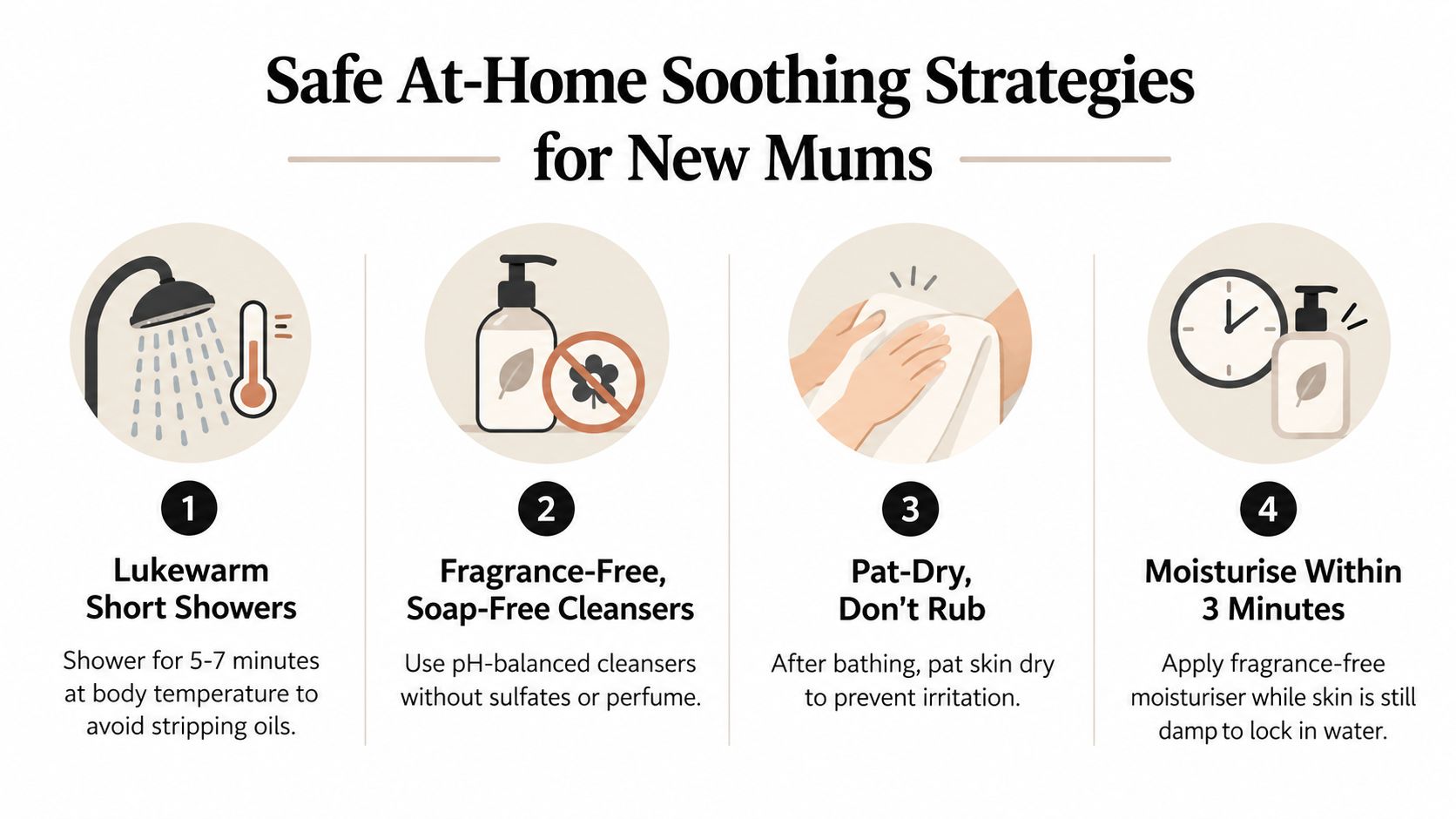
Apply a richer moisturiser promptly after bathing. Petroleum jelly, shea butter and ceramide creams can help reduce water loss by reinforcing the surface barrier. Use a plain, fragrance-free formula and apply it while the skin still has a little moisture. If you're comparing oils and creams, this guide to using oil for dry skin can help you think about texture and application rather than treating every oil as interchangeable.
For specific symptoms, match the comfort measure to the pattern:
- For general dryness: Choose breathable cotton layers and avoid overheating. A cool-mist humidifier may make the room more comfortable if the air feels dry.
- For raised abdominal welts: A cool cotton cloth can calm the sensation. Calamine may soothe some areas, but don't apply it over broken or infected skin.
- For a possible contact reaction: Stop the newest product or material one change at a time, wash gently and use a separate clean towel for the affected area.
- For breastfeeding-related areas: Check breast pads, detergents and fragranced products first. Any treatment used on or near the nipple should be checked with a pharmacist, GP or midwife, particularly if the baby's mouth may contact it.
Breastfeeding doesn't make every skincare ingredient unsafe, but it does make placement important. Avoid essential oils, high-strength retinoids, leave-on salicylic acid and unproven herbal creams unless a clinician has specifically advised them. Don't apply medicated products where your baby can lick them without checking instructions.
The following video demonstrates a soothing approach to itchy skin care:
Moisturiser is comfort care, not a liver test. If itching is widespread, concentrated on the palms and soles or markedly worse at night, contact your midwife or GP even if your skin looks normal.
Signs Your Itching Needs a GP Appointment
Postpartum itch isn't automatically harmless. The NHS-linked maternity information notes that cholestasis commonly causes itching without a rash, often involving the palms and soles, and that symptoms should improve after birth. Persistent symptoms therefore need a different response from ordinary dry skin.
Arrange a same-day call to your GP, community midwife or maternity assessment service if you notice any of the patterns below. You may be asked about your symptoms and offered blood tests, including liver function tests and bile acid testing, to assess for cholestasis or another liver problem.
Postpartum Itch and At-Home vs GP-Visit Triggers
| Symptom pattern | Likely cause | Action |
|---|---|---|
| Mild flaking or tightness without a rash, improving with gentle cleansing and moisturiser | Dry or dehydrated skin | Continue barrier care and monitor |
| Itchy bumps around abdominal stretch marks shortly after birth | Polymorphic eruption of pregnancy | Speak to a GP or midwife if it's severe, spreading or not settling |
| Itch under a breast pad, clothing area or after a new detergent | Contact irritation or allergy | Stop the suspected trigger and seek advice if it spreads or swells |
| Itching on the palms or soles, especially without a rash or worse at night | Possible persistent cholestatic itch | Call your GP or midwife the same day |
| Yellow skin or eyes, dark urine, pale stools, nausea or upper-right abdominal pain | Possible hepatobiliary problem | Seek same-day medical advice |
| Widespread rash with fever, blistering, marked swelling or signs of infection | Inflammatory, allergic or infectious condition | Seek urgent medical assessment |
A UK maternity guideline states that symptoms and liver tests should typically resolve within 4 weeks after birth, and that itching or abnormal bile acids or liver tests persisting beyond 6 weeks should lead clinicians to investigate alternative liver disease. The Royal Cornwall Hospitals clinical guideline also describes diagnosis as something confirmed retrospectively when itching resolves and bile acids normalise.
Don't wait for another cream to work if the itch has no rash and is keeping you awake. You should also call if a rash lasts beyond two weeks, if itching hasn't improved after a week of careful moisturising, or if the skin becomes painful, weepy or infected.
Remember: A visible rash points towards a skin condition, but the absence of a rash doesn't make severe itching unimportant.
Your Simple Postpartum Skin Recovery Plan
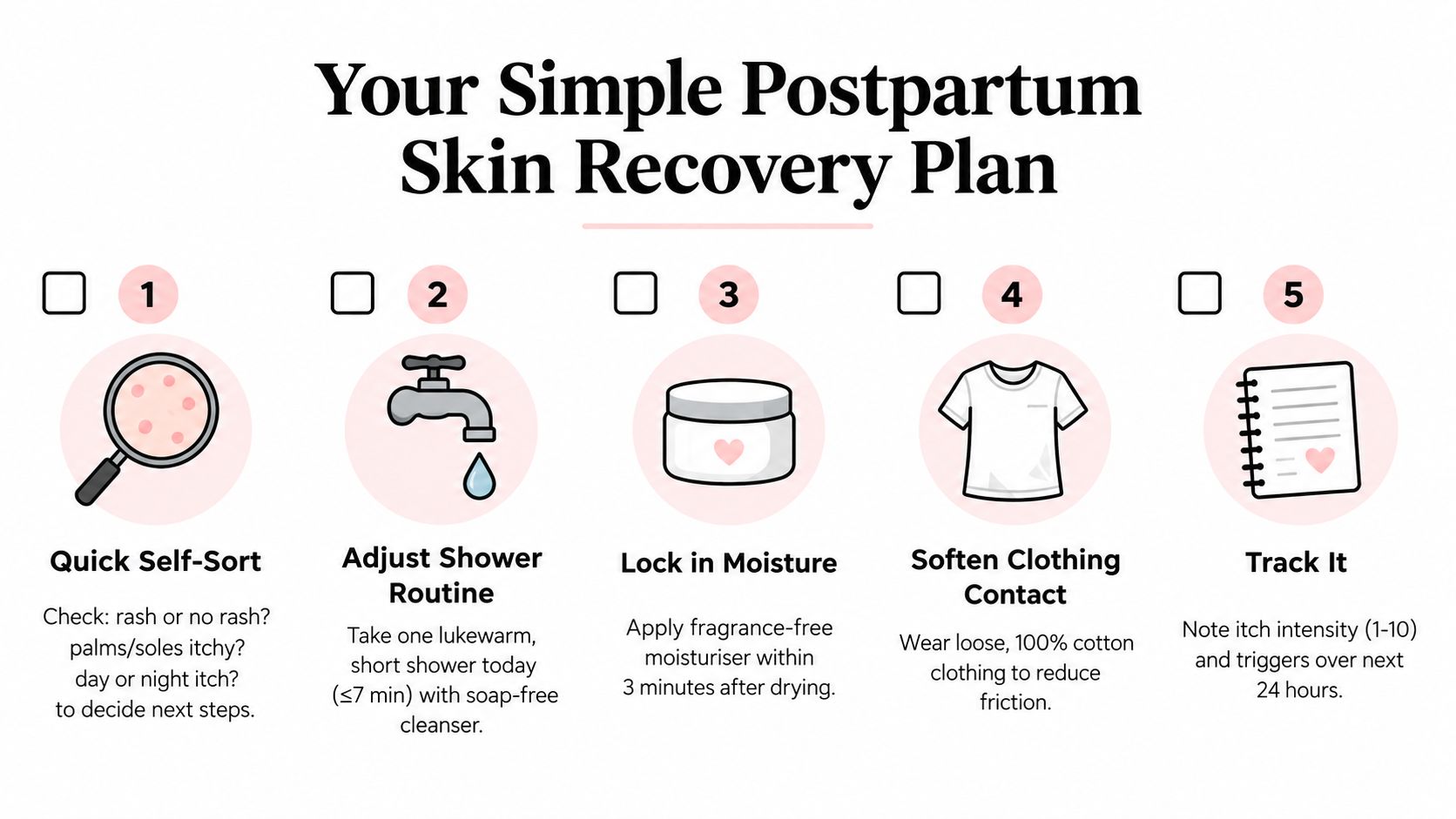
In the next 24 hours, start by sorting the symptom rather than shopping for a product. Look at the skin in good light and ask three questions: Is there a rash? Are the palms or soles involved? Is the itch worse at night? Write the answers down, especially if you're speaking to a midwife later.
Then keep the routine deliberately plain:
- Cleanse gently. Take a short lukewarm shower and use a soap-free cleanser where necessary. Don't scrub stretch marks or flaky patches.
- Moisturise promptly. Pat dry and apply a fragrance-free cream or ointment while the skin is still slightly damp.
- Reduce friction. Wear loose cotton clothing, change sweaty layers and keep rough seams away from irritated areas.
- Protect against scratching. Keep nails short and use a cool cloth when the urge to scratch rises. Broken skin is more vulnerable to irritation and infection.
- Track the pattern. Note where the itch appears, whether it wakes you, what touches the area and whether the skin is improving.
Use one matching rule for each likely cause. Dryness gets barrier care. A stretch-mark rash needs an assessment if it spreads or persists. A contact reaction calls for removing the suspected trigger. Palm-and-sole itching without a rash calls for clinical advice, not stronger moisturiser.
For abdominal changes and stretch-mark care, you can read what happens to stretch marks after birth. Keep any product choice secondary to the symptom pattern.
Contact your GP or community midwife the same day if you have itching on the palms or soles, yellowing skin or eyes, dark urine, fever with a rash, or itch that continues after a week of careful moisturising. You don't need to prove the cause before you call. Describe what you feel, where it is, when it started and whether there's a rash.
The Happy Bump Co offers bump-focused body care, including Belly Butter, Belly Oil for Stretch Marks and Pregnancy Tummy Scrub, designed to nourish changing skin during pregnancy and beyond. If your postpartum skin needs gentle daily support alongside appropriate medical advice, visit The Happy Bump Co to explore the range.