

You step out of the shower, catch your reflection and notice that your skin feels tight before you've even reached for a towel. Perhaps your nose is flaking, your legs feel rough, or the skin across your bump has started itching at bedtime. It can feel as though your familiar skincare routine has stopped working overnight.
The answer usually isn't a more complicated shelf of products. For a moisturizer for dry skin during pregnancy, choose a gentle barrier-supporting formula, match its texture to the severity of your dryness, and apply it at the moments when your skin can hold on to moisture best. Fragrance-free, unperfumed products are the sensible starting point, particularly if your skin has become reactive.
Table of Contents
- Why Pregnancy Skin Gets So Thirsty
- Choosing the Right Texture for Your Dryness
- Ingredients to Welcome and Avoid on the Label
- A Realistic Morning and Evening Routine
- How Much Moisturiser Is Actually Enough
- Common Mistakes That Undermine Your Routine
- Quick Answers for Worried Mums-to-Be
Why Pregnancy Skin Gets So Thirsty
Pregnancy-related dryness and itching are widely recognised in UK clinical guidance as common symptoms of hormonal change. The problem often appears where skin is stretching, including the abdomen, breasts and thighs, and UK guidance notes that itching in pregnancy affects around one in four women and pregnant people (Healthier Together guidance on itching and rash).
That means the sudden rough patch on your bump isn't a sign that you've neglected yourself. Hormonal changes can make the skin barrier more sensitive, while stretching places extra physical stress on the outer layer. Your skin may also lose water more readily from the surface, leaving it feeling tight even when you're drinking normally.
You might notice this on your stomach, but dryness can also show up on your hands, shins, breasts, hips and thighs. Oily skin doesn't make you immune, either. A face that still looks shiny can have flaky nostrils or tight cheeks, because oil and water are different issues. This helpful guide on dry skin versus dehydrated skin explains the distinction in simple terms.
Why the bump often feels different
As the abdomen expands, the surface needs to stretch while continuing to protect the water and lipids held beneath it. If the barrier becomes less efficient, the result can be roughness, tightness or itch rather than merely a cosmetic change.
The practical response is consistent moisturising, not aggressive scrubbing. UK maternity guidance specifically recommends a simple, non-scented moisturiser as a first-line comfort measure, so applying an unperfumed emollient is part of sensible symptom care, not an indulgence.
The reassuring bit: pregnancy dryness is a physiological skin change. It isn't a failure of hygiene, hydration or self-discipline.
Choosing the Right Texture for Your Dryness
Brand names matter less than whether the formula gives your skin the level of protection it needs and feels comfortable enough to use generously. A light lotion can be perfect for mild tightness, but it won't always calm a patch that is flaking or cracking. Conversely, a heavy ointment can become so sticky that you avoid applying it, which makes its theoretical richness irrelevant.
Use this straightforward framework.
Mild tightness
Choose a lightweight lotion containing humectants such as glycerin or hyaluronic acid. These ingredients help attract water to the outer skin, and a lotion is quick to spread over the face, hands or body after washing. It suits warmer weather, daytime use and anyone who dislikes a noticeable film.
Moderate roughness
Visible flaking or persistent rough texture calls for a mid-weight cream. Look for barrier-supporting ingredients such as ceramides, with softening ingredients that make the skin feel supple rather than slick. Cream is usually the most useful all-round texture because it offers more protection than lotion without the cling of an ointment.
Severe dryness or itchy areas
For very tight, cracked or intensely dry patches, choose an occlusive balm or ointment, particularly at night. Shea butter and other rich emollient ingredients can create a protective layer that reduces water loss while you sleep. Apply it to the bump, hands, heels or other stubborn areas rather than forcing a thick texture across your entire face.
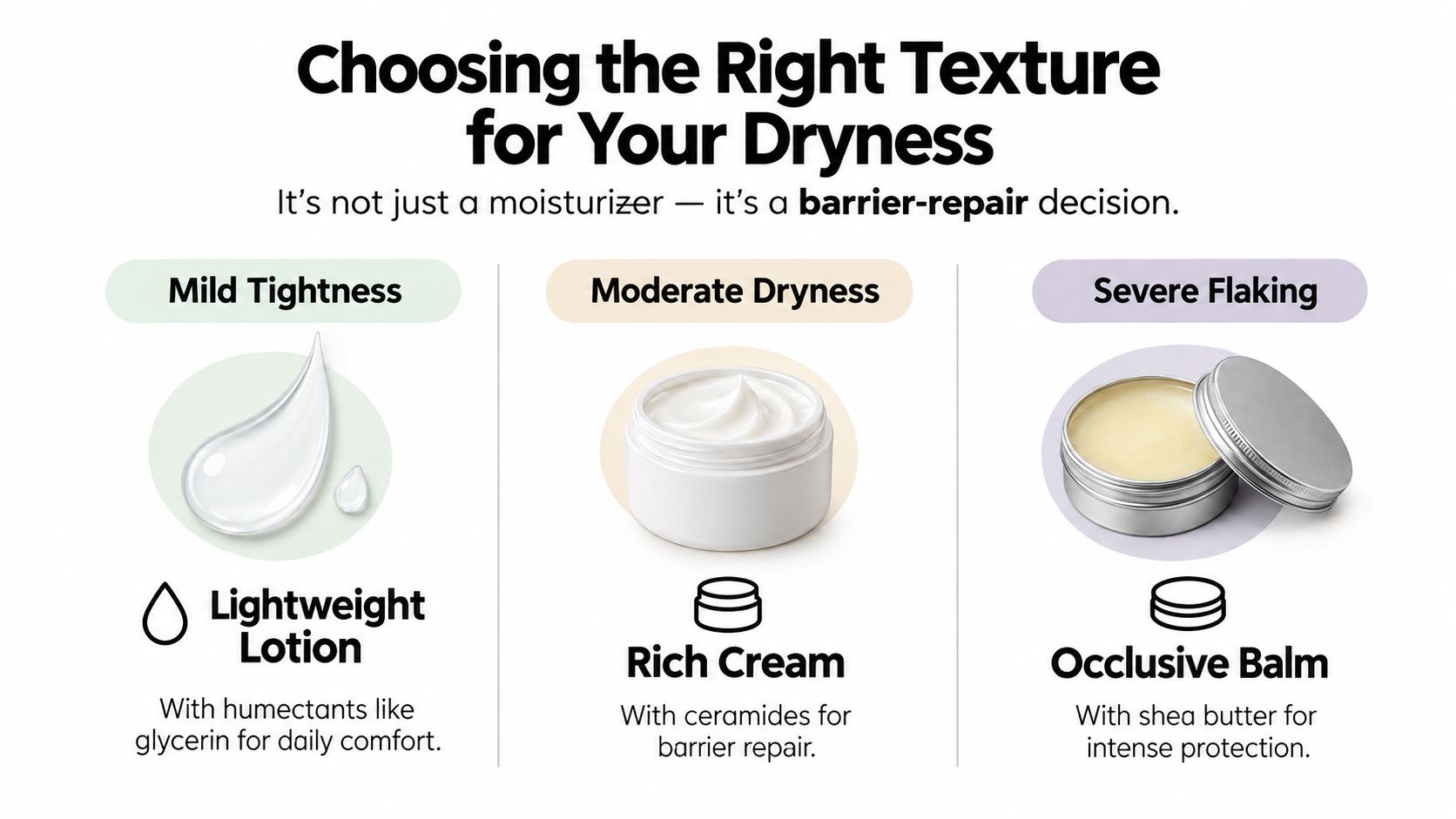
| Level of dryness | Texture to choose | Why it makes sense |
|---|---|---|
| Mild tightness | Lightweight lotion | Comfortable daily hydration |
| Moderate dryness | Cream | More substantial barrier support |
| Severe flaking | Balm or ointment | Stronger overnight protection |
Think about your routine as well as your skin. A rich cream may feel too heavy under make-up in warm weather, while a lotion can feel inadequate during cold, windy UK days. The right product is the one you'll apply twice daily and in a generous layer. Once you've chosen the texture, inspect the ingredient list rather than buying on scent or packaging alone.
Ingredients to Welcome and Avoid on the Label
A good label check should take minutes, not turn into a research project. UK pregnancy-skincare guidance repeatedly favours emollients and humectants, including shea butter, glycerin, hyaluronic acid, ceramides and colloidal oat. Fragrance, essential oils and denatured alcohol can aggravate dryness or sensitivity, so they deserve particular scrutiny (Cosmopolitan UK pregnancy-safe skincare guidance).
Ingredients worth welcoming
- Glycerin: A dependable humectant that helps draw water towards the outer skin.
- Hyaluronic acid: Adds lightweight hydration and works well beneath a cream.
- Ceramides: Support the lipid structure of the skin barrier. Look for names such as ceramide NP, AP or EOP.
- Cholesterol: Works alongside ceramides in barrier-focused formulas.
- Squalane: Softens dry skin without necessarily feeling as heavy as a balm.
- Shea butter: Adds richness and helps cushion stretched, uncomfortable areas.
- Panthenol: A soothing, conditioning ingredient for skin that feels stressed.
- Colloidal oatmeal: Particularly useful when dryness comes with itch or sensitivity.
- Niacinamide: A gentle option for supporting the barrier, provided the formula doesn't sting.
Ingredients to pause or use cautiously
- Retinoids: Avoid retinol, retinal, tretinoin and adapalene during pregnancy unless your clinician gives specific advice. If you're comparing product order, this guide to hyaluronic acid or retinol first is useful, but retinoids shouldn't be part of a pregnancy routine.
- High-strength salicylic acid: Avoid leave-on BHA peels and strong treatments. A mild wash-off product may be viewed differently by clinicians, so ask your midwife, GP or dermatologist about a product you already use.
- Hydroquinone: Don't use it during pregnancy without medical direction.
- Concentrated essential oils: These can be irritating, especially when your skin is already reactive.
- Fragrance and denatured alcohol: Pause them if your skin stings, burns or becomes noticeably red.
- Aqueous cream as a leave-on product: UK eczema guidance warns that its sodium lauryl sulphate content can irritate eczema-prone skin. It may be better suited as a wash product than as your leave-on moisturiser.
| Ingredient Quick-Scan for Pregnancy-Safe Moisturisers | |
|---|---|
| Welcome | Use With Caution or Avoid |
| Glycerin and hyaluronic acid | Retinoids such as retinol and tretinoin |
| Ceramides and cholesterol | High-strength leave-on salicylic acid |
| Squalane and shea butter | Hydroquinone |
| Panthenol and colloidal oat | Concentrated essential oils |
| Gentle niacinamide formulas | Fragrance, denatured alcohol and SLS-containing leave-on aqueous cream |
Keep the formula simple. A short, fragrance-free ingredient list that supports the barrier is usually more useful than a product packed with active ingredients.
A Realistic Morning and Evening Routine
Your moisturiser works best when you apply it before the skin has dried completely. The routine below is deliberately ordinary, because a pregnancy skincare plan needs to survive tired mornings, busy afternoons and evenings when bending over your bump feels like a major undertaking.
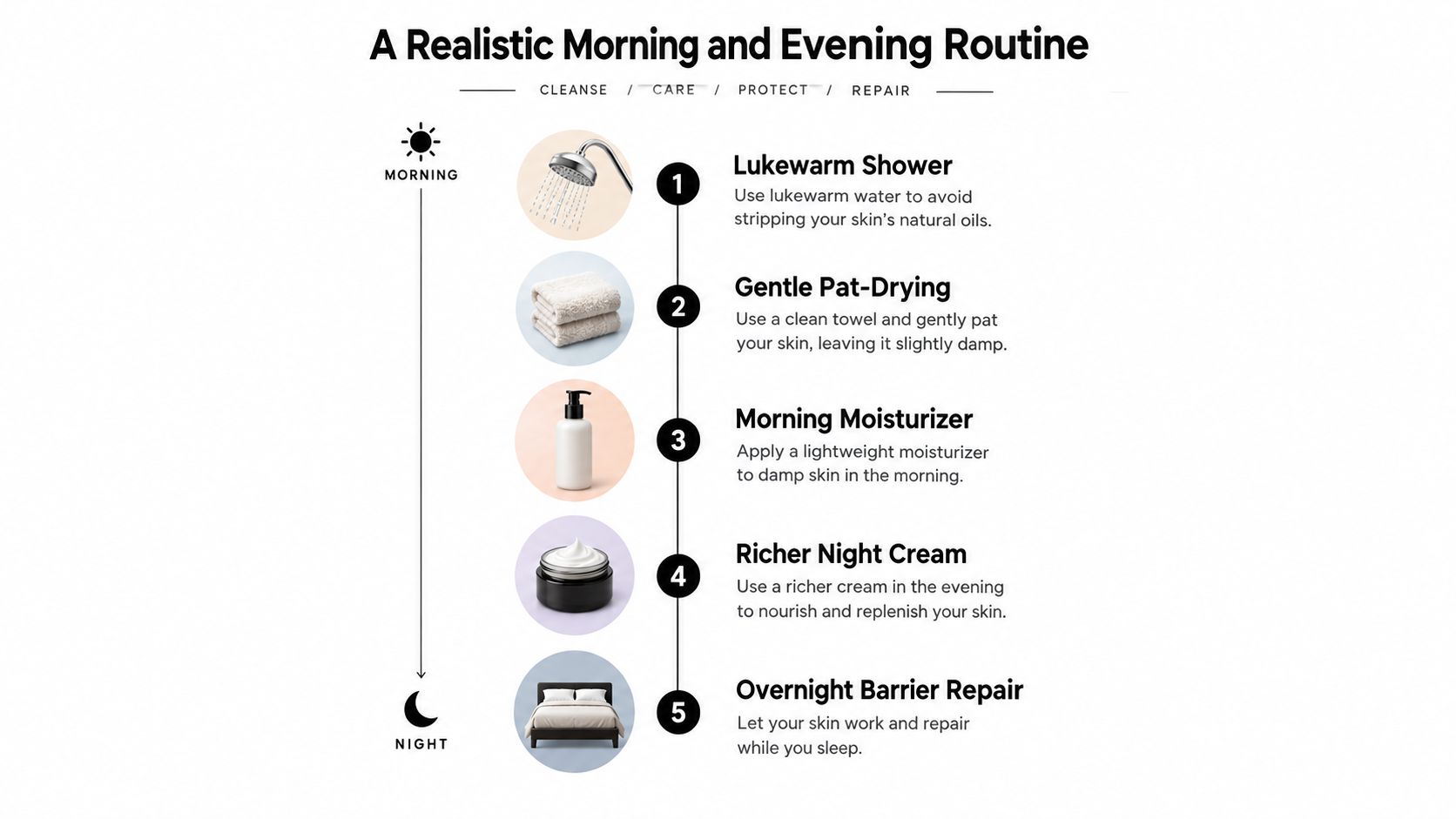
Morning
Start with a lukewarm shower, not a hot one. Hot water can strip surface oils and leave already-dry skin feeling tighter. Use a gentle cleanser only where you need it, then pat your skin with a towel. Don't rub.
Within roughly three minutes of stepping out, smooth a lightweight, humectant-led lotion over slightly damp skin. Cover your face if it feels tight, then move to your neck, hands, bump and any rough patches. Damp skin gives the moisturiser water to help retain, while rubbing it in gently avoids unnecessary friction.
Apply SPF as a separate final step rather than mixing it into your moisturiser. If your face is sensitive, a mineral SPF may feel more comfortable. At midday, don't worry about repeating a full routine. Reapply to your hands, cheeks or any patch that feels tight.
Evening
Cleanse gently and leave your skin slightly damp. Use a richer cream on the face and a cream or balm on the bump, hips, thighs and breasts. Massage slowly, with enough product to leave the skin comfortable and protected, not so little that it disappears before you've covered the area.
For stubborn dryness, make the evening application your heavier one. A balm or ointment can sit over the cream on specific areas, creating an occlusive layer overnight. This is more practical than using the heaviest texture everywhere.
The UK's NHS guidance on itching and intrahepatic cholestasis recommends regular unperfumed moisturiser or emollient use. UK eczema guidance also supports applying a leave-on emollient after bathing, using lukewarm water and avoiding irritants such as fragrance and sodium lauryl sulphate.
For especially parched areas, use a richer occlusive layer as a weekly comfort treatment, then wash it off gently the next day if you dislike the feel. You'll find more ideas for a night-time moisturiser routine when you want to make bedtime application easier.
How Much Moisturiser Is Actually Enough
A pea-sized amount may be reasonable for a small facial area, but it isn't a full-body strategy for persistent pregnancy dryness. If you're smoothing a tiny amount over a large bump and expecting it to repair a stressed barrier, you're asking too little product to do too much work.
South West London ICB guidance gives adults with generalised eczema a useful benchmark of about 600 g of emollient per week (pregnancy eczema and emollient guidance). Treat that as a practical reference for intensive, full-body barrier care, not a compulsory target for every pregnant person with mild tightness.
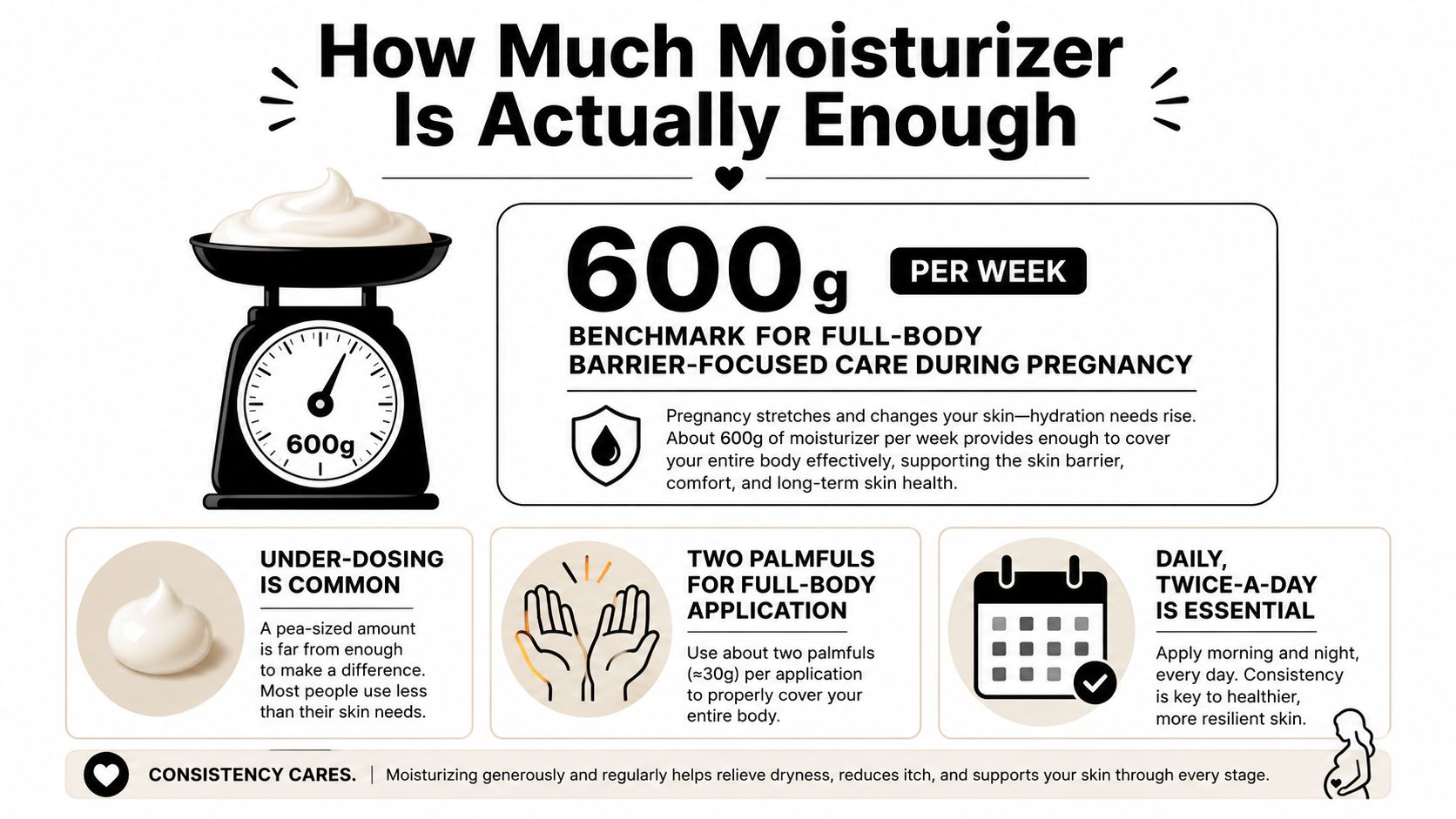
A useful quantity check
- Face: Use a fingertip-sized amount, adjusting for the area and texture.
- Bump: Use enough to cover the abdomen evenly without dragging.
- Body zones: Think in terms of a generous coin-sized amount for each area such as one thigh, one lower leg or both hands.
- Full-body care: If dryness is widespread, apply a substantial layer twice daily rather than rationing a small tube.
A 200 ml tube used twice a day may disappear faster than you expect. Don't judge success by how long the bottle lasts. If you're sceptical, weigh it once a week and note whether you're applying enough to cover the areas that feel dry.
Serums don't replace moisturiser. A hyaluronic acid serum attracts water, but it needs a cream over it to reduce water loss. A rich balm may stand alone because it already supplies more occlusive protection. During the later stages of pregnancy, heavier application on stretched areas is sensible when your skin feels tight, itchy or rough.
My rule: if you have to pull at the skin to spread the product, you haven't used enough.
Common Mistakes That Undermine Your Routine
A good moisturiser can't compensate for habits that repeatedly strip the barrier. The most common problem isn't choosing the wrong luxury cream. It's applying too little, too late or too inconsistently.
Stopping as soon as the itch settles
Comfort can return before the barrier has properly stabilised. Keep applying consistently after the skin feels better instead of abandoning the routine at the first improvement. Otherwise, the same patch may become tight again after another shower or cold day.
Treating aqueous cream as a harmless leave-on
Aqueous cream is often assumed to be a neutral default, but formulations containing sodium lauryl sulphate can irritate eczema-prone skin. Swap it for a fragrance-free leave-on emollient, and use a cleanser designed for sensitive skin if you need a wash product.
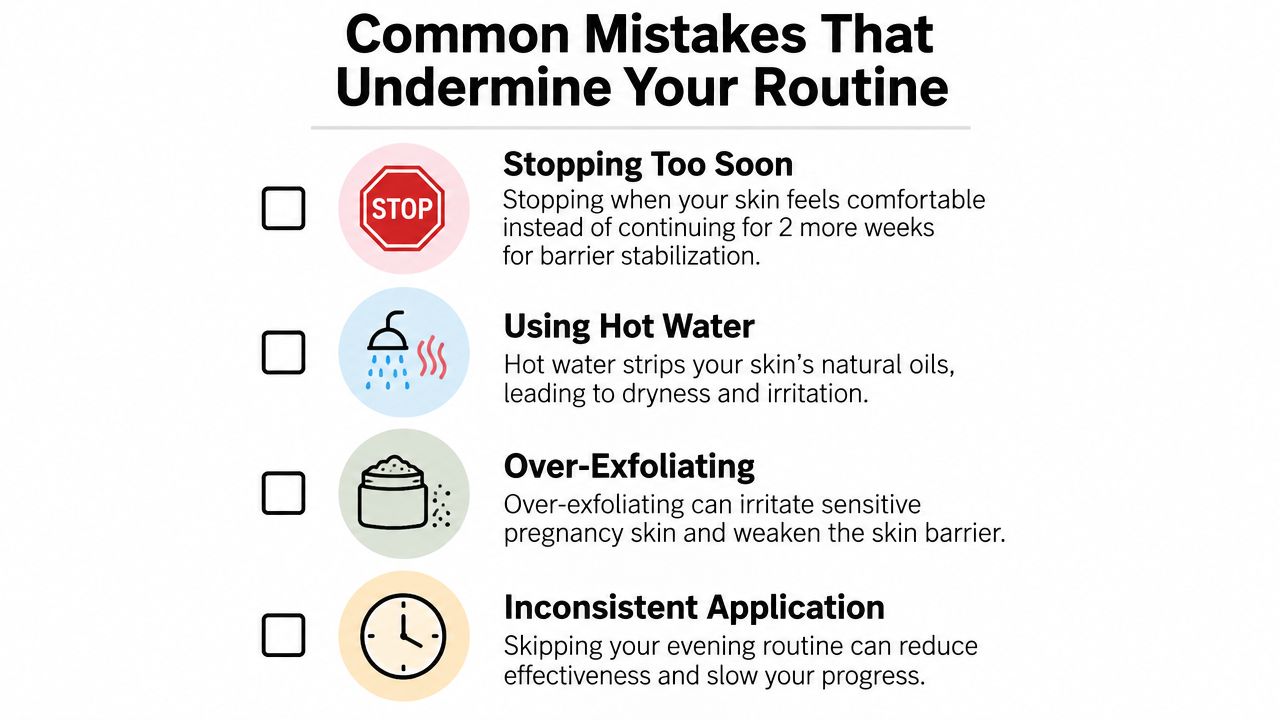
Exfoliating irritated skin
Glycolic and lactic acid pads, scrubs and strong retinoid alternatives can make already-uncomfortable skin feel raw. If the bump is itchy or flaky, stop exfoliating that area and focus on a plain barrier cream or ointment.
Relying on a complicated routine
Layering several actives increases the chance of stinging when pregnancy has made your skin more reactive. Keep the core routine consistent: gentle cleansing, damp-skin moisturiser, richer evening protection and daytime SPF on exposed skin, including on bright winter days.
Quick Answers for Worried Mums-to-Be
I used retinol before I realised I was pregnant. Have I caused harm?
Stop using it and speak to your midwife, GP or obstetric team. Don't panic or try to diagnose risk from skincare forums. Retinoids are generally avoided during pregnancy as a precaution, but your healthcare professional can advise based on the product and your individual circumstances.
Can I use salicylic acid?
Avoid high-strength leave-on products and BHA peels. If you're considering a low-strength wash-off product, ask your clinician rather than assuming every formulation carries the same exposure. For dry skin, salicylic acid usually isn't the right answer anyway. It can add irritation when your priority is barrier repair.
What should I do if I develop an eczema flare?
Stop fragranced products and exfoliating treatments. Apply an unperfumed emollient regularly, particularly after bathing, and choose a cream for moderate dryness or an ointment for more severe areas. UK pregnancy eczema guidance advises avoiding hot water and irritants such as fragrance and sodium lauryl sulphate (Eczema UK pregnancy guidance).
When does itching need medical attention?
Contact your midwife or maternity unit promptly if itching becomes intense, widespread or particularly affects your palms and the soles of your feet, especially if there's little or no rash. Pregnancy itching can sometimes indicate intrahepatic cholestasis, so don't assume every itch is ordinary dry skin. Seek urgent advice if the itching is sudden, severe or worrying you.
Is a simple moisturiser enough?
For ordinary surface dryness, a fragrance-free, humectant and ceramide-supportive moisturiser used generously is the right starting point. Persistent cracking, spreading rash or unexplained itching needs medical input rather than another product swap. Trust a consistent, texture-matched routine over panic-driven ingredient changes.
The Happy Bump Co offers bump-focused body care, including a Belly Butter and Belly Oil for Stretch Marks, designed to support hydration and comfort as pregnancy skin changes. Explore the range and choose a simple daily ritual that suits your dry or stretched skin at The Happy Bump Co .