

A growing bump can feel wonderful and uncomfortable at the same time. You may notice skin that feels tight after a shower, dry patches that catch on clothing, or itching that becomes more distracting as the day goes on. Then you see a new line or mark and start wondering whether you should have started using a tummy oil sooner.
A pregnancy tummy oil can make daily skincare feel soothing and manageable, but it can't control every change happening beneath the skin. The most useful approach combines realistic expectations, a carefully chosen formula, and attention to symptoms that may need medical advice.
Table of Contents
- Navigating Pregnancy Skin Changes and Comfort
- Understanding Tummy Oils and Pregnancy Skin Changes
- Ingredients to Embrace and Avoid During Pregnancy
- Tummy Oil for Sensitive and Eczema-Prone Skin
- How to Apply Tummy Oil for Maximum Hydration
- Comparing Tummy Oils with Butters and Creams
- Frequently Asked Questions About Pregnancy Skincare
Navigating Pregnancy Skin Changes and Comfort
After a warm shower, your bump may feel stretched and slightly papery. You apply oil with both hands, hoping the massage will calm the tightness before you get dressed. That small ritual can be valuable, particularly when pregnancy has made ordinary tasks feel physically demanding.
The purpose of this routine is comfort and moisturisation, not a promise that every mark will be prevented. A tummy oil can soften the skin's surface, reduce the unpleasant sensation of dryness, and give you a quiet moment to reconnect with your changing body. It can't reliably alter the biological processes that determine whether stretch marks develop.
Dryness and dehydration aren't always the same experience, so learning the difference can help you choose a more suitable routine. This guide to dry skin versus dehydrated skin can help you recognise what your skin may be asking for.
A routine that supports, rather than promises
Use your oil as one part of a wider comfort plan. A gentle cleanser, loose breathable clothing, lukewarm water, and regular moisturisation may all help when your bump feels uncomfortable. If a product stings, makes redness worse, or leaves you increasingly itchy, stop using it rather than assuming the reaction means the product is working.
A realistic expectation: Your skincare routine can support a comfortable skin barrier. It can't guarantee that pregnancy-related stretch marks won't appear.
This distinction matters because stretch marks are a normal pregnancy-related change, not evidence that you failed to care for your skin. Some people develop them despite consistent moisturisation, while others don't use a dedicated oil and experience few visible changes. Neither outcome proves that an oil caused or prevented the result.
Your daily application can still be worthwhile. Think of it as a practical moisturising step and a calming self-care habit, rather than a medical treatment or a test of how well you've managed pregnancy.
Understanding Tummy Oils and Pregnancy Skin Changes
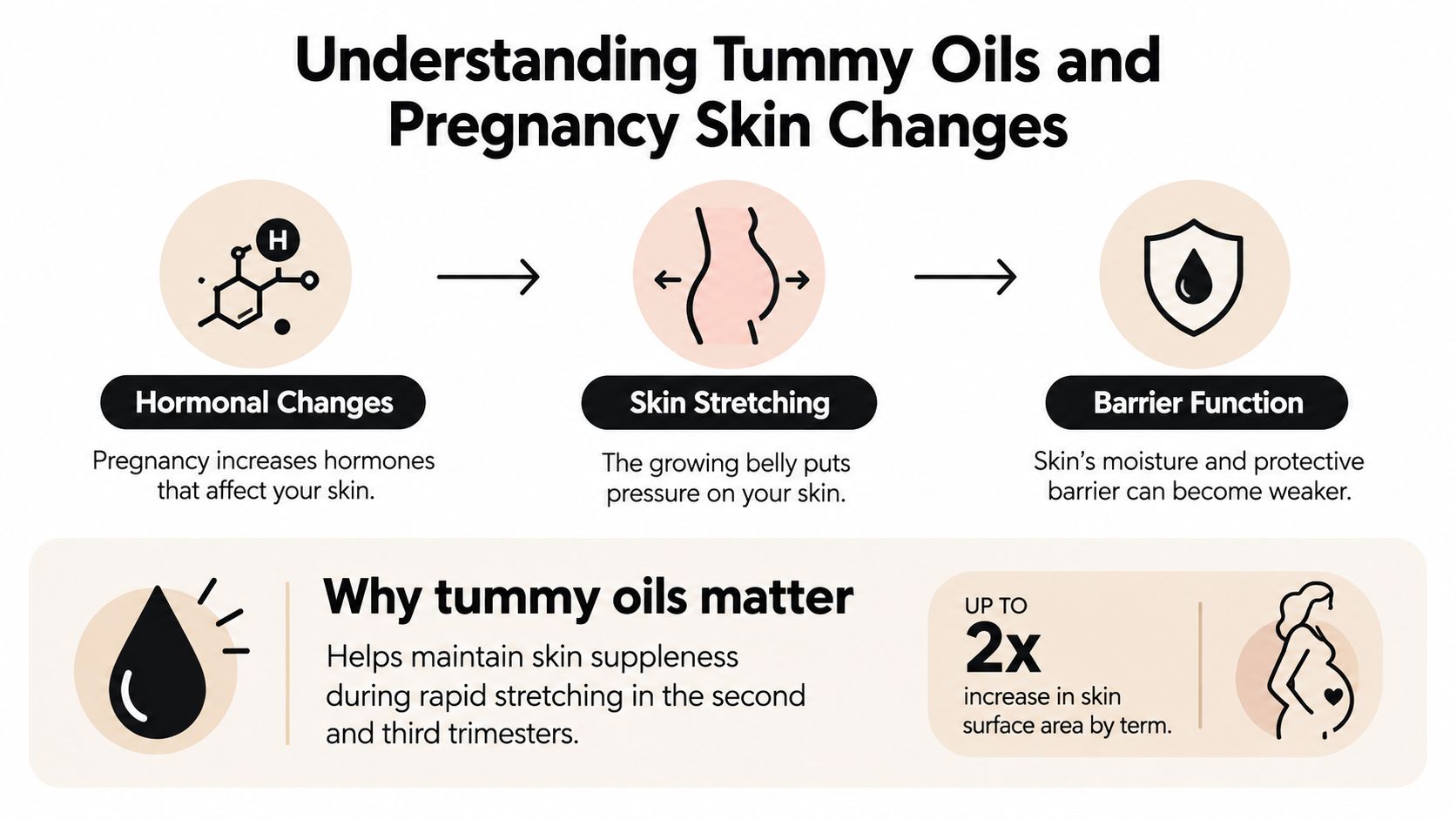
Pregnancy skin changes involve more than a growing abdomen. As the body adapts, hormonal changes, hereditary factors, weight change, and stretching can all influence how the skin responds. This is why two pregnant people with similar bump sizes can have very different experiences.
Stretch marks are particularly common. The National Childbirth Trust's pregnancy skincare guidance reports that they're seen after approximately six months of pregnancy in around 7 in 10 people, or about 70%. They commonly appear on the abdomen, hips, breasts, and buttocks, where the skin is subject to stretching.
A UK survey provides further context. 46.3% of respondents, representing 342 women, had experienced stretch marks before their current pregnancy, while 46.7%, representing 344 women, reported developing them during the current pregnancy. These figures show why many people search for tummy oil pregnancy products, but they don't demonstrate that an oil prevents striae.
What moisturisation can realistically do
The available UK guidance states that there's no evidence that applying a cream or oil prevents stretch marks. A standard moisturiser may still improve comfort by reducing the sensation of dryness, tightness, or itchiness.
Oil works mainly as a lipid-rich moisturising layer. It can help smooth the skin's surface and reduce water loss, especially when applied while the skin is still slightly damp. It also spreads easily over a larger area, which makes it useful for a gentle massage around the bump, hips, and breasts.
That doesn't mean an oil is always the best texture. Someone with eczema or a damaged skin barrier may find a richer emollient more comfortable, while another person may prefer an oil because it feels lighter and is easier to apply. Tolerance matters more than the product format.
Why stretch marks aren't simply a stretching problem
The skin does stretch as the bump grows, but stretching alone doesn't explain every outcome. Hormonal shifts may influence the skin's structure and moisture balance, while inherited characteristics can affect how it adapts. Substantial weight change can also contribute.
This makes prevention claims especially difficult to justify. An oil can support the surface and make tight skin feel more comfortable, but it can't reliably control hereditary or hormonal influences. The most honest benefit is hydration, softness, and a more comfortable daily routine.
Ingredients to Embrace and Avoid During Pregnancy
Pregnancy skincare needs a more cautious label-reading habit than ordinary body care. A short formula with clear ingredients is often easier to assess than a heavily fragranced blend built around broad promises such as “detoxifying”, “corrective”, or “firming”.
UK pregnancy skincare guidance advises avoiding topical retinoids, including retinol, retinal, tretinoin, and isotretinoin. It also discourages hydroquinone because of its relatively high systemic absorption. These ingredients may appear in products aimed at skin renewal, pigmentation, or mark correction, so check the full ingredient list rather than relying on the product name.
A simple label check
Use this sequence when comparing tummy oils:
- Look for a short formula. Fewer ingredients can make it easier to identify a potential irritant if your skin reacts.
- Check for retinoids and hydroquinone. Don't use a product containing these during pregnancy unless a qualified clinician has specifically advised you.
- Treat fragrance as a separate question. “Natural” fragrance can still irritate sensitive skin, and essential oils need particular caution, especially during the first trimester, because safety evidence is limited.
- Choose transparent labelling. You should be able to see the complete ingredient list and understand whether the formula is fragrance-free or fragranced.
- Patch test first. Apply a small amount to a limited area and observe how your skin responds before using it across your bump.
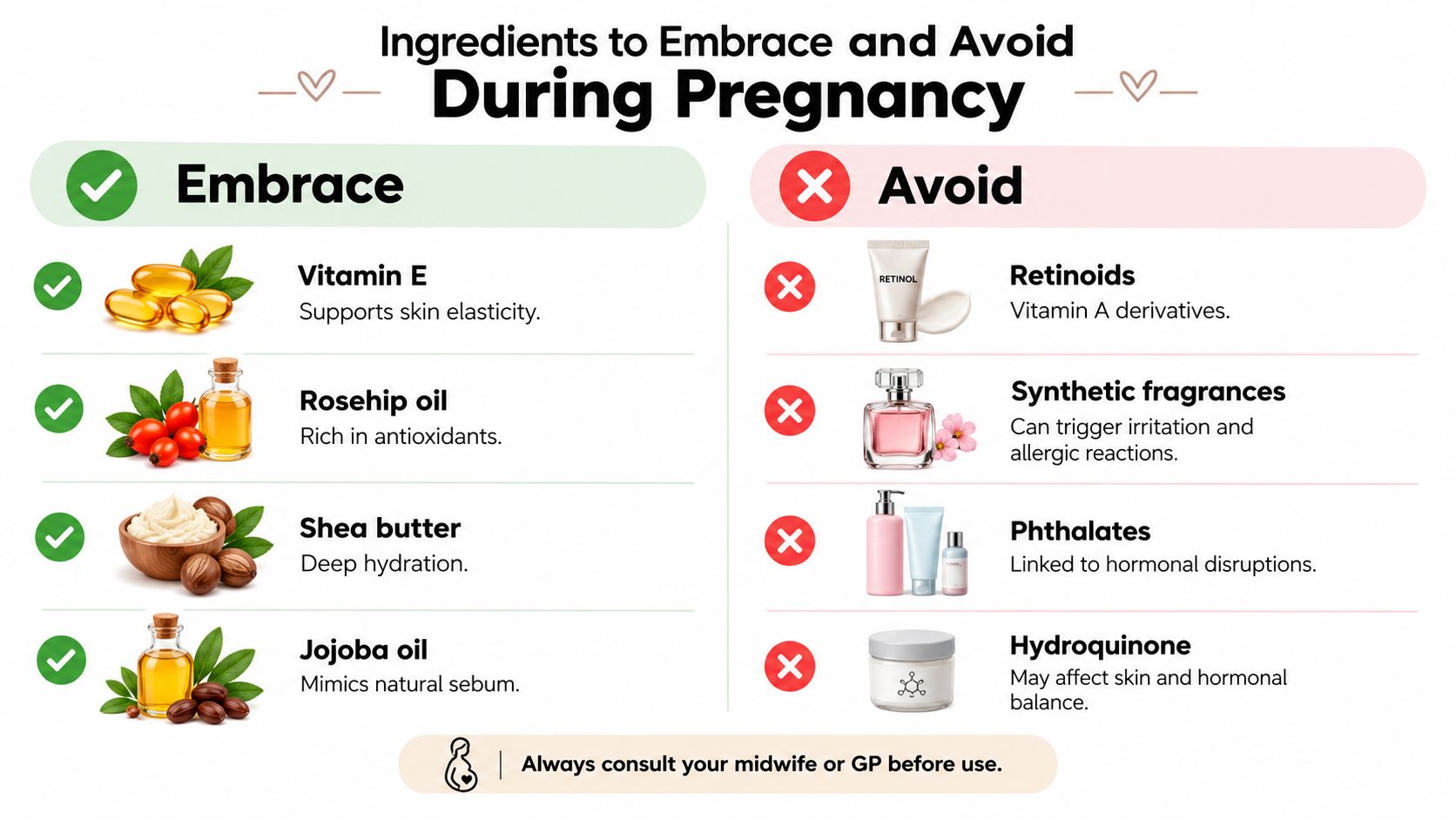
A formula based on straightforward emollient oils or butters may suit a routine focused on comfort. However, an ingredient being plant-derived doesn't automatically make it suitable for every pregnancy or every skin type. Your skin may react to a botanical extract, fragrance component, or essential oil even if the packaging describes it as gentle.
Fragrance-free is often the safer starting point
If you're prone to nausea, eczema, headaches, or irritation, begin with a fragrance-free or minimally fragranced option. You may also want to read this guide to fragrance-free body oil before choosing a product.
Pregnancy can make skin more reactive, and many cosmetic products haven't been tested in pregnant populations for ethical reasons. That doesn't mean every product is dangerous, but it does mean manufacturers and consumers should avoid unsupported certainty.
Don't use a cosmetic oil to manage a prescribed skin condition without professional advice. Speak to a midwife, pharmacist, or doctor about prescribed treatments, a significant rash, severe itch, or a suspected allergic reaction.
Tummy Oil for Sensitive and Eczema-Prone Skin
“Natural” and “gentle” aren't interchangeable. A botanical tummy oil may contain fragrance or essential oils, and those ingredients can irritate eczema-prone skin. The UK National Eczema Society's pregnancy and eczema guidance advises people to continue using a regular emollient rather than automatically switching to a naturally marketed product.
Pregnancy-related dryness may feel tight and mildly itchy, then improve after moisturisation. Eczema can behave differently. You might notice persistent inflammation, rough or scaly patches, cracking, weeping, or a flare that keeps returning despite applying oil.
Choosing between oil, cream, and treatment
For reactive skin, a high-lipid emollient with fewer potential allergens may offer better barrier support than a scented oil. Creams and ointments can feel more protective because they contain a blend of water-binding and lipid ingredients, while a plain oil mainly supplies lipids and helps reduce surface water loss.
An oil may be suitable for intact, comfortable skin if it passes a patch test. It shouldn't be your only response to cracked, inflamed, infected, or actively weeping skin.
Follow these safety steps:
- Patch test first: Try the product on a small area away from the most irritated skin.
- Avoid broken skin: Don't massage cosmetic oil into cracks, open areas, or suspected infection.
- Remove fragrance from the equation: Choose fragrance-free where possible, and be cautious with essential oils.
- Keep using tolerated emollient care: Don't abandon a product that reliably supports your skin barrier just because a new oil is marketed as more natural.
- Stop if symptoms worsen: Increased burning, redness, swelling, or itching is a reason to discontinue the product.
Important: Cosmetic tummy oil isn't a substitute for eczema treatment or an assessment of persistent pregnancy itching.
Contact your midwife, pharmacist, or doctor if the itch is persistent or severe, if a rash is spreading, or if the skin is cracked, painful, weeping, or showing signs of infection. Severe itching in pregnancy deserves professional assessment rather than repeated experimentation with cosmetic products.
How to Apply Tummy Oil for Maximum Hydration
Application technique affects comfort more than using a large quantity. The aim is to spread a thin, even layer without rubbing already-sensitive skin aggressively.
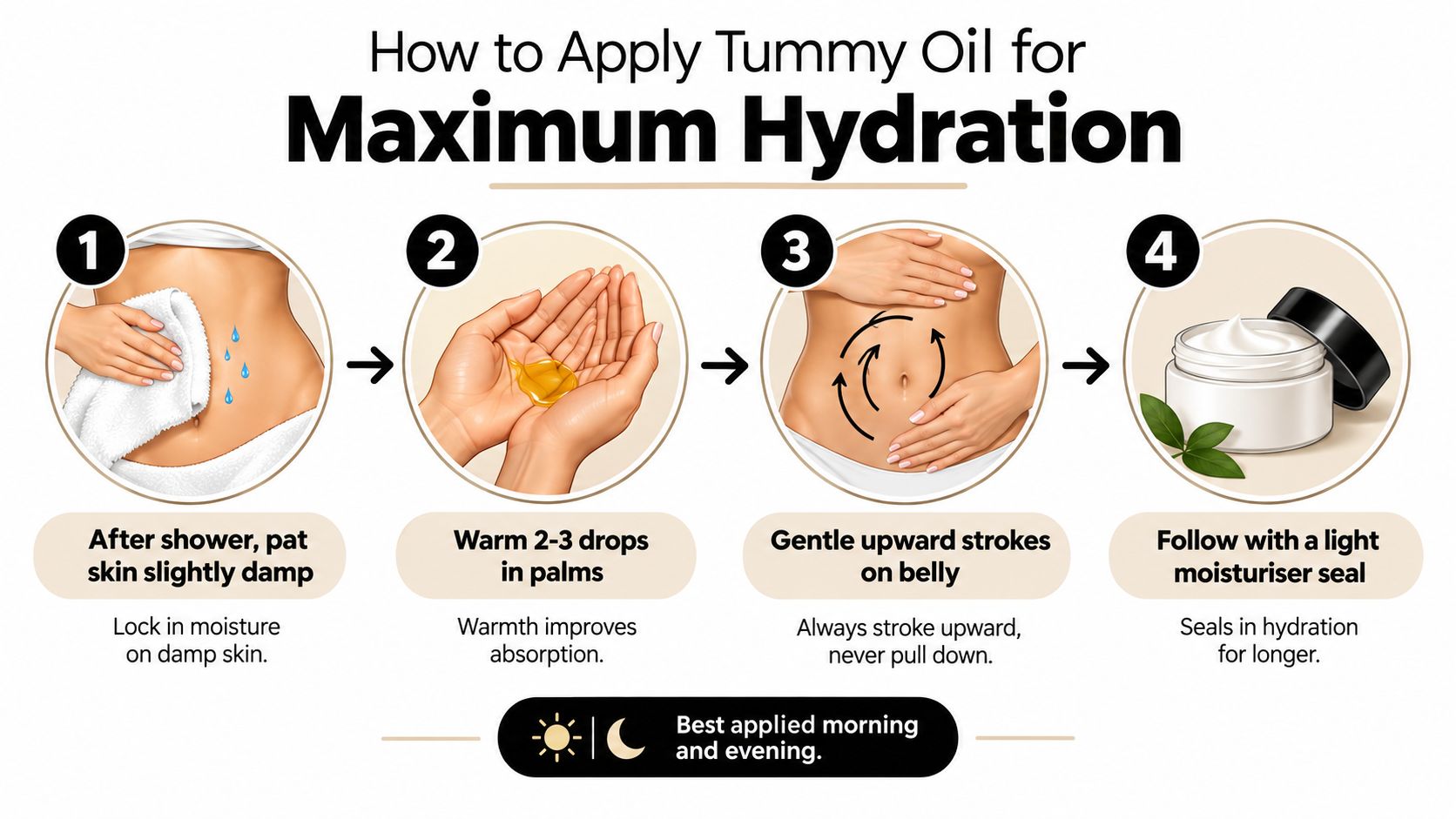
Start after bathing, when your skin is clean and still slightly damp. Pat rather than scrub with a towel, then warm a small amount between your palms. This helps the oil spread across the bump instead of requiring repeated rubbing.
A gentler application pattern
Use broad, slow movements over the abdomen, sides, hips, and any other areas that feel dry. Let your hands glide over the skin rather than pulling or pinching it. You don't need a vigorous massage to make an oil useful, and firm pressure can aggravate tender or reactive skin.
A practical routine looks like this:
- Cleanse gently. Use warm rather than hot water and avoid harsh scrubbing.
- Leave skin slightly damp. Pat away excess water without drying completely.
- Warm a small amount. Add more only if your hands begin dragging.
- Smooth across the bump. Use comfortable circular or sweeping movements.
- Allow a moment to absorb. Dress in breathable clothing once the surface feels comfortable.
- Layer carefully. If you need more barrier support, apply a fragrance-free cream or butter after the oil has settled.
The guide to using body oils can help you build this step into a broader body-care routine. Avoid scrubs on inflamed, cracked, or eczema-prone skin, since exfoliation can increase irritation.
You can use the routine at a time that feels practical, whether that's after a morning shower or before bed. The most useful schedule is the one you can maintain without discomfort. If the oil causes stinging or redness, wash it off and return to a previously tolerated emollient.
The video below demonstrates a gentle approach to body oil application.
Comparing Tummy Oils with Butters and Creams
The best texture depends on what your skin needs that day. An oil can feel elegant and easy to spread, but a rich butter or cream may be more comfortable when dryness is intense or the barrier feels fragile.
Oils are mostly lipid-based. They can smooth the surface and help reduce water loss, particularly when applied to damp skin. But they don't always provide the same cushioning feel as a thicker emollient, and some people find that they need to layer another product over them.
Butters usually feel denser and more occlusive. That can be useful for rough, tight areas, especially at night, although a heavy texture may feel uncomfortable under clothing or in warm weather. Creams sit between the two, offering a balance of spreadability, barrier support, and everyday wear.
Pregnancy moisturiser texture comparison
| Product type | Absorption rate | Barrier support | Best for |
|---|---|---|---|
| Tummy oil | Usually light and easy to spread | Supports the surface lipid layer and helps reduce water loss | Comfortable, intact skin and massage rituals |
| Body butter | Slower, with a richer finish | Stronger occlusive feel for very dry areas | Night-time use, rough patches, and people who prefer a protective layer |
| Cream or emollient | Varies by formula | Can combine water-binding ingredients with lipids | Dry, eczema-prone, or easily irritated skin |
| Prescribed treatment | Depends on the medicine and base | Designed for a diagnosed condition rather than general moisturisation | Skin disease or symptoms requiring clinical management |
Match the product to the symptom
Choose an oil if you value easy spreading and your skin is comfortable with the formula. Choose a richer butter when the main issue is surface dryness and you want a more protective finish. Choose a fragrance-free cream or regular emollient when eczema, cracking, or sensitivity is part of the picture.
You can also use textures at different times, but adding more products isn't automatically better. Each new ingredient creates another opportunity for irritation, so keep the routine organised and introduce products one at a time.
Price and branding don't determine suitability. A simple, well-tolerated emollient may be more useful than an expensive oil that makes your skin itch. The right product is the one your skin tolerates and you can apply consistently.
Frequently Asked Questions About Pregnancy Skincare
Can I use tummy oil while breastfeeding?
Check the full ingredient list and follow the product's safety instructions. Keep cosmetic oils away from the nipple and areola unless a healthcare professional has confirmed that the product is suitable there, and wash away any residue before feeding. Ask your midwife, health visitor, pharmacist, or doctor if the formula contains fragrance, essential oils, active ingredients, or anything you're uncertain about.
What should I do about sudden or severe itching?
Don't assume severe itching is ordinary stretching. Stop any recently introduced product, avoid scratching, and contact your maternity team, midwife, pharmacist, or doctor for assessment. A persistent rash, inflamed skin, cracking, weeping, suspected infection, or severe itch needs more than a cosmetic oil.
Is a natural oil safer than a standard cream?
No. “Natural” describes an origin or marketing position, not a guarantee of tolerability or pregnancy suitability. A fragrance-free cream with a short ingredient list may be a better choice for eczema-prone skin than a scented botanical oil.
Can tummy oil prevent stretch marks?
There's no evidence that applying a cream or oil prevents stretch marks, as the UK pregnancy skincare guidance cited earlier explains. Use it for moisturisation, softness, and relief from the sensation of dryness or tightness, while accepting that stretch marks are a common biological change.
Is an expensive branded oil better?
Not necessarily. Compare the complete ingredient list, fragrance level, texture, patch-test response, and suitability for your skin. A modest, transparent formula that doesn't irritate you can be a sounder choice than a premium product built around dramatic prevention claims.
What if my skin is already reacting?
Pause the oil and return to a previously tolerated emollient if appropriate. Don't apply cosmetic products to broken or infected skin, and seek professional advice if symptoms persist, worsen, or become severe.
The Happy Bump Co offers pregnancy-focused body care, including Belly Oil for Stretch Marks, Belly Butter, and Pregnancy Tummy Scrub, designed to nourish changing skin and support a daily self-care routine. Visit The Happy Bump Co to explore the range and choose a texture that suits your skin's comfort needs.