

You catch sight of them after a shower, just as you're pulling on your top. Fine pink lines trace the side of your bump. The skin feels tight, perhaps a little itchy, and your fingertips notice a faint change in texture that the mirror barely shows. Then come the familiar questions: Are these normal? Did I cause them? Will they stay?
Pregnancy stretch marks can feel personal because they appear on your changing body. They aren't a sign that you've neglected your skin, though. They form through the interaction of rapid physical stretching, changes within the skin's structure, pregnancy-related hormones, and inherited skin characteristics. The NHS says they affect around 8 out of 10 pregnant women, making them one of the most common skin changes in pregnancy (NHS guidance on pregnancy stretch marks).
There's also a clinical question that deserves more attention. Most stretch marks are harmless, but unusual marks or marks accompanied by other symptoms should sometimes be discussed with a midwife or GP. Understanding what causes pregnancy stretch marks helps you know what belongs to ordinary skin adaptation, what care can realistically do, and when reassurance from a professional is sensible.
Table of Contents
- The First Time You Notice Them on Your Bump
- How Skin Actually Works and Why It Stretches
- The Four Pregnancy-Specific Drivers Behind Stretch Marks
- When Stretch Marks Typically Appear and Where to Look
- Risk Factors You Can and Cannot Change
- Myths Worth Putting to Rest
- A Realistic Daily Care Routine for Changing Skin
- Red Flags and When to Speak to a Clinician
The First Time You Notice Them on Your Bump
You notice them while getting dressed, perhaps as faint lines that appear only when the light catches your bump. The skin may feel tight or mildly itchy, although some people see the change before feeling anything. That variation is normal.
Stretch marks often follow the direction of tension in the skin. Across a growing abdomen, they may run vertically or at a slight angle. Pregnancy can also bring them to the breasts, upper thighs, or other areas where tissue is changing. The NHS pregnancy symptoms guidance explains that stretching can affect the dermis, the middle layer of skin, producing the visible lines.
The important reassurance: stretch marks reflect changing tissues and skin structure, not poor care or a mistake you made.
A cream can still have a useful, limited role. Moisturiser may ease dryness, tightness, and itch, making the surface more comfortable. It cannot reliably stop marks from forming, because the mechanical and hormonal changes involved occur deeper in the skin than a cream can reach.
Early marks may look pink, red, purple, or brown, depending partly on your skin tone and how recently they appeared. Over time, they commonly become paler and less noticeable. Their final appearance is not a scorecard for your skincare, diet, or pregnancy health.
Most marks are harmless. A sudden or unusual change, especially alongside other symptoms, deserves a conversation with your midwife or GP rather than another product from the bathroom shelf. That is the point where stretch marks become a clinical question, not only a cosmetic one.
The more useful question is not whether you can prevent every line. Ask what your skin is responding to, whether the pattern fits ordinary pregnancy change, and whether anything feels unusual. Those questions make it easier to choose comfort care while recognising when reassurance from a clinician would help.
How Skin Actually Works and Why It Stretches
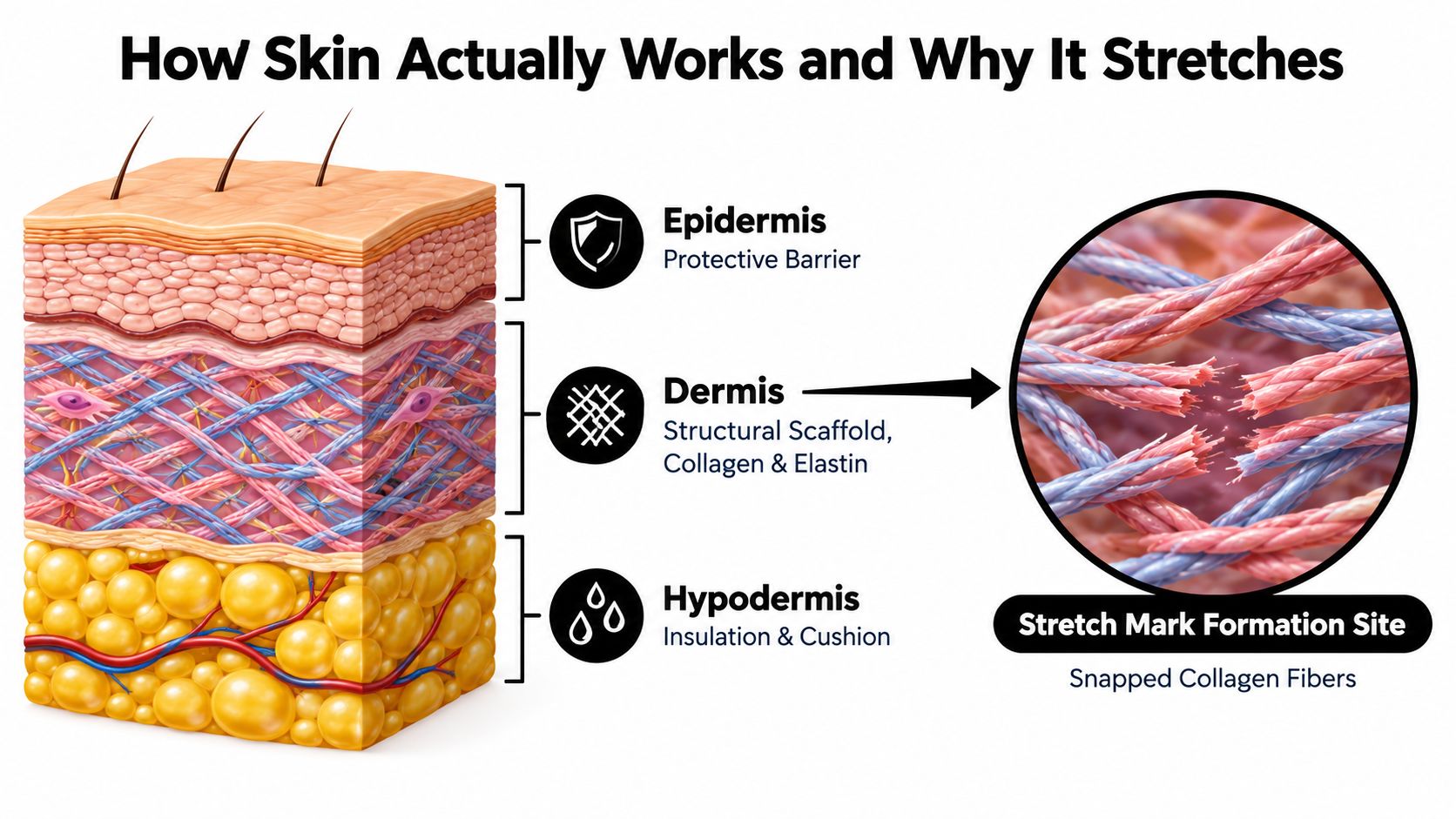
Your skin has several layers, and each has a different job.
- The epidermis is the outer shield. It helps protect against the environment and forms the surface you can see.
- The dermis sits underneath. It contains collagen and elastin, along with structures that support the skin's strength and flexibility.
- The hypodermis is deeper still. It contains fatty tissue that helps cushion and insulate the body.
Stretch marks develop in the dermis, rather than being simple scratches on the surface. Collagen gives the skin tensile strength, which helps it withstand pulling. Elastin lets skin stretch and return towards its previous shape. During pregnancy, those fibres must accommodate changing tissues over a relatively short period.
A useful comparison is a knitted fabric. If you pull a jumper gently, its fibres shift and recover. Pull it quickly and repeatedly in one area, and the weave can loosen or fray. The outer appearance may still look intact, but the underlying structure has changed. Stretch marks are a little like those altered areas in the deeper skin, where collagen and elastin have been disrupted and reorganised.
Why the surface can look different
As the dermis changes, the epidermis follows the contours of the altered tissue. That's why a stretch mark may look like a line, dip, ridge, or slightly puckered streak. Newer marks can be more colourful or feel mildly raised, while older marks often become flatter and lighter.
This also explains why a rich product can improve comfort without rebuilding every damaged fibre. A moisturiser works at the surface and supports the skin barrier. It doesn't control the speed at which the uterus, breasts, or surrounding tissues grow.
For a clearer explanation of the skin's structure, you can read this guide to the texture of the skin. Once you have that mental picture, the pregnancy-specific causes become easier to separate from myths about dryness or poor skincare.
The Four Pregnancy-Specific Drivers Behind Stretch Marks
You may notice a new line after a period of rapid growth, perhaps on your abdomen, breasts, or thighs. It can feel as though it appeared overnight, but the skin has been responding to several forces at once. What causes pregnancy stretch marks is a combination of mechanical pressure, internal changes, tissue expansion, and inherited skin behaviour. No single factor explains every mark.
Rapid expansion creates the physical load
As the uterus and bump grow, the abdominal skin must cover a larger area. This places increasing tension through the dermis, the deeper layer that supports the skin's surface. The NHS describes stretch marks as developing when skin stretches and the deeper tissue changes (NHS explanation of stretch marks). Growth that happens quickly can give the tissue less time to adapt, particularly when volume is changing in the same area.
The abdomen often draws the most attention, yet the breasts and thighs may also experience substantial expansion. A mark usually reflects the combined load on that region, rather than a failure of care or cleanliness.
Pregnancy changes the tissue environment
Pregnancy hormones affect many body systems, including connective tissue. Oestrogen, progesterone, relaxin, and glucocorticoids may influence how supportive fibres behave and how the skin responds to tension. These hormonal effects occur alongside physical growth. The tissue may become more yielding while the bump and other areas continue to expand, leaving the dermis to manage a changing mechanical demand.
Added tissue can increase tension
Weight gain and increased tissue beneath the skin can add to the pull on the dermis. That is a normal part of pregnancy and is not a reason to fear healthy physical change. The likelihood of stretch marks may be higher when pregnancy weight gain is above average, but weight gain alone does not determine the outcome.
Growth also varies between people. The same amount of change may place different demands on different skin, depending on its elasticity and inherited structure.
Genetics influence the starting point
Inherited differences affect collagen quality, elasticity, and how readily someone develops stretch marks. Family history can therefore offer a clue, not a fixed forecast. Someone with a family tendency may develop few marks, while someone without an obvious family history may still develop them when expansion, hormonal changes, and tissue tension coincide.
| Driver | Primary mechanism | How it interacts with the others |
|---|---|---|
| Rapid abdominal expansion | The dermis faces increasing mechanical tension | Growth rate and pregnancy-related tissue changes can make adaptation harder |
| Hormonal shifts | Connective tissue may become more yielding and respond differently to stress | Hormones influence how skin copes while the body expands |
| Maternal tissue change | Additional tissue beneath the skin can increase the pull on the dermis | It adds mechanical demand alongside bump and breast growth |
| Genetics | Baseline collagen and elastin behaviour varies between people | It can raise or lower susceptibility without guaranteeing an outcome |
Supporting healthy collagen production is a reasonable skincare aim, but it cannot override biology. This guide to increasing collagen production explains the wider skin-supporting picture without turning stretch marks into a personal test. Persistent, painful, or unusual skin changes belong in a clinical conversation, not just a product routine.
When Stretch Marks Typically Appear and Where to Look
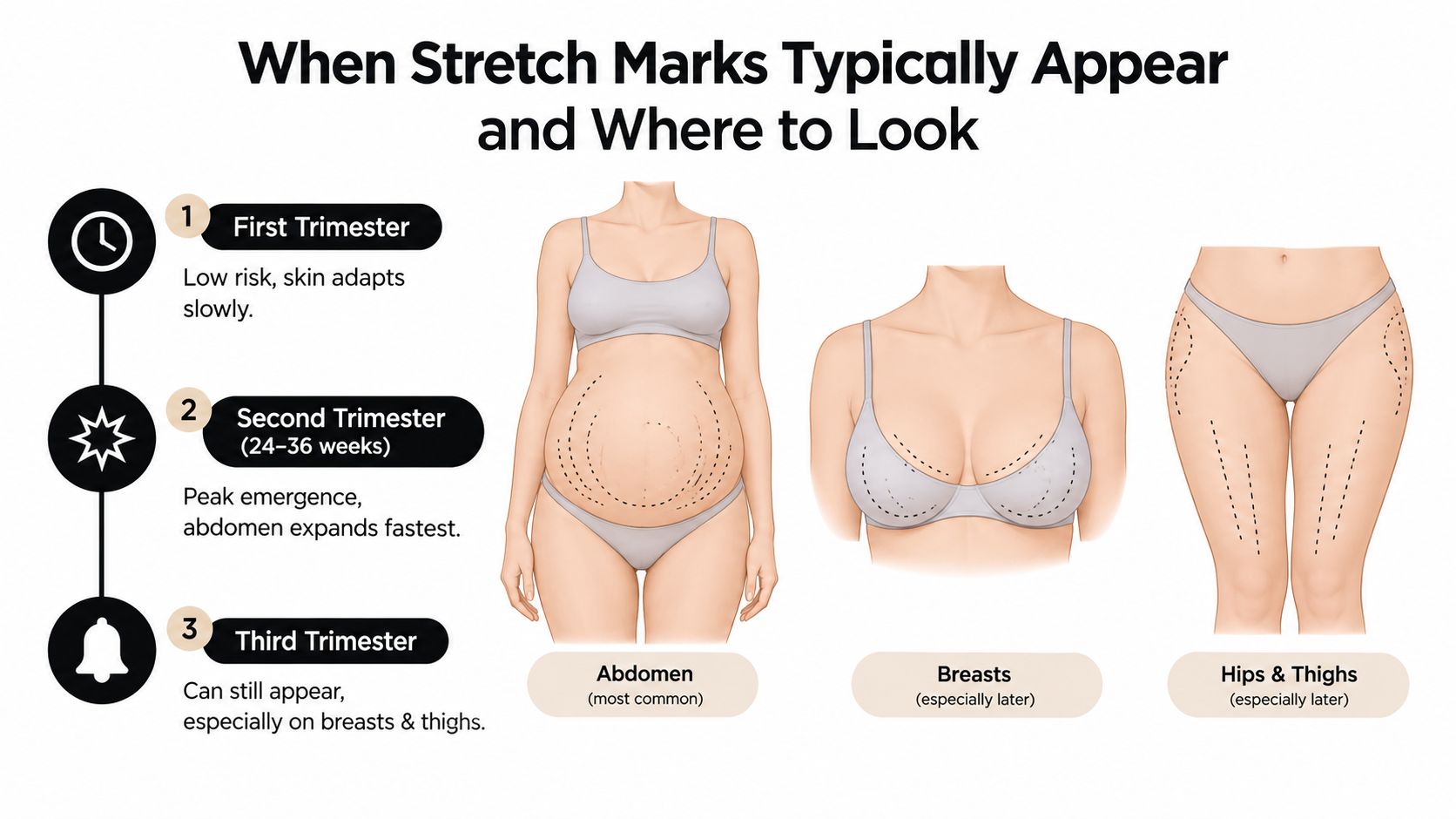
You may notice a fine line while dressing, showering, or applying moisturiser, even before your bump feels especially large. Pregnancy does not follow one skin timetable. Marks can appear as the abdomen grows, or first show on the breasts, hips, or thighs when those areas begin changing. Their position often reflects where the skin is experiencing the greatest combination of stretching and tissue change.
Common places to check include:
- Lower abdomen, especially above the pubic line
- Breasts, including the sides and upper surfaces
- Hips and upper thighs
- Buttocks
- Upper arms, less commonly
The lower abdomen and breasts often draw attention because their volume can change noticeably during pregnancy. Skin may feel softer, tighter, more sensitive, or itchy as the underlying tissues expand. A mark appearing in one area does not mean other areas will necessarily develop them.
What a new mark may look and feel like
Early stretch marks can look pink, red, purple, or brown, depending on your skin tone. They may be slightly raised, faintly indented, or itchy. As the skin matures, they often become paler and flatter.
The tummy, upper thighs, and breasts are recognised areas where pregnancy stretch marks may develop. Spotting a new mark early helps you observe changes and choose soothing care. It does not show that a cream could reliably stop the process, because marks arise from mechanical strain, hormonal changes, and individual skin response. Persistent pain, marked inflammation, or an unusual rash deserves a conversation with a clinician rather than treatment with skincare alone.
Here's a visual overview of how these changes may develop:
Risk Factors You Can and Cannot Change
A new mark can bring an unfair question: “What did I do wrong?” In many cases, the answer is nothing. Family history, your past experience of stretch marks during puberty or rapid weight change, age, skin characteristics, and carrying more than one baby can all influence how the dermis handles tension.
Your skin's collagen and elastin also behave in an individual way. They work like the supporting fibres beneath fabric, helping skin accommodate change and recover its structure. Some bodies tolerate expansion with fewer visible marks; others show marks more readily, even with careful routines.
Some influences can be supported without turning pregnancy into a project. Your rate of weight gain, nutritional status, hydration, and regular skin care affect general skin condition. The NHS guidance on causes and associated conditions also lists family history, steroid use, and rapid weight change among factors associated with stretch marks.
| Non-modifiable | Modifiable |
|---|---|
| Family tendency | Following pregnancy weight guidance from your maternity team |
| Previous stretch marks | Eating a varied, nourishing diet |
| Individual collagen and elastin behaviour | Drinking fluids regularly |
| Skin characteristics | Using gentle moisturising care |
| Age and pregnancy pattern | Avoiding unnecessary irritation from harsh products |
| Multiple pregnancy | Asking for advice if weight changes feel difficult to manage |
What “modifiable” really means
A modifiable factor is something you can support, not a result you can command. Choose nourishing meals, drink regularly, and avoid sudden dieting or unnecessary restriction. Moisturiser may ease dryness and itching, while gentle products reduce avoidable irritation. These steps support comfort and skin condition, but cannot guarantee that the dermis will remain unchanged.
Pregnancy weight management belongs with your midwife or doctor, not with fear of stretch marks. Your body needs enough nourishment for you and your baby. If you followed sensible advice and still developed marks, you have not failed. Inherited skin behaviour and hormonal and mechanical changes may matter more than any single care choice. Most marks are a normal skin response, while unusual symptoms or concern about steroid use deserve a clinical conversation rather than another cream.
Myths Worth Putting to Rest
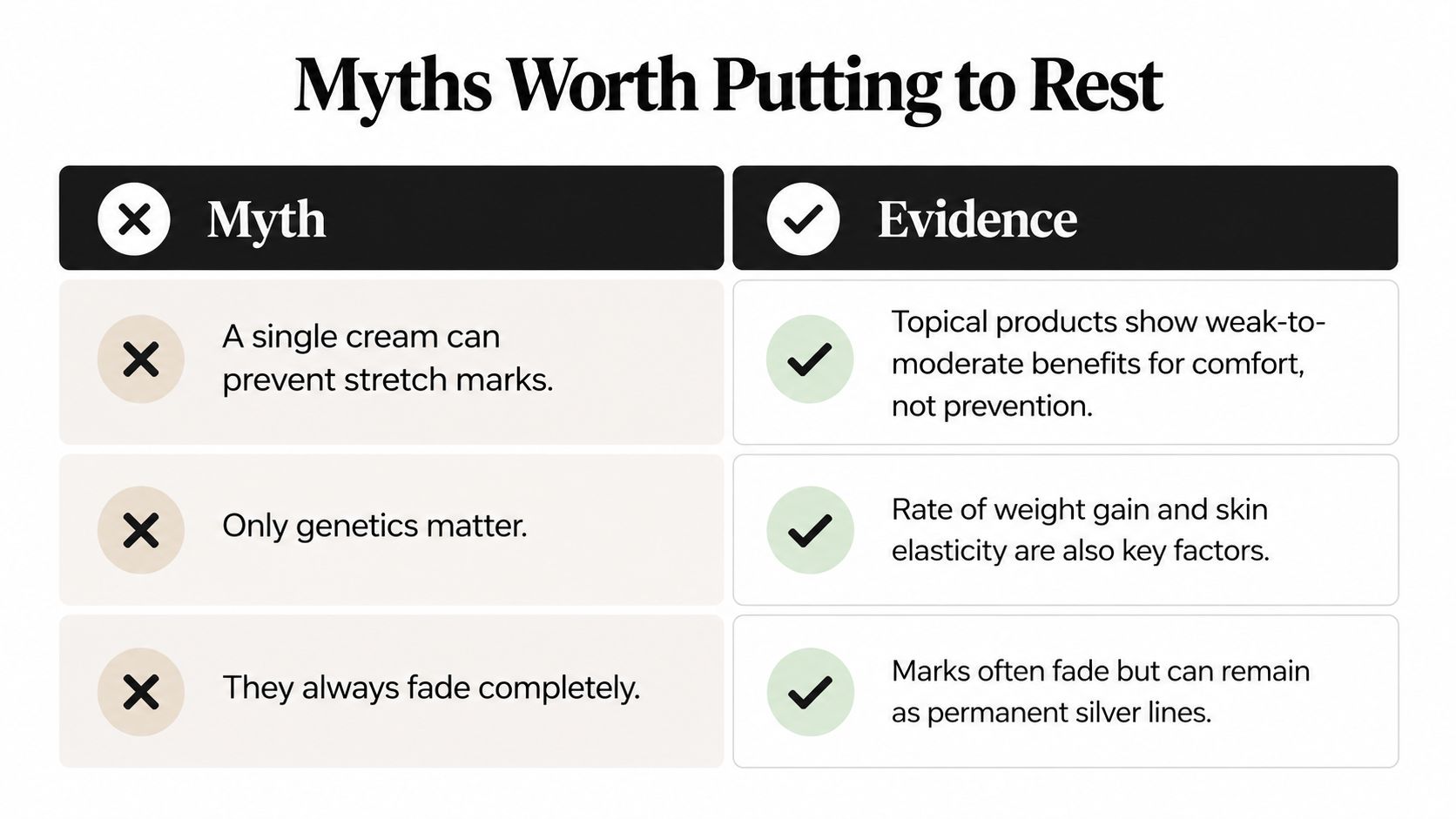
You may notice a new line after a shower and wonder whether the cream in your bathroom has failed. Stretch marks are not just a skincare scorecard. They reflect mechanical strain and hormonal changes in deeper skin, while products mainly affect the surface.
Myth one, one cream can prevent them
Cocoa butter, oils, and moisturisers can soften the skin and ease dryness or tightness. No single topical ingredient has been shown to reliably prevent pregnancy stretch marks. A product promising complete protection is claiming more than skincare can deliver.
Myth two, only creams matter
Creams work at the surface. Genetics, hormones, and the speed at which underlying tissue expands influence the dermis, the supportive layer beneath it. Daily care can improve comfort, but it cannot override those biological factors.
Myth three, nothing helps
That conclusion is also too broad. Gentle moisturising, avoiding irritation, and caring for newly changed skin can make itching and dryness easier to manage. These measures support comfort and appearance as marks mature, rather than reversing the process.
Myth four, they're always purely cosmetic
Most stretch marks are harmless, but “cosmetic” should not mean “ignore every unusual change.” The NHS describes them as generally harmless and notes that rare associated conditions can occur, including Cushing's syndrome. Changes that are widespread, unusually sudden, painful, very itchy, or accompanied by other symptoms deserve a conversation with a clinician. That is a question about your health, not a reason to keep buying creams.
Myth five, a previous pregnancy predicts the next
Each pregnancy combines hormonal shifts, tissue growth, and individual skin behaviour differently. Having no marks before does not guarantee the same outcome now. Previous marks do not determine their severity in every pregnancy either. Their appearance is information about how your skin responded during that pregnancy, not evidence that you caused a problem.
A Realistic Daily Care Routine for Changing Skin
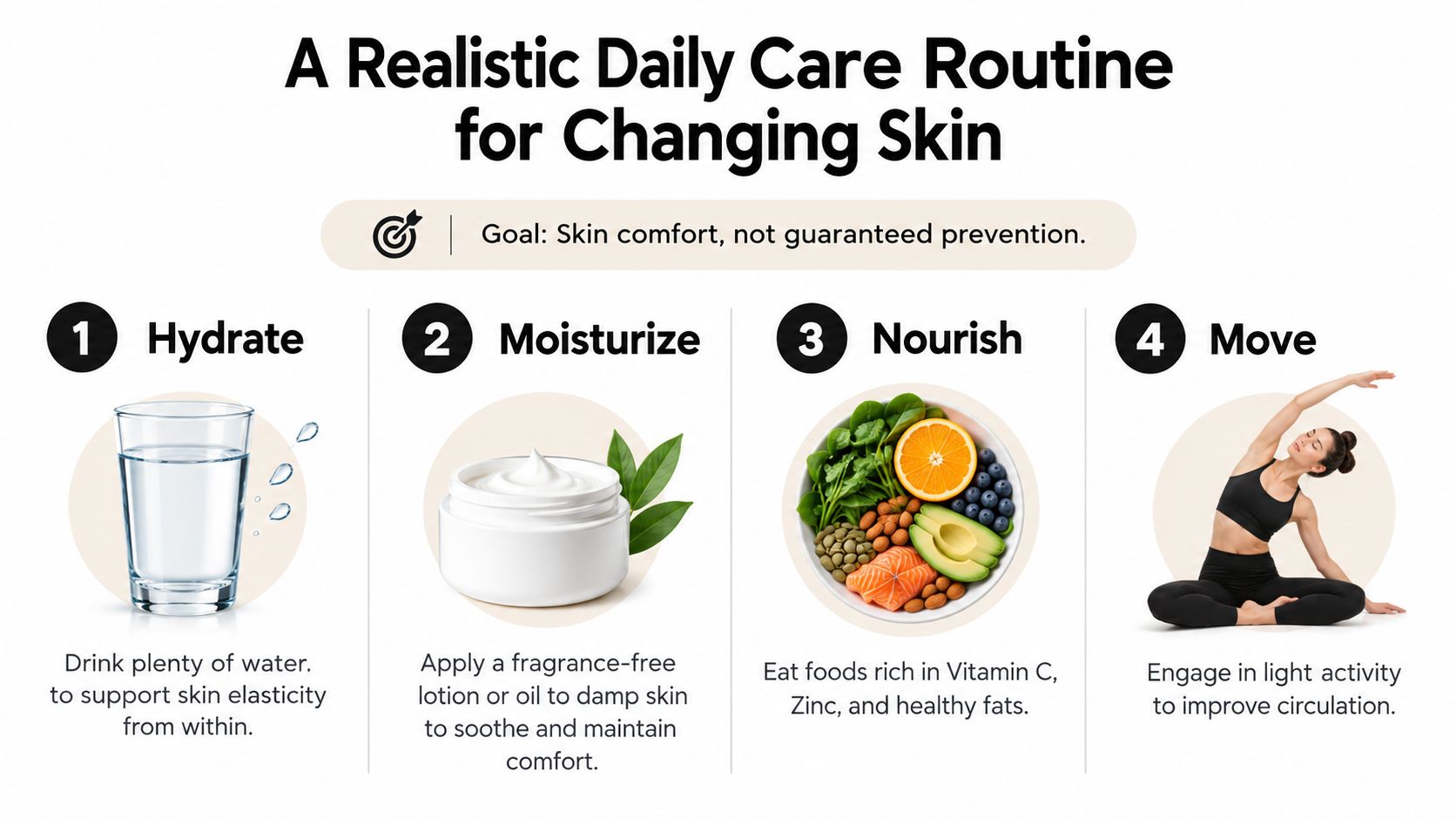
Treat skincare as a comfort and barrier-support routine, not an insurance policy against stretch marks. No topical product reliably prevents them, but calm, moisturised skin is less likely to feel tight, flaky, or irritated while your body changes.
Morning care
Use lukewarm water rather than a very hot shower, then choose a gentle, fragrance-free cleanser if you need one. Pat your skin dry instead of rubbing, leaving a little moisture on the surface.
Apply a fragrance-free moisturiser while the skin is still damp. Ingredients such as glycerin, hyaluronic acid, and panthenol help the product hold water near the surface. If your bump feels particularly dry, layer a simple occlusive product, such as shea butter, petrolatum, or squalane, over areas that need extra protection.
Evening care
A short evening massage can turn application into a soothing ritual, but use light pressure. The massage may help you notice changes and care for dry areas, though it shouldn't be described as a way to mechanically prevent marks.
Exfoliation needs restraint. A soft washcloth may be enough. If you use a mild alpha hydroxy acid product, keep it occasional and avoid fresh, inflamed, or sore skin. More exfoliation isn't better. Irritation can make itching and sensitivity harder to manage.
Centella asiatica, vitamin E, and hyaluronic acid appear in many stretch-mark products and may offer supportive benefits, but expectations should stay modest. Silicone-based gels are another option people discuss for newer marks, although pregnancy suitability and the evidence for your specific product should be checked with a clinician or pharmacist.
Support beyond the bathroom
Eat regular, varied meals that include protein and foods containing zinc, rather than taking high-dose supplements without medical advice. Drink according to your thirst and maternity guidance, and choose a supportive maternity bra if breast movement makes your skin uncomfortable. Use broad-spectrum SPF on exposed areas, because sun exposure can make colour differences more noticeable.
For a product-based routine, The Happy Bump Co offers a Belly Butter, Belly Oil for Stretch Marks, and Pregnancy Tummy Scrub designed for changing skin during pregnancy and beyond. You can compare that approach with this pregnancy skincare routine, then choose products based on comfort, ingredients, and advice from your maternity team.
Red Flags and When to Speak to a Clinician
You notice new lines on your bump after a restless night. They may be pink, red, purple, or darker than the surrounding skin, and can itch or feel slightly raised. That pattern often reflects skin adapting to pregnancy, rather than a separate illness.
Speak with your midwife or GP if the marks appear suddenly, spread unusually widely, or arrive with other symptoms. Stretch marks are usually harmless, but a pattern that looks different from ordinary lines can sometimes relate to an underlying condition or medication exposure. The appearance alone cannot explain the cause, so the surrounding symptoms matter.
Changes that need prompt attention
Contact your maternity service promptly if unusual purple marks occur with significant swelling of the face or hands, a severe headache, blurred vision, or upper abdominal pain. These symptoms can have pregnancy-related causes that need assessment. Treat the marks as one clue, not a diagnosis.
A raised, blistered, hive-like, intensely itchy, weeping, or crusted rash may not be a stretch mark. Pregnancy-specific skin conditions can resemble irritation or lines at first, yet require different care. A clinician can check whether the change is mechanical stretching, inflammation, or another condition.
Take photographs and ask
If you are unsure, photograph the area in good light and show it at an antenatal appointment. Record when you first noticed it, whether it is spreading, and whether itching, pain, swelling, or other changes appeared at the same time.
Reassurance is a valid reason to ask. A midwife, GP, or dermatologist can examine the skin and distinguish expected adaptation from a change that needs follow-up. Most marks are a skin event, not a threat, but pregnancy symptoms deserve attention when they do not fit the usual pattern.
The Happy Bump Co offers pregnancy-focused Belly Butter, Belly Oil for Stretch Marks, and Pregnancy Tummy Scrub to nourish and comfort changing skin, without promising to prevent every mark. Explore the range at The Happy Bump Co and choose a simple routine that feels supportive during pregnancy and beyond.