

You're lying in bed, rubbing the side of your bump because it won't stop itching. There are no obvious lines yet, just a persistent, irritating sensation where your skin feels tight. You may wonder whether it's your clothing, dry weather, or your imagination.
Often, the itch has a physical explanation. Stretch marks can begin changing in the deeper skin before they become visible, and dryness can make that early irritation feel stronger. Understanding why stretch marks itch also helps you separate ordinary discomfort from symptoms that deserve medical advice.
Table of Contents
- When the Itch Starts Before the Marks
- How Stretching Skin Actually Damages the Dermis
- The Four Triggers Behind Stretch Mark Itch
- Normal Itch Versus Itch You Should Not Ignore
- What the Evidence Says About Prevention and Treatment
- A Pregnancy-Safe Routine to Soothe Itchy Stretch Marks
- When to Call Your Midwife or GP
When the Itch Starts Before the Marks
Stretch-mark itch can appear before your mirror shows anything unusual. The NHS explains that an early sign of pregnancy stretch marks may be itchiness around skin that's becoming thinner. The Primary Care Dermatology Society also describes early striae as sometimes mildly itchy and connects them with continuous, progressive skin stretching.
That timing can feel confusing. You may expect a visible pink, purple, or pale line to appear first, followed by discomfort. In reality, changes in the supporting tissue beneath the surface can begin while the outer layer still looks normal.
What the sensation is telling you
Think of the skin around your abdomen, hips, breasts, and thighs as an area under increasing tension. As your body grows, the deeper support network has to accommodate that expansion. Small areas of irritation can stimulate nerve endings before a clear mark develops at the surface.
The itch may feel localised at first. It can be a faint prickling, a low-level tightness, or an urge to rub one particular patch. Rubbing can then make the area more sensitive, especially if the skin is already dry or exposed to friction from clothing.
Practical rule: An itch that arrives before visible lines isn't automatically imaginary or abnormal. It may be an early sign of skin stretching, but the pattern and any accompanying symptoms still matter.
The most useful way to understand the sensation is as a two-part story. Mechanical stretching affects the dermis, the deeper layer that gives skin much of its structure. At the same time, dryness can weaken the outer barrier and amplify the signals coming from an already-stressed area.
Most pregnancy itching is not caused by stretch marks alone, however. If the itch becomes severe, widespread, or appears without a rash, contact your midwife or GP rather than assuming it's skincare-related.
How Stretching Skin Actually Damages the Dermis
Your skin is easier to understand if you picture a mattress with layers. The top sheet represents the epidermis, the outer layer you can see and touch. Beneath it sits the dermis, a supportive layer containing collagen, elastin, blood vessels, and nerve endings. Under that is subcutaneous fat, the softer filling beneath the structural layers.
Stretch marks begin in the dermis, not in the outer surface. The Primary Care Dermatology Society describes striae as linear scars caused by continuous, progressive stretching of the skin. During pregnancy, expansion can place mechanical stress on the dermal support network.
A simple step-by-step model
- The body expands. The abdomen, breasts, hips, and other areas may enlarge over a relatively short period.
- The dermis takes the load. Collagen provides strength and structure, while elastin helps skin stretch and move back towards its usual shape.
- The support network becomes disrupted. Rapid or continuous stretching can damage and reorganise parts of the collagen-rich matrix.
- The surface appearance changes. Thinning in the dermis can allow underlying blood vessels to show through, making newer marks look pink, red, purple, brown, or darker than nearby skin, depending on skin tone.
- The area may itch. Local irritation and stimulation of dermal nerves can create an itch signal while the mark is forming.
A moisturiser can soften the epidermis and support its barrier, but it doesn't rebuild a damaged dermal matrix just by sitting on the surface. That's why a product can make tight skin feel more comfortable without guaranteeing that stretch marks won't appear.
For readers interested in the skin's structural support, this guide to collagen production provides further background. It's important to keep the distinction clear: supporting general skin health isn't the same as proving that a topical product can prevent pregnancy stretch marks.
A short visual explanation can also help make the layers and signals easier to follow.
The Four Triggers Behind Stretch Mark Itch
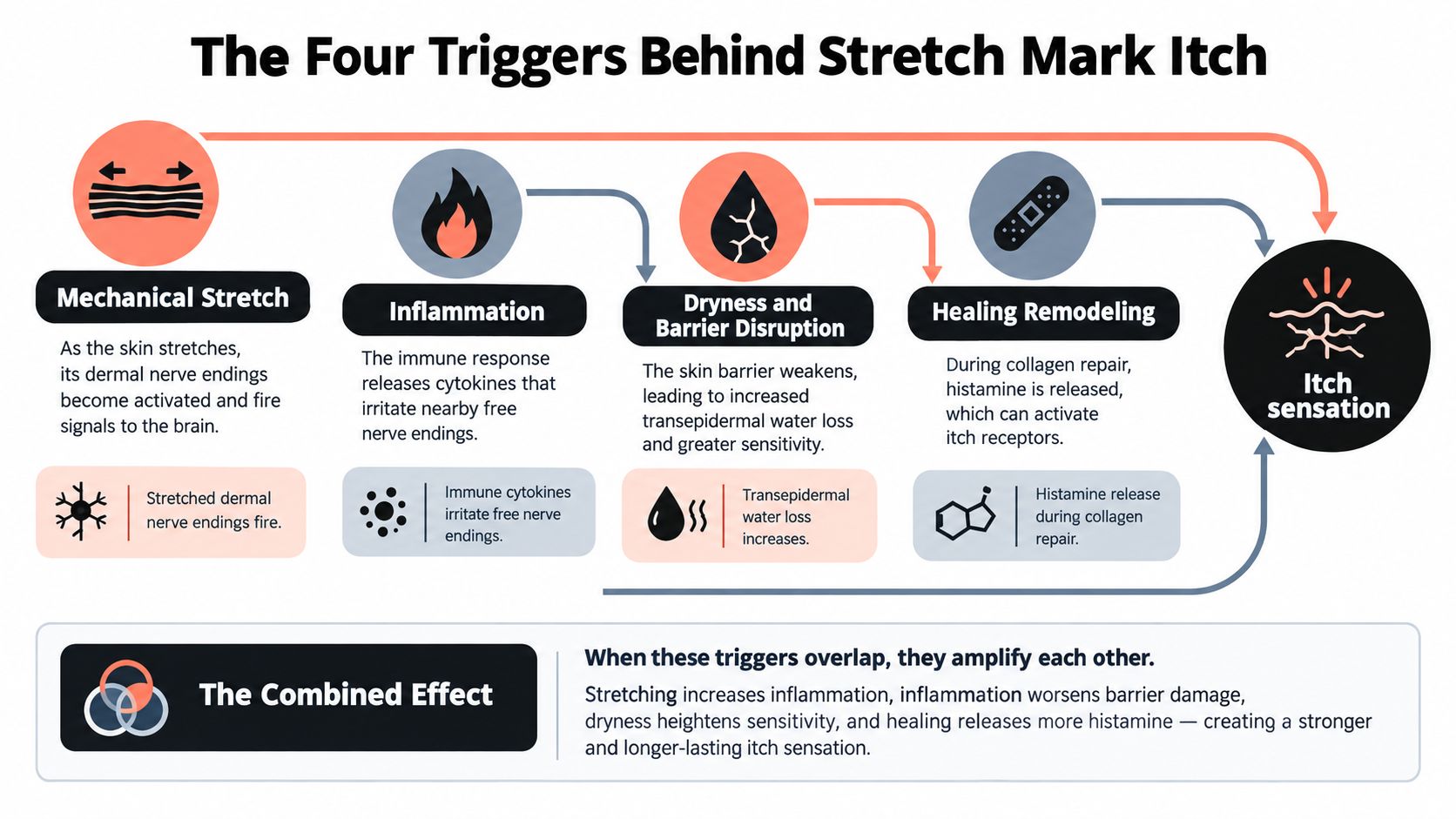
Why stretch marks itch isn't explained by one mechanism in every person. The sensation can come from several overlapping signals, with each one adding to the next.
Mechanical stretch
The dermis contains nerve endings that respond to changes in tension and tissue shape. When the skin is expanding, those nerves may register the deformation as pulling, tingling, or itching. This is the most direct explanation for why a particular area can itch even before a mark is easy to see.
The signal doesn't mean that the skin is dangerously tearing open. It means the deeper tissue is under strain and the local nerves are responding to that change.
Local irritation
Stretch-mark formation involves dermal injury and repair. The NHS describes stretch marks as common and harmless, while UK dermatology guidance links early lesions with dermal damage from stretching. A small local inflammatory response may add warmth, sensitivity, or itch to the mechanical sensation.
This is not the same as an infection. Inflammation is part of the body's ordinary response to tissue stress, but increasing redness, pain, heat, weeping, or crusting needs assessment.
Dryness and barrier stress
Dry skin acts as an itch amplifier. When the outer barrier loses water, it becomes less flexible and more reactive to rubbing, sweat, seams, and temperature changes. The stretch itself may be the original trigger, while dryness makes the signal harder to ignore.
This explains why two people can experience similar skin expansion but describe very different levels of discomfort. One person may notice mild tightness; another may feel persistent itching because dryness and friction are adding to the same area.
Healing and remodelling
The skin doesn't stop changing as soon as a line appears. The dermal tissue continues to settle and remodel, and the area may remain sensitive while that process is under way. Older marks usually become paler and less symptomatic, while newly forming marks are more likely to feel active, raised, tender, or itchy.
These triggers can overlap rather than taking turns. Stretch stimulates nerves, local irritation adds chemical signals, dryness lowers the skin's tolerance, and repair keeps the area sensitive.
The practical implication is reassuring but limited: moisturising may reduce the dryness component, but it can't remove the mechanical forces driving dermal change. Comfort care and prevention are separate questions.
Normal Itch Versus Itch You Should Not Ignore
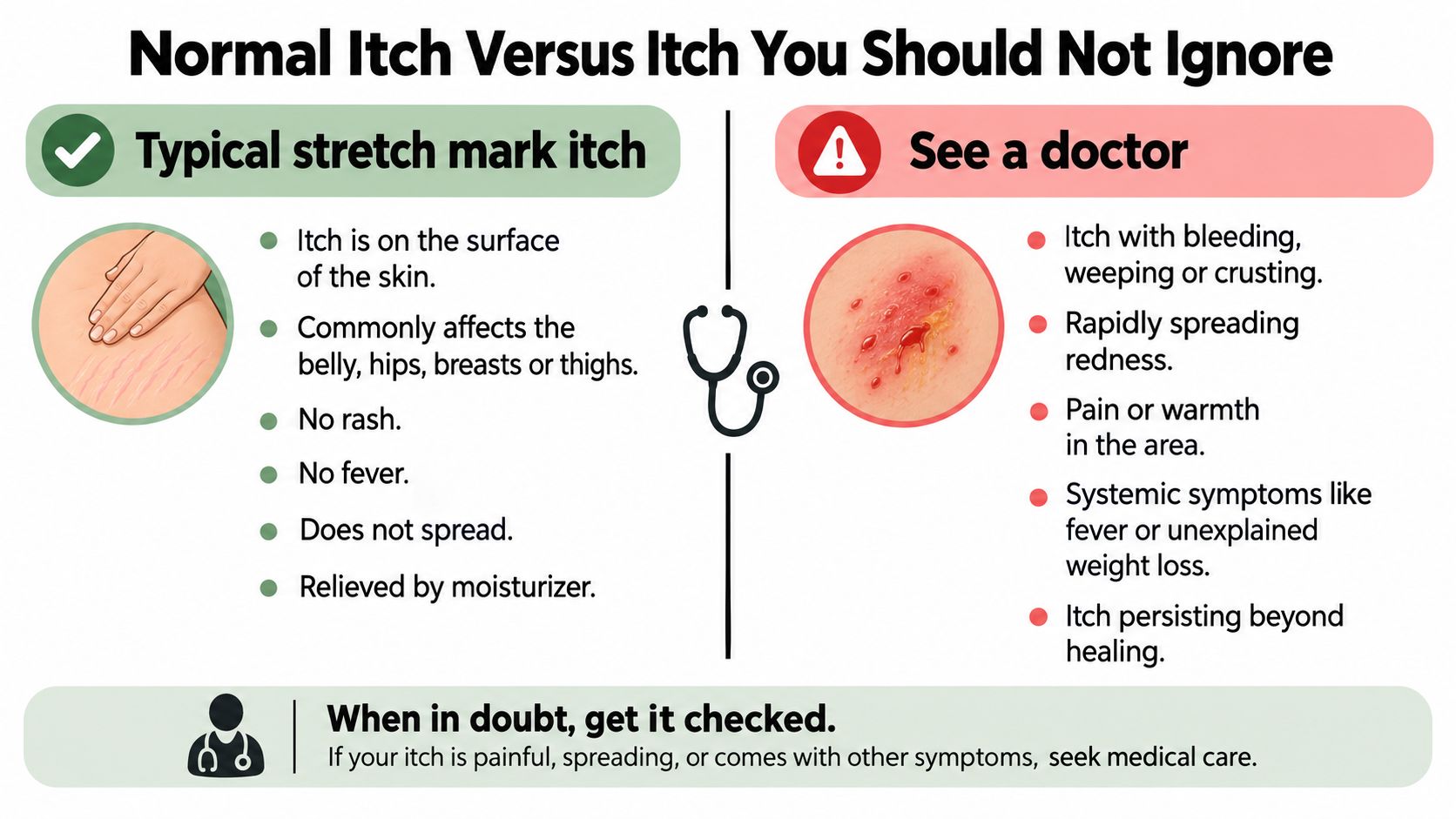
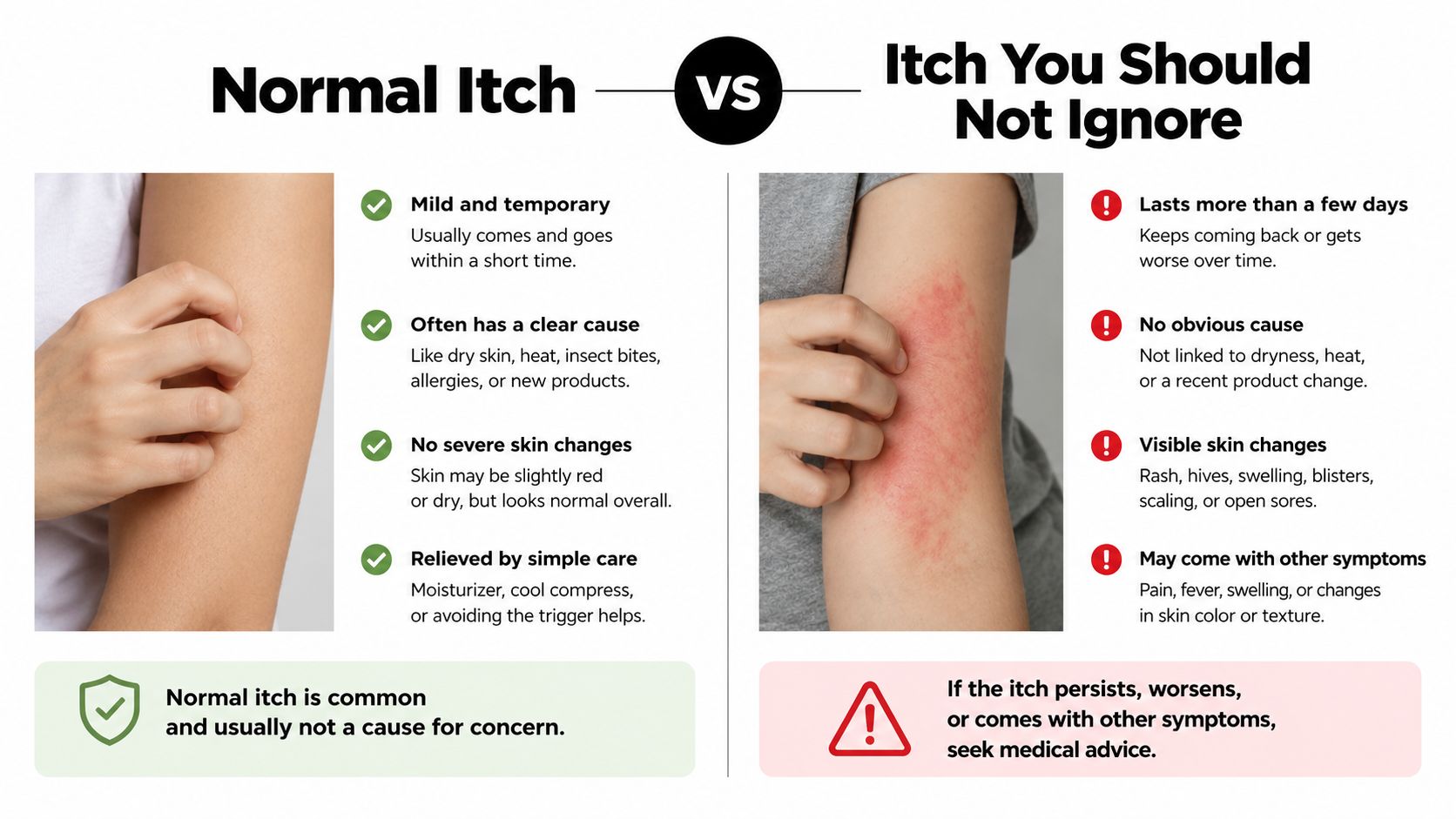
A short-lived itch over stretched skin is usually less concerning when it remains around the abdomen, hips, breasts, or thighs, without an unusual rash, and eases with gentle moisturising. The NHS advises pregnant people to seek medical help if itching becomes severe, widespread, or occurs without a rash.
The pattern matters more than the mere presence of itching. Stretch-mark irritation usually follows the area under tension, while a broader or changing pattern deserves prompt attention.
Features that fit ordinary stretch-related irritation
- Location: The sensation stays near skin that feels tight or is developing visible lines.
- Surface appearance: There is no spreading rash, marked swelling, or broken skin.
- Intensity: It feels irritating but manageable, without steadily escalating.
- Response: A cool room, loose clothing, or bland moisturiser makes it easier to tolerate.
- Course: It comes and goes rather than affecting the whole body.
Symptoms that need a call
The warning patterns are listed in full in the section on when to call your midwife or GP. One important distinction is itching that is especially strong on the palms or soles, particularly when it occurs without an obvious rash or follows a different pattern from the stretched skin.
Yellowing of the skin or eyes, dark urine, nausea, unusual fatigue, or pain high on the right side of the abdomen also need medical attention. These symptoms can occur with pregnancy-related liver conditions, including obstetric cholestasis, which is different from stretch-mark irritation. Creams cannot diagnose or treat that cause, so a clinician may arrange blood tests and monitoring.
You do not need to identify the cause before asking for help. These distinctions are there to clarify your next step, not to make you responsible for diagnosing the itch.
What the Evidence Says About Prevention and Treatment
If your skin feels tight and itchy, an oil may make the surface more comfortable. That does not mean it can prevent changes deeper in the skin. Pregnancy skincare often blends these two goals, so keep soothing itch and preventing stretch marks separate. Stretch marks are common, usually harmless, and often fade after birth. Creams and oils have not been shown to reliably prevent or remove them.
Retinoids require particular caution. Avoid retinoid creams during pregnancy unless a qualified clinician gives specific advice. They may be considered for some newer stretch marks outside pregnancy, but pregnancy changes the safety decision.
Evidence at a glance
| Approach | Evidence in pregnancy |
|---|---|
| Fragrance-free moisturiser | Supports the outer skin barrier and may reduce water loss linked with dryness. It has not been proven to prevent stretch marks. |
| Pregnancy body oil | Occlusive oils can reduce transepidermal water loss when applied to damp skin. No pregnancy trial has shown that they prevent striae. |
| Retinoid cream | Avoid during pregnancy unless a qualified clinician recommends it. |
| Laser, microneedling, or similar procedures | Not routine pregnancy treatments. Discuss cosmetic procedures with a dermatologist after pregnancy. |
| Massage | Can spread a product evenly and provide gentle sensory relief, but pressure should stay comfortable. It is not a guaranteed preventive treatment. |
Genetics, hormonal changes, and the amount and speed of skin expansion all influence risk. A routine can support the skin's surface and make itching easier to tolerate, while the deeper dermal response remains partly outside your control.
For a closer examination of the claims made about oils, read what stretch-mark oil can and can't do. Check whether the formulation suits pregnancy, whether it helps with dryness, and whether its promises match the available evidence.
A Pregnancy-Safe Routine to Soothe Itchy Stretch Marks
A reliable routine should reduce irritation without promising to rewrite the deeper biology of stretch marks. Keep it simple enough to repeat, because frequent changes and heavily fragranced products can make it harder to identify what your skin tolerates.
Start gently in the bath or shower
Use lukewarm water rather than very hot water. Heat can leave the outer barrier feeling drier, while vigorous scrubbing can aggravate already sensitive areas.
Wash with a mild, fragrance-free cleanser where you need it. You don't need to exfoliate an itchy bump to make it healthier. On irritated skin, scrubbing can create more friction and prolong the discomfort.
Seal in moisture
After bathing, pat rather than rub. Leave the skin slightly damp, then apply a fragrance-free emollient while that moisture is still on the surface.
Look for familiar barrier-supporting ingredients such as:
- Glycerin: Helps attract water to the outer skin.
- Shea butter: Adds a rich, protective feel to dry areas.
- Ceramides: Support the skin barrier in suitable formulations.
- Colloidal oatmeal: Can be comforting for dry, itchy skin.
- Mineral oil: Forms an occlusive layer that helps reduce water loss.
A plain cream may suit you better than an oil, particularly if you're prone to blocked pores or dislike a greasy finish. If you prefer an oil, apply a small amount to damp skin and stop if it causes stinging, redness, or a new rash.

Reduce friction through the day
Choose breathable clothing with soft seams around the bump and hips. If fabric is irritating one particular area, change it rather than scratching through the clothing.
Keep nails short and use a cool compress for a few minutes when the urge to scratch is strong. Scratching can break the surface and turn a manageable itch into soreness, scabbing, or infection risk.
Check the active ingredients
Avoid retinoids during pregnancy, and be cautious with high-concentration salicylic acid, concentrated essential oils, and unlabelled herbal blends. “Natural” doesn't automatically mean gentle or pregnancy-suitable, and a product's full ingredient list matters more than its marketing name.
For more practical ideas, these pregnancy-itching tips can sit alongside advice from your midwife or GP. Consistent, low-irritation care is more sensible than searching for a miracle product.
When to Call Your Midwife or GP
Most stretch-related itching can be managed calmly at home, but some patterns need professional assessment. Contact your midwife or GP promptly if you notice:
- Palms or soles: Intense itching in these areas, particularly if there's little or no rash.
- Night-time disruption: Itching that repeatedly prevents sleep or becomes markedly worse at night.
- Widespread symptoms: Itch across much of your body, or a spreading rash that doesn't look like ordinary stretch marks.
- Liver-related signs: Yellow skin or eyes, dark urine, pale stools, nausea, unusual fatigue, or pain in the upper-right abdomen.
- Inflamed skin: Raised bumps with fever, rapidly spreading redness, warmth, significant pain, bleeding, weeping, or crusting.
The NHS pregnancy guidance on itching and stretch marks supports seeking care when itching is severe or widespread, or when it appears without a rash. You don't need to wait until you can identify the cause.
What happens after you make contact
During office hours, call your midwife first and describe where the itching is, how severe it feels, whether it's worse at night, and whether you have a rash. Out of hours, use NHS 111 for guidance. If you have severe systemic symptoms or feel acutely unwell, seek urgent help through A&E.
Your clinician may examine your skin and arrange blood tests, including liver function and bile acids, if pregnancy-related cholestasis is a concern. They may also ask about urine, nausea, fatigue, pain, and changes in skin or eye colour. These checks help separate ordinary skin discomfort from conditions that need monitoring.
Obstetric cholestasis is uncommon, but pregnancy itching with the warning pattern is time-sensitive enough to check. Calling doesn't make you a nuisance. It gives your care team the information needed to decide whether reassurance, skin treatment, testing, or follow-up is appropriate.
The Happy Bump Co offers bump-focused body care, including Belly Butter, Belly Oil for Stretch Marks, and Pregnancy Tummy Scrub, for daily moisturising and comfort on changing skin. If your itch is linked to dryness or tightness, explore The Happy Bump Co and choose a gentle routine while contacting your midwife about any warning symptoms.