

The most popular advice about the best body tightening cream starts in the wrong place: it asks which product lifts skin most, as though a lotion can reverse substantial looseness. A more useful question is what a cream can realistically change, and whether its formula suits your skin and, if relevant, pregnancy or breastfeeding.
Topical moisturisers can improve dryness, softness and surface smoothness. That can make skin look temporarily plumper or firmer, but it isn't the same as structural tightening. For shoppers in the UK, the sensible comparison starts with the ingredient list and a realistic goal, not the boldest claim on the jar.
| What you want | What a cream may reasonably support | What to compare |
|---|---|---|
| Less dryness and tightness | Better hydration and comfort | Humectants combined with occlusive lipids |
| Smoother-looking skin | A softer, more even surface | A tolerable formula suitable for regular use |
| Pregnancy-conscious body care | Daily moisturisation with careful ingredient screening | Full INCI list, fragrance level and suitability guidance |
| A lasting change to loose skin | A topical cream can't be assumed to provide this | Ask a qualified clinician about appropriate options |
Table of Contents
- What Body Tightening Creams Can and Cannot Do
- The Ingredient Architecture That Actually Matters
- Firming Actives Worth Comparing and Those to Skip
- Pregnancy and Breastfeeding Safety Screening
- Creams Versus Non-Topical Alternatives
- Matching the Right Option to Your Situation
- A Four-Week At-Home Evaluation Protocol
- Choosing the Best Body Tightening Cream for You
What Body Tightening Creams Can and Cannot Do
No over-the-counter cream should be assumed to physically tighten lax skin. A moisturiser can make the outer skin layer feel more comfortable and look smoother, but that surface effect isn't proof of collagen remodelling or a lasting change in loose skin. The distinction matters after pregnancy or significant weight loss, when a marketing phrase such as “lifting” can suggest more than a cosmetic product has demonstrated.
The British Association of Dermatologists explains that emollients smooth and hydrate skin while forming an artificial barrier that helps lock in moisture. That gives shoppers a credible benchmark: assess whether a product supports hydration and comfort, rather than treating “firming” on the label as evidence of structural change. The BAD's guidance on moisturisers and skin-barrier care is a useful starting point.
Read claims as evidence questions
UK advertising guidance says efficacy claims need strong evidence, and beauty-product evidence will usually include at least one controlled human study. A claim that skin improves within a stated timeframe, or becomes progressively tighter, needs substantiation that matches the specific promise. The Advertising Standards Authority's guidance for beauty and cosmetics gives the relevant standard.
For a stronger tightening claim, the useful question is whether the finished product was tested on people against a control, with objective measurements. An ingredient's reputation isn't the same as evidence for the formula containing it.
Before-and-after pictures deserve the same scrutiny. Lighting, posture, camera angle, skin hydration and the way a person stands can change the appearance of an image. A smoother-looking result may be real as a cosmetic effect without proving that loose skin has physically tightened.
A practical filter: Treat “softer”, “smoother” and “more hydrated” as moisturising outcomes. Treat “lifts loose skin” as a claim that needs product-specific evidence.
For readers comparing the best body tightening cream, this distinction isn't a reason to dismiss moisturisers. It helps identify the outcome a cream is most defensibly chosen for: improved surface comfort and appearance, not a substitute for structural treatment.
The Ingredient Architecture That Actually Matters
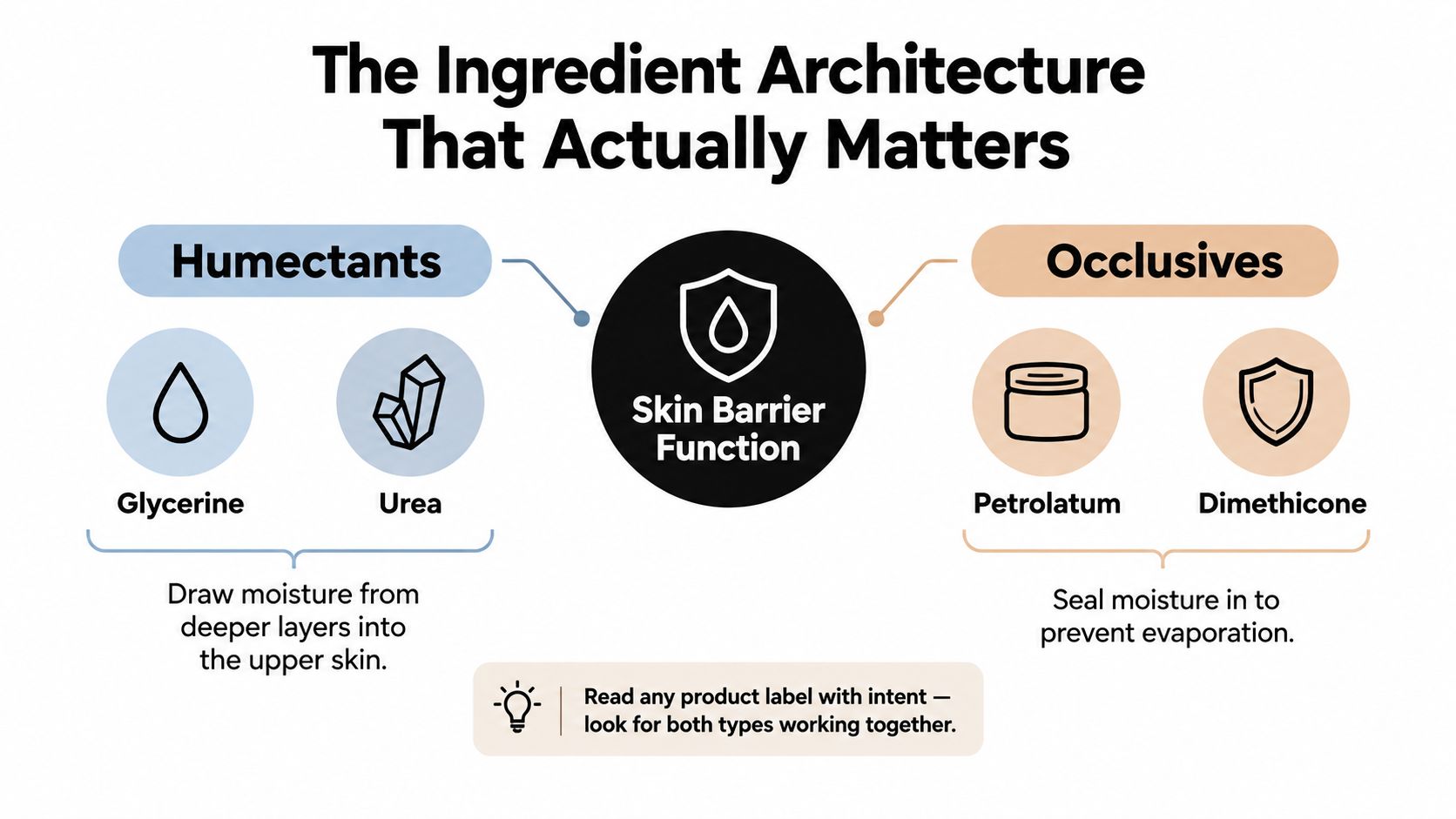
A useful body cream doesn't need a long list of fashionable actives. Start by looking for a combination of ingredients that draw water into the upper skin and help reduce its loss. The British Dermatological Nursing Group describes moisturisers as lipid emulsions combining humectants, commonly glycerine or urea, with occlusive lipids. Its explanation of how moisturisers work supports a more practical comparison than choosing by a single “firming” botanical.
Read the INCI list as a system
Humectants such as glycerine and urea draw water into the epidermis. Occlusives, including lipid-based ingredients, help limit transepidermal water loss by forming a barrier on the skin. Emollients soften and smooth the surface, helping a formula feel comfortable to spread.
Look for a humectant towards the upper portion of the ingredient list, supported by emollient oils or lipids. Ingredient order can help you understand the formula's architecture, but it doesn't tell you the exact concentration of each ingredient or prove a particular result. The point is to assess the combination, rather than to treat one star ingredient as the whole product.
Texture matters because a body moisturiser has to fit daily use over a relatively large area. If a cream feels unpleasant, stings, or leaves skin too uncomfortable, you're less likely to use it consistently. For dry or sensitive skin, a gentle, non-perfumed formula may be a more defensible choice than a heavily scented lotion with a dramatic firming promise.
How to assess a product at the shelf:
- Find the humectant: Check for glycerine or urea among the listed ingredients.
- Look for supporting lipids: Oils or other occlusive ingredients can complement the water-attracting component.
- Consider repeat use: Choose a texture that feels manageable for the areas you plan to moisturise.
- Check fragrance and tolerance: People with sensitive or dermatitis-prone skin may prefer gentle, non-perfumed moisturisers.
For a deeper look at peptide terminology, this guide to peptides for skin can help put a popular “firming” ingredient category in context. Peptides don't replace the basic question of whether the overall formula supports comfortable daily moisturisation.
Firming Actives Worth Comparing and Those to Skip
A “firming” active is worth comparing only when its intended job matches your concern. Roughness, dryness and loose skin call for different assessments. The useful distinction is between an ingredient marketed for firmness and one selected for surface texture. For claim terminology, consult ASA's beauty and cosmetics guidance.
Compare the active's intended job
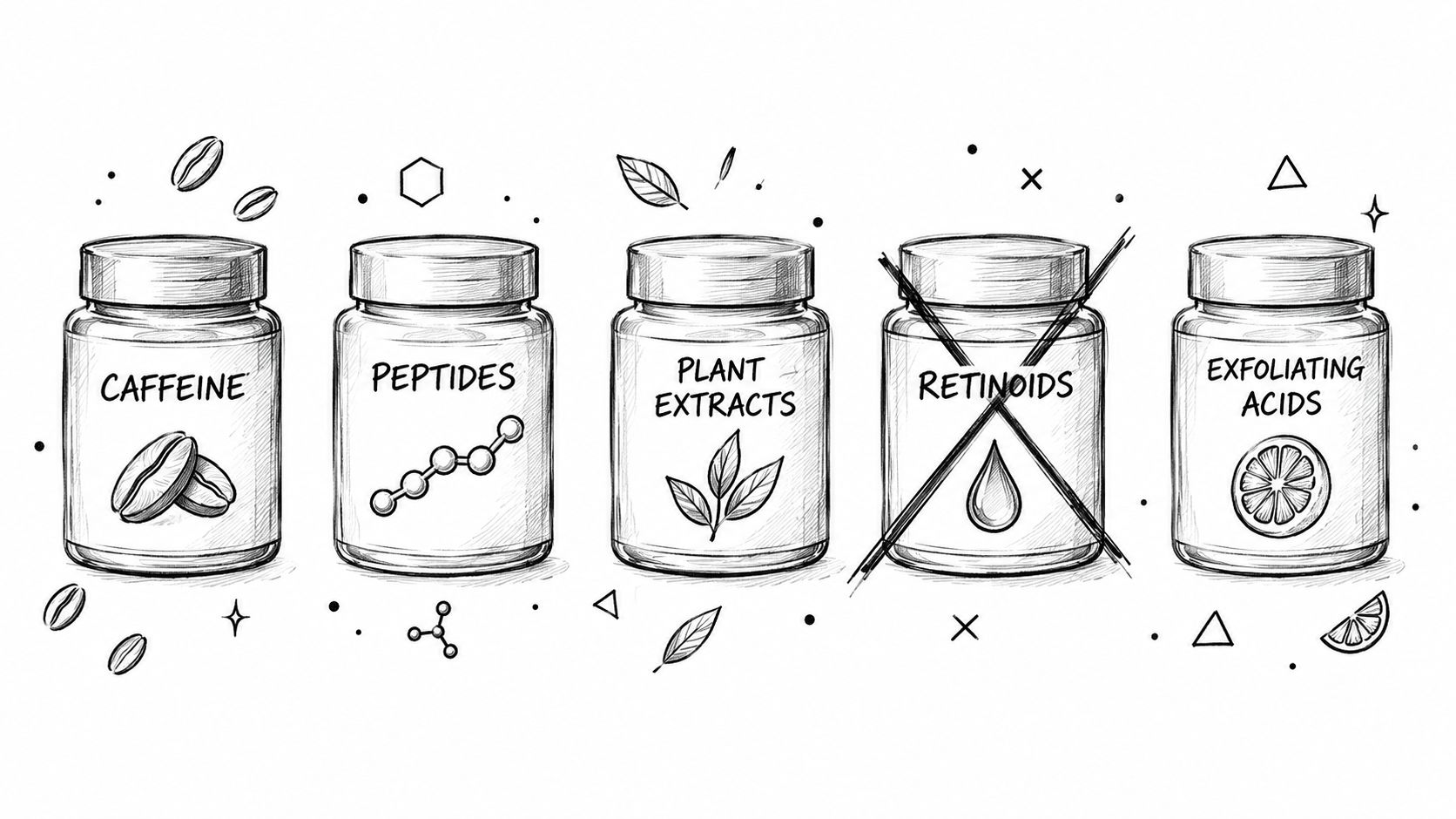
Caffeine commonly appears in products marketed for a firmer-looking body contour. Separate that cosmetic appearance claim from a promise to reduce skin laxity. If supporting material describes only smoother-looking skin, keep your expectations within that outcome.
Plant extracts need more scrutiny than a botanical headline allows. Check which extract the INCI list names and what benefit the seller assigns to it. “Plant-powered firmness” gives you little basis for choosing between creams; skip that selling point when the ingredient and intended effect remain vague.
Peptides are marketed through their association with skin firmness, but the category name conceals differences between ingredients. Look for the named peptide rather than accepting “peptide complex” as sufficient detail. A peptide appearing after fragrance deserves questions about its role, although ingredient order alone cannot establish its concentration or make it ineffective.
Retinoids belong in a texture-focused comparison with a separate suitability check. Their inclusion should prompt pregnancy screening before purchase, rather than make a cream automatically more desirable. During pregnancy, avoid retinoid-containing creams unless a clinician specifically advises otherwise.
Exfoliating acids target rough surface texture. Smoother skin can look more even without becoming less loose. Stronger exfoliation also carries a tolerance trade-off, particularly for reactive or pregnancy-sensitive skin, so skip an acid-led option if roughness is not your concern.
This explainer provides context for assessing ingredient-led skincare language:
The analyst's test: Write down the outcome you want before comparing actives. Assess hydration through softness and comfort, exfoliation through roughness, and any tightening promise through a clearly defined change in laxity. Avoid paying for a claim that answers a different concern.
Pregnancy and Breastfeeding Safety Screening
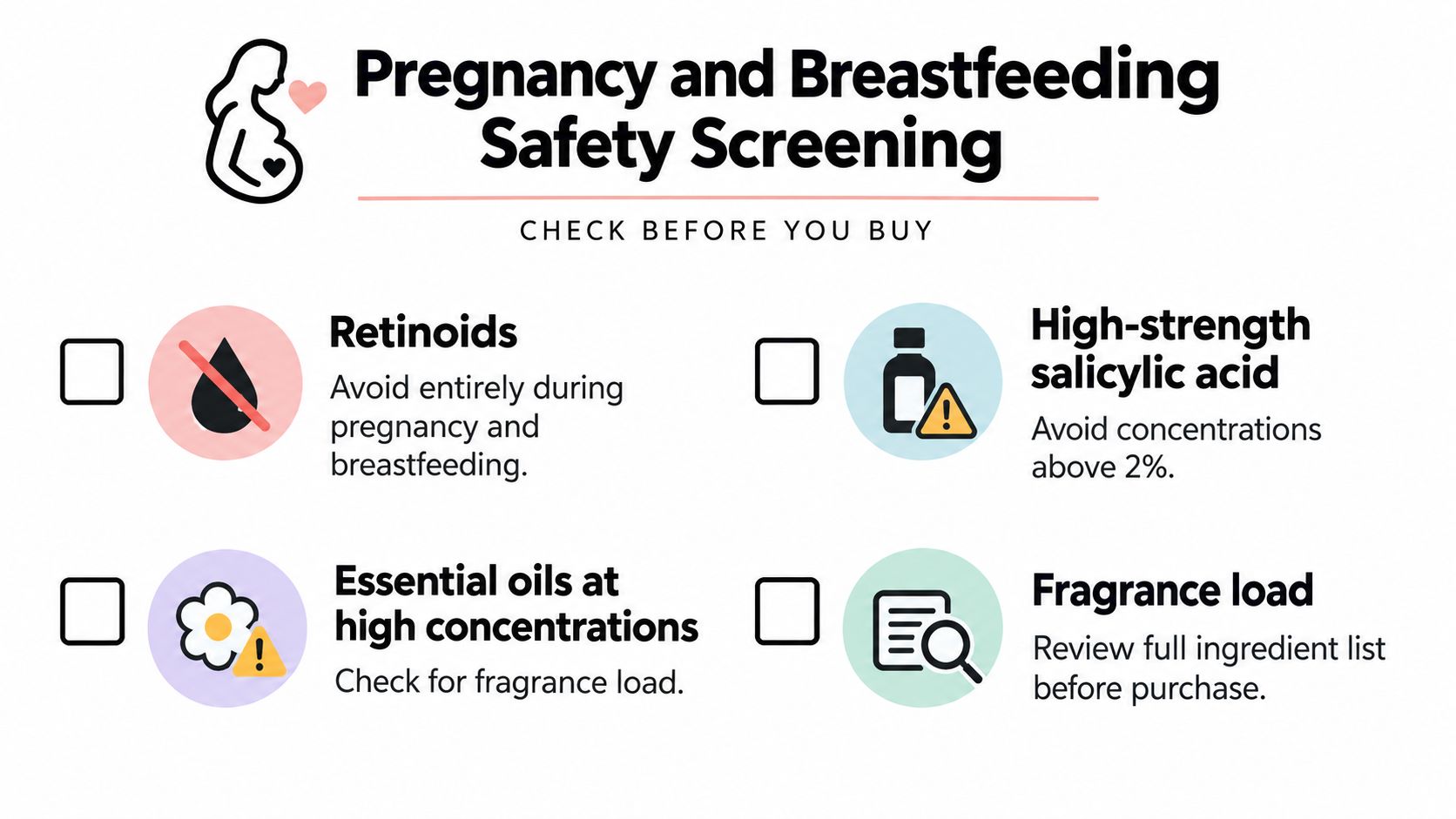
When you're pregnant, ingredient suitability comes before comparing firming claims. A product designed for daily use over a large body area deserves careful label-checking, especially if you have sensitive skin or are unsure about an active. Pregnancy guidance advises avoiding topical retinoids as a precaution, and recommends caution with extensive or frequent use of salicylic-acid products on the body. UK pregnancy skincare guidance from Holland & Barrett offers a practical overview.
Screen first, compare later
Use a pre-purchase check rather than relying on a front-label promise:
- Check for retinoids: Look for retinol, retinal, tretinoin, adapalene and other retinoid ingredients. UK government guidance says topical retinoids are contraindicated during pregnancy as a precaution because risk cannot be excluded, despite low expected systemic exposure. The government's retinoid pregnancy-prevention guidance explains the precautionary approach.
- Review exfoliating acids: Be cautious about extensive or frequent use of salicylic-acid body products during pregnancy. If you can't establish whether a product is suitable, ask a clinician before using it.
- Read the whole INCI list: Don't rely on the product name or a short highlighted-ingredient panel. Transparent labelling makes it easier to spot ingredients you intend to exclude.
- Assess fragrance and irritation potential: A fragrance-free or low-fragrance moisturiser may be easier to tolerate, particularly on sensitive or dermatitis-prone skin.
An exclusion screen isn't a contest to find the most “natural” formula. It's a way to rule out ingredients or products that don't fit your circumstances, then compare the remaining options on comfort, moisturising architecture and suitability for repeated use.
Don't treat hydration as proof that a cream prevents stretch marks or permanently tightens skin. A moisturiser may improve suppleness, scaling or perceived texture, but that doesn't establish either outcome. Patch-test a new product, stop if burning or a rash develops, and ask a midwife, GP or dermatologist when pregnancy or breastfeeding safety is uncertain.
Creams Versus Non-Topical Alternatives
A body cream is easiest to justify when the goal is skin comfort or a smoother-looking surface. Other goals may call for a different approach. Exercise or physiotherapy-led pelvic floor and core work can support strength and function, while substantial excess skin is a separate concern for a qualified clinician to assess.
| Goal | Best-fit approach | Why |
|---|---|---|
| Comfort from dryness or tightness | Regular moisturiser | Hydration and barrier support are realistic topical aims |
| Smoother-looking surface | A tolerable cream used consistently | Moisturising can improve softness and perceived texture |
| Strength and function after pregnancy | Exercise or physiotherapy-led guidance | These approaches address movement and function rather than surface hydration |
| Major loose-skin concern | Clinical discussion | A cream shouldn't be expected to remove substantial excess skin |
The table isn't a ranking of what matters most. It separates different needs so a moisturiser doesn't end up carrying the burden of a problem it can't address. A person can reasonably use a cream for comfort while also seeking help with movement, strength or a concern about significant laxity.
Choose by outcome, not by label: If the goal is a softer feel, compare moisturisers. If the goal is functional recovery, discuss suitable movement or physiotherapy. If you're concerned about pronounced excess skin, seek an individual clinical assessment.
For readers interested in the biology behind collagen-related skincare claims, this overview of collagen production offers further context. It shouldn't be read as evidence that applying a cream will deliver structural tightening.
The pressure to “fix” a postpartum body can make strong topical claims sound compelling. A more balanced routine treats moisturiser as one layer of care, not a test of effort or a substitute for professional advice. The right choice may be a simple formula used for comfort, alongside another approach that better matches the reader's actual goal.
Matching the Right Option to Your Situation
The best body tightening cream depends on why you're shopping. An expectant mum seeking relief from dry, stretched-feeling skin needs a different decision from someone hoping to address significant looseness after weight loss. The same jar can be useful for one goal and disappointing for another.
An expectant mum focused on comfort: She starts with the pregnancy screen, excluding retinoids and checking any product's guidance on acids. Then she looks for a gentle formula with a humectant supported by emollient or occlusive ingredients. Her aim is comfortable, hydrated skin, not proof that a cream will prevent stretch marks.
A new mum six months postpartum: She wants her abdominal skin to feel softer and look smoother. A fragrance-free or low-fragrance moisturiser with a suitable humectant-plus-lipid system is a defensible trial if it feels comfortable. If she's concerned about recovery or core function, a cream won't replace advice from a physiotherapist or another qualified professional. This postpartum belly skin-care guide offers related care context.
A reader after significant weight loss: He or she may have a specific concern about skin that hangs or folds. A moisturiser can still support surface comfort, but the reader shouldn't expect it to remove excess skin. A conversation with a clinician is more appropriate for assessing whether a non-topical option fits the concern.
These are decision scenarios, not promised outcomes. In each one, the first question is whether the skin needs hydration, a change in routine, or assessment for something beyond a cream.
A product's texture and fragrance can also affect whether it feels suitable for regular use. Someone who dislikes a sticky finish may abandon a rich formula, while someone with irritation-prone skin may prefer to avoid fragrance. That doesn't make one texture universally superior. It makes tolerability part of the comparison.
For pregnancy-focused body care, The Happy Bump Co's Belly Oil for Stretch Marks is a topical product intended for areas prone to stretching, including the belly and breasts. As with any body-care product, assess the ingredient list and suitability for your circumstances rather than treating its purpose as proof of stretch-mark prevention or tightening.
A Four-Week At-Home Evaluation Protocol
A product trial can help you decide whether a cream improves your dryness, tightness, itch or perceived smoothness. It can't establish structural skin tightening, but a consistent method is more useful than relying on memory or a single photograph. Before starting, check the ingredient list and suitability, especially if you're pregnant, breastfeeding or prone to irritation.
Keep the comparison simple
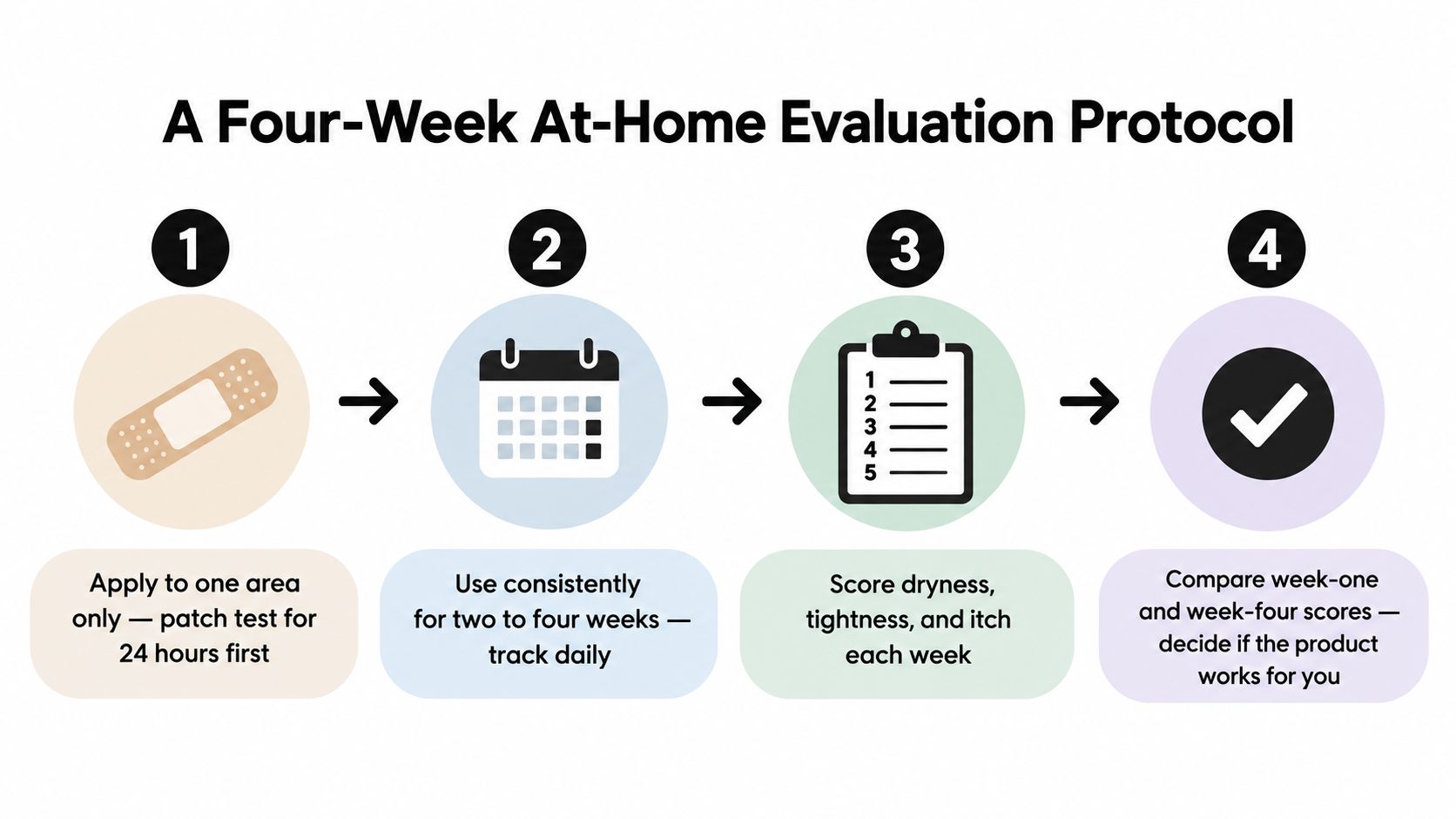
First, patch-test. Apply the product to a small area and wait before using it more widely. If it causes burning or a rash, stop rather than pushing through discomfort.
Next, choose one body area and apply the cream consistently for two to four weeks. If possible, leave a comparable patch untreated so you have a reference. Keep other products and routines steady during the trial, because changing several things at once makes the result harder to interpret.
Record dryness, tightness and itch on a 0–10 scale, using the same scale each time. Take photographs under identical lighting and in the same position if you want a visual record. Consistency matters more than an elaborate setup.
| What to track | How to keep it consistent |
|---|---|
| Dryness | Use the same 0–10 rating each time |
| Tightness | Score at a similar time of day |
| Itch | Note whether it changes or worsens |
| Appearance | Photograph under identical lighting and positioning |
At the end, compare your notes and images with the untreated area. A change in comfort or visible smoothness may support keeping the product in your routine. It doesn't demonstrate lasting collagen change or prove that the cream physically tightened loose skin.
If irritation develops, discontinue use. If you're pregnant or breastfeeding and uncertain about an ingredient, or if symptoms persist, speak with a midwife, GP or dermatologist. The purpose of a trial is to make a more informed personal choice, not to override safety advice.
Choosing the Best Body Tightening Cream for You
A defensible shortlist starts with your goal. If you want relief from dryness or a smoother surface, prioritise a comfortable formula that combines humectants with supporting emollient or occlusive ingredients. For pregnancy or breastfeeding, screen the full INCI list before comparing firming claims, and ask a clinician if suitability isn't clear.
Then judge the promise. “Hydrates” and “softens” are not the same as “tightens loose skin”; stronger claims call for product-specific evidence. If structural change is the goal, don't assume a cream can deliver it.
Finally, trial a suitable product consistently and record changes in comfort and appearance. The best body tightening cream for you may be a gentle moisturiser that you'll use regularly, rather than an aggressive formula whose claims outrun its evidence. That's a more reliable basis for choosing than a “lift” label alone.
The Happy Bump Co offers pregnancy-focused body care, including Belly Butter, Belly Oil for Stretch Marks and Pregnancy Tummy Scrub, formulated to nourish changing skin. If you're comparing gentle moisturising options for your routine, visit The Happy Bump Co to explore the range.