

You're standing in a UK skincare aisle with two tubs in your hands. One promises a smoother bump, another says “natural”, and both look rich enough to rescue dry skin. The price difference is obvious, but the formulation difference is hidden in tiny print on the back.
That's the problem with shopping for body butter in the UK. “Butter” describes a texture and marketing position, not a guaranteed level of hydration, comfort or pregnancy suitability. The useful questions are more practical: what's in the jar, how does the formula moisturise, and does the brand's “pregnancy-safe” claim mean anything beyond a reassuring label?
Table of Contents
- What to Know Before You Buy a Body Butter in the UK
- What Body Butter Actually Is and How It Works
- Why and When to Reach for a Body Butter
- Reading the Label Like a Formulator
- Pregnancy-Safe Body Butter in the UK
- Where to Buy Body Butter in the UK
- Matching Body Butter to Your Skin and Stage
What to Know Before You Buy a Body Butter in the UK
Start with the product's job. A body butter is a leave-on moisturiser designed to soften skin and reduce moisture loss, but formulas vary widely. One may be mostly plant butters and oils, another may be a cream containing water, humectants, emulsifiers and preservatives, while a third may be a fragranced balm with little emphasis on hydration.
You don't need to become a cosmetic chemist before buying a tub. You do need to ask four questions:
- What skin feel do you want? Rich formulas suit tight, dry areas, while lighter emulsions work better if you dislike a greasy finish.
- What does the ingredient list show? Look beyond the front label and check the order and presence of humectants, oils, butters and fragrance.
- How will you use it? A product applied over the bump every day needs a different comfort profile from a balm reserved for elbows and heels.
- Can the pregnancy claim be supported? “Natural”, “clean” and “free from” slogans don't replace a full formula review.
The commercial context is strong, but growth shouldn't make you lower your standards. The Cosmetic, Toiletry and Perfumery Association's UK sector figures report £10.3 billion in UK toiletries and beauty sales in 2024, an 8.4% year-on-year increase, with skincare sales rising 12.2%. That gives shoppers plenty of choice, not a reason to assume every premium-looking jar is well formulated.
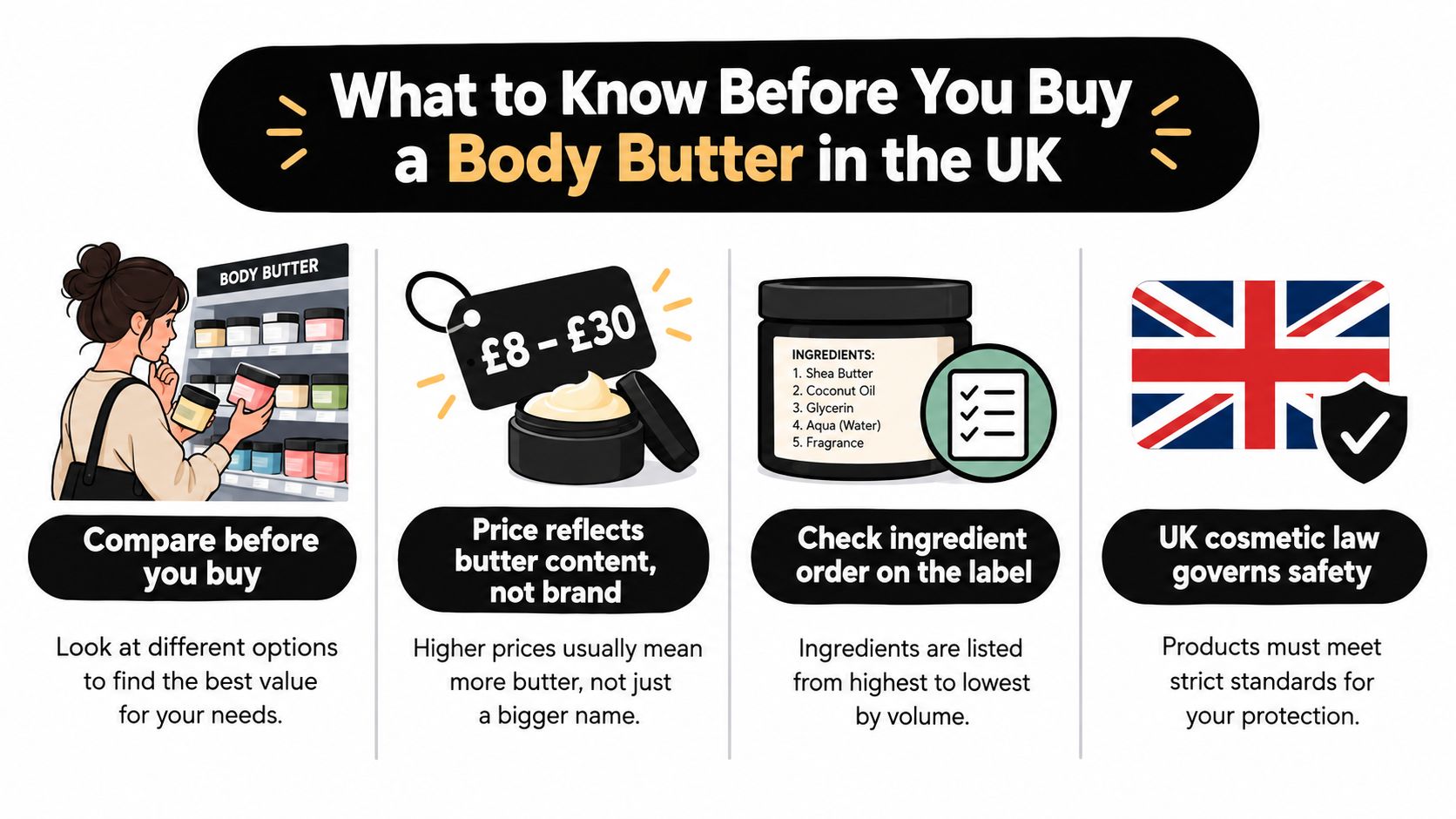
Shop-floor rule: Buy the ingredient list, the intended use and the safety information. Buy the branding only if those three things stand up first.
What Body Butter Actually Is and How It Works
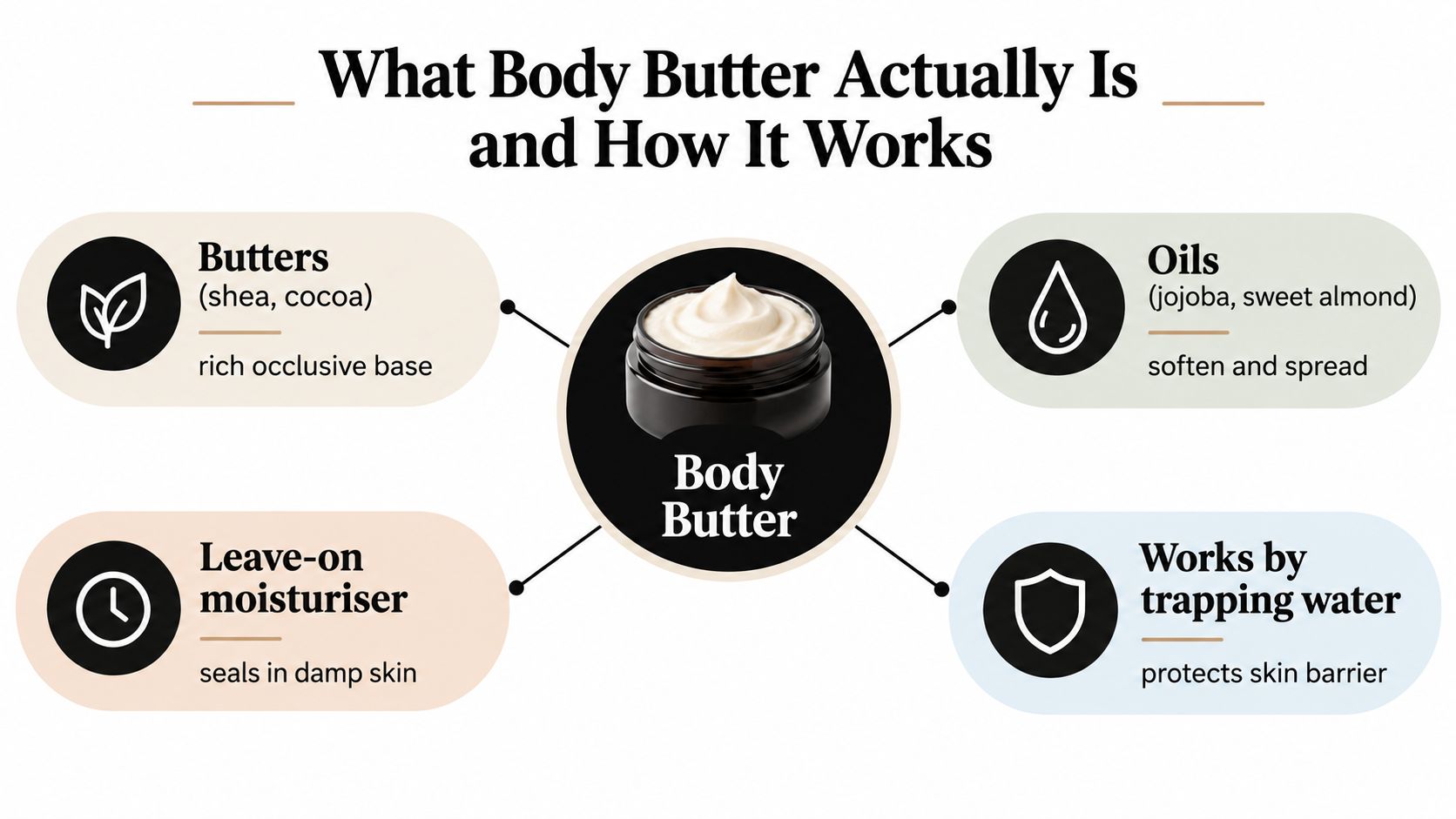
A body butter is best understood as a rich leave-on moisturiser built around oils and solid plant butters. Shea, cocoa and mango butters give a formula body and a protective feel. Liquid oils help it spread, soften the skin and reduce the drag you get from using a solid butter alone.
The important distinction is between humectants and occlusives. Humectants such as glycerin and urea help attract and retain water in the outer layers of skin. Oils and butters form an emollient and occlusive phase that smooths the surface and slows water escaping. A good body butter doesn't need to choose one side. It can combine both.
That's why texture alone is a poor buying guide. A thick, luxurious jar may feel occlusive but still lack a strong humectant system. Conversely, a lighter formula may deliver excellent hydration without leaving the heavy finish many shoppers associate with body butter.
Body butter compared with other moisturisers
| Product | Typical feel | Main formulation role | Best use |
|---|---|---|---|
| Body lotion | Light and quick to spread | Water phase with moisturising agents | Large areas and daytime use |
| Body cream | Medium-rich | Balanced water, oils and emollients | General dry or normal skin |
| Body butter | Dense and cushiony | Higher oil and butter content | Tight, dry or rough skin |
| Body oil | Slippery and fluid | Lipid-based softening and sealing | Damp skin and massage |
| Body balm | Firm and protective | Concentrated oils, waxes or butters | Localised rough patches |
Moisturisation should be treated as a barrier outcome, not merely a promise about richness. A University of Sheffield-linked study compared a 5% urea humectant emollient with a non-humectant emollient in 21 older adults with dry skin. The humectant formula produced greater and longer-lasting hydration and better preserved barrier function, although the participants weren't pregnant, so the findings guide formulation logic rather than proving a pregnancy-specific result. You can review the study's hydration and barrier comparison for the underlying methodology.
The practical takeaway is simple. Look for a formula that pairs a comfortable lipid phase with sensible water-binding ingredients, rather than assuming a thicker product is automatically more effective.
Why and When to Reach for a Body Butter
Body butter earns its place when your skin feels tight, dry, rough or uncomfortable, and when you want application to feel like care rather than a rushed chore. Use it after bathing while the skin is still slightly damp. That gives the formula water to help retain and creates a smoother spread than applying a dense butter to completely dry skin.
Pregnancy is a common time to want that extra comfort. As the abdomen, breasts, hips and thighs change, skin may feel stretched or dry. A richer product can make the daily massage more pleasant and help reduce the sensation of tightness, especially before bed or after a warm shower.
The honest boundary matters. The NHS guidance on pregnancy stretch marks says they affect around 8 in 10 pregnant women. A UK review published in the British Journal of Dermatology concluded that no topical or other treatment had been shown to be consistently effective with minimal adverse effects.
That means your strongest reason to use body butter is hydration, softness and comfort, not a guaranteed change to the structure or appearance of stretch marks. Be sceptical of any tub that turns a pleasant moisturising ritual into a medical promise.
Good moments to apply it
- After a shower: Smooth a small amount over damp skin, concentrating on the bump, hips, thighs, elbows and knees.
- Before bed: Choose a scent you enjoy, or fragrance-free if your skin or sense of smell is reactive.
- In colder weather: A butter-rich formula can feel protective when skin is exposed to cold air and indoor heating.
- On rough patches: Use a smaller amount on heels and elbows rather than covering your whole body with an unnecessarily heavy layer.
For a practical application routine, follow this guide to using body butter, particularly if you're applying it over a growing bump. Start with less than you think you need. A thick layer can sit on the surface, transfer to clothing and make you dislike an otherwise sensible formula.
Reading the Label Like a Formulator
The back of the pack is more useful than the front. In Great Britain, consumers must have access to the full ingredient list, so a product that hides behind “botanical blend” or “natural nourishment” without showing its INCI list hasn't given you enough information to judge it properly.
INCI ingredients are generally listed from the highest concentration to the lowest, although ingredients used in small amounts and certain functional components follow specific labelling conventions. You don't need to calculate every percentage. Read the list as a map of the formula.
Start with the base
Look near the beginning for the ingredients that define the product:
- Shea butter, cocoa butter or mango butter: These provide richness, structure and an occlusive feel.
- Plant oils: Jojoba, sweet almond, sunflower, oat, apricot kernel and similar oils help soften and spread the formula.
- Glycerin or urea: These are useful humectants that support water retention.
- Squalane: A lightweight emollient that can make a rich product feel less greasy.
- Water and emulsifiers: Their presence usually means you're looking at a cream rather than a waterless butter.
A product doesn't need every ingredient on this list. A well-made waterless butter may not contain glycerin because glycerin needs a water phase to work effectively in the same way. The point is to understand what the formula is trying to do, not to collect fashionable ingredients.
For a more detailed ingredient-by-ingredient breakdown, use this body butter ingredients guide alongside the pack you're considering.
Then check fragrance and clarity
“Fragrance”, “parfum” and essential oils aren't automatically unsafe, but they can matter if your skin is sensitive or your sense of smell has changed during pregnancy. Fragrance allergens may also be listed separately, depending on the formula and labelling requirements.
Be cautious when:
- The full INCI list is missing: You can't assess what you're applying over a large area.
- The front says “natural” but the back is vague: Natural doesn't mean allergen-free or suitable for every pregnancy.
- A long fragrance blend appears prominent: It may be a poor choice for reactive skin, even if the base is excellent.
- The formula relies on one hero butter: A jar dominated by occlusives may feel rich without offering the balanced hydration you want.
Label test: If a brand makes a confident safety claim, ask whether the full INCI list, usage guidance and responsible contact details are easy to find. Transparency should be ordinary, not something you have to chase.
Patch test new products on a small area first, especially if your skin is already itchy, broken or irritated. Stop if the product stings or causes a reaction, and seek professional advice for persistent symptoms rather than applying more butter over them.
Pregnancy-Safe Body Butter in the UK
“Pregnancy-safe” sounds definitive, but brands use the phrase in different ways. Sometimes it means the formula has been assessed for intended use during pregnancy. Sometimes it means the brand has removed ingredients consumers commonly avoid. Sometimes it means little more than “natural” packaging and reassuring language.
In Great Britain, body butter is a cosmetic product, not a medicine. Before sale, it must be safe under normal and reasonably foreseeable use. The manufacturer or Responsible Person needs a qualified safety assessment and the required product-safety documentation, and consumers must be able to access the ingredient list. Serious undesirable effects must be reported to the UK Office for Product Safety and Standards. These requirements are set out in the UK Government guidance for making cosmetic products available to consumers in Great Britain.
What the law does and doesn't mean
UK cosmetic rules prohibit ingredients classified as carcinogenic, mutagenic or toxic to reproduction, subject to tightly defined regulatory exceptions. That is an important baseline, but it doesn't mean every product carrying “pregnancy-safe” on the front has the same formulation quality or suitability for every person.
A “free from” list also isn't proof of a superior formula. Removing one ingredient may be sensible, but the complete product still needs reviewing for fragrance, allergens, concentration, exposure route, intended frequency and use over a large area.
The National Childbirth Trust points out that there aren't many clinical trials of beauty products in pregnancy, so advice is often cautious. That uncertainty should lead to sensible checking, not a blanket fear of every cosmetic ingredient.
A sensible safety check
Use this order of questions:
- Is the complete INCI list available? If not, choose a more transparent product.
- What is the intended use? A leave-on product applied daily over the bump deserves closer scrutiny than an occasional hand cream.
- Is the skin intact? Don't apply a fragranced product over broken, inflamed or actively irritated skin.
- Are you reacting to anything? Stop using the product if it causes burning, rash or worsening irritation.
- Do you recognise a potentially concerning ingredient? Ask a midwife, pharmacist or doctor instead of relying on an online avoidance list.
“Natural” and “chemical-free” aren't meaningful safety guarantees. Water, plant extracts and essential oils are chemicals too, and natural materials can still trigger sensitivity.
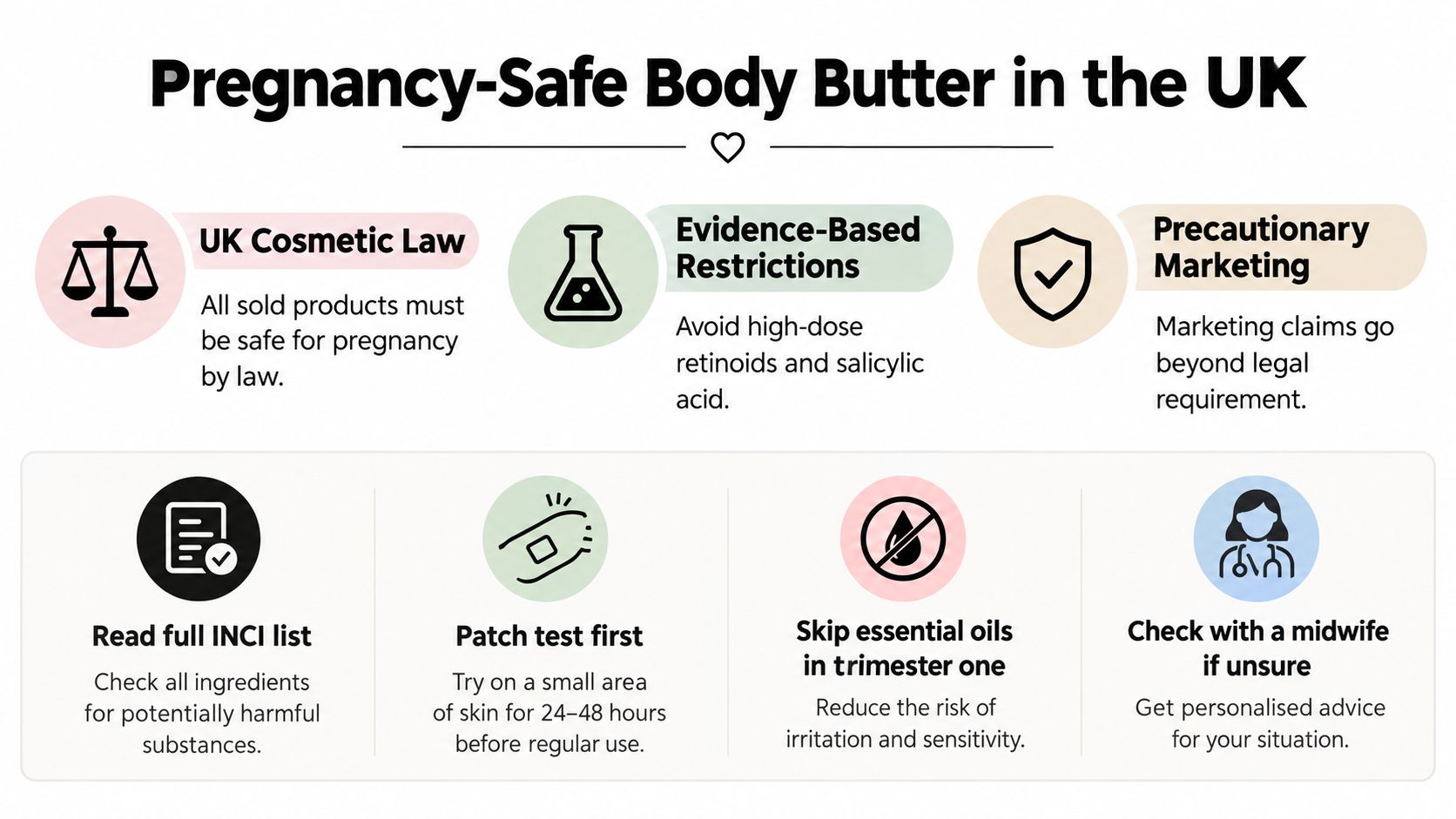
The right standard is neither “avoid everything” nor “trust the influencer”. Look for a documented safety approach, a complete label and claims that stay within what a cosmetic can honestly support.
Where to Buy Body Butter in the UK
The best place to buy depends on what you value most. Convenience, price and formulation transparency rarely peak in the same channel, so decide which matters before you start comparing tubs.
| Buying route | Strength | Watch for |
|---|---|---|
| Specialist pregnancy brands | Clearer bump-focused use guidance and targeted product design | Marketing claims can still overreach |
| Pharmacies and high-street retailers | Easy access and familiar returns processes | Product selection and ingredient detail vary |
| Independent UK brands | Often distinctive textures, scents and direct customer support | Smaller brands may explain safety inconsistently |
| Large marketplaces | Broad choice and frequent price comparisons | Seller identity, stock age and authenticity need checking |
| Salons and spas | Strong sensory experience and staff recommendations | Pregnancy suitability may not be the main focus |
Buying direct from a brand usually makes it easier to ask about the full INCI list, intended use and testing. That's especially useful when the product is designed for a large area and daily application.
Pharmacies can be a sensible choice if you need something quickly, but don't assume a pharmacy shelf means a product is fragrance-free or pregnancy-specific. Marketplaces are convenient, yet the cheapest listing may not offer the clearest information about who made the product or how it has been stored.
Independent brands often win on texture and personal service. Their formulas may feel more considered, but you should still apply the same label test. If you want to assess a dedicated bump formula directly, review the Pregnancy Belly Butter 200ml by its ingredients and use instructions, not just its positioning.
Matching Body Butter to Your Skin and Stage
Match the formula to your skin first, then to the season and stage of pregnancy.
- Very dry or tight skin: Choose a butter-dominant formula with shea, cocoa or mango butter and a spreadable oil phase. Apply it to damp skin after bathing.
- Bumpy or rough skin: Look for a humectant-led cream containing ingredients such as glycerin or urea, rather than relying on oils alone.
- Sensitive or reactive skin: Choose a simple, fragrance-free formula and patch test before applying it widely.
- Hot weather or a heavy-feeling third trimester: Pick a lighter cream, oil-gel or whipped texture that spreads easily without leaving a thick film.
England and Wales recorded 594,677 live births in 2024, compared with 591,072 in 2023, an increase of 0.6%, according to the published figures. That represents a substantial group of women making pregnancy skincare choices, but there still isn't one universally correct texture for every bump.
My recommendation is direct: choose the simplest full-label formula that gives you comfortable, hydrated skin and that you'll actually use. Ignore guarantees about preventing stretch marks, and prioritise a product whose texture suits your routine.
The Happy Bump Co offers UK-made pregnancy body care, including its Belly Butter, Belly Oil for Stretch Marks and Pregnancy Tummy Scrub, designed around gentle daily use and changing skin. Visit The Happy Bump Co to read the full ingredient lists and choose a bump-care routine based on comfort, hydration and transparent formulation.