

You're standing in the bathroom after a shower, towel in one hand, bump feeling tight and itchy. Three bottles are open on the side. One promises results for stretch marks, one smells strongly scented, and one has an ingredient list you can't pronounce.
You don't need more products tonight. You need a body skin care routine that's calm, short, and built around protecting your skin barrier. That means gentle cleansing, regular moisturising, and a clear way to check labels before anything goes on your skin.
Table of Contents
- Your Daily Body Care Schedule and First Week
- How to Cleanse, Dry and Moisturise Without Irritating Skin
- Checking Ingredients and Labels Before You Apply
- Treating Stretch Marks and Dry Patches Without Overclaiming
- When Dry Skin Might Be a Flare
Your Daily Body Care Schedule and First Week
Start tonight with this default routine. Cleanse once a day in lukewarm water, moisturise your whole body at least twice daily, and add one targeted product to your abdomen, hips, breasts, and thighs once or twice daily. Keep it that simple for the first week.
The moisturiser step is the part you should never skip. It follows NHS guidance on emollients for dry or eczema-prone skin, and it's what supports comfort day after day. Exfoliation, by contrast, is optional, capped at once a week, and skipped completely if your skin's irritated.
Your Daily Schedule at a Glance
| Step | When | How often | Product type |
|---|---|---|---|
| Cleanse | Shower or bath, lukewarm water | Once daily | Soap substitute or emollient wash |
| Moisturise whole body | Within 3 minutes of drying, skin still damp | At least twice daily | Fragrance-free emollient, cream or body butter |
| Targeted treatment for stretch-prone areas | After moisturiser, abdomen, hips, breasts, thighs | Once or twice daily | Pregnancy-suitable oil or cream, label checked |
| Gentle exfoliation (optional) | Shower, very light pressure | Once a week at most, skip during any irritation | Soft cloth or mild scrub without harsh particles |
| Ingredient check | When buying or changing a product | Before first use | Full ingredient list reviewed against the ingredient check section |
Read the table from top to bottom. Cleansing comes first because it sets up everything else. If you wash with a harsh or heavily fragranced product, the moisturiser that follows has to work against that irritation.
Moisturising while skin's still damp matters because damp skin holds water better under a cream or butter. Waiting until you're dressed and dry makes the same product feel less effective. You haven't bought the wrong moisturiser. You've missed the best moment to use it.
The targeted step is deliberately small. You're covering the areas where skin stretches most, not adding a second full routine. One product, gently spread, is enough.
Why Short Routines Tend to Stick
Consistency is the hard part for many people, not buying products. In YouGov's survey of 2,095 adults in Great Britain, 60% of adults said they'd bought skincare products for themselves in the previous year, yet 60% also said they didn't really follow a skincare routine.
Only 39% followed a routine of one to three steps in the same YouGov findings on routine length is not needed to repeat here, because the point is simpler. Buying a product doesn't create a habit. A routine you can do when you're tired is more useful than a long programme you abandon by Wednesday.
Practical rule: If a step needs a separate session, good lighting, and lots of energy, it'll be the first step you drop. Build each step into washing or getting dressed instead.
That's especially true in pregnancy and early motherhood. Time is short, sleep is broken, and your body may not feel comfortable standing for long. Two or three steps done daily will support your skin better than seven steps done once.
Your First Week in Three Actions
Night one is your starting point. Cleanse gently, moisturise your whole body, then apply your targeted product to your bump, hips, breasts, and thighs. Don't add exfoliation yet, even if your skin feels rough.
- Night one: Cleanse, moisturise, then apply the targeted product. Note how your skin feels an hour later.
- Days two and three: Repeat the same steps. Add a short phone note each evening marking whether skin felt tight, itchy, or comfortable.
- Days four to seven: Keep the steps unchanged. Check any product you already own against the ingredient check further down this page.
Changing only one thing at a time helps you learn. If you swap your wash, cream, and oil on the same day and your skin stings, you won't know which product caused it. A steady week gives you useful information.
Your phone note doesn't need detail. One word is enough, such as tight, comfortable, or itchy. Over several evenings, that pattern tells you more than a single good or bad day.
Low-Energy Adjustments That Still Count
Keep your moisturiser where you'll really use it. By the bed works if evenings are easier there. By the sofa works if you rest there after washing. A product left in a bathroom cabinet is easy to forget.
Moisturise straight after your shower rather than planning a separate session later. Later often doesn't happen. Skip exfoliation on bad days without treating that as failure, because it's optional by design.
If twice-daily whole-body moisturising feels like a lot at first, prioritise coverage over perfection. Do your bump, breasts, hips, thighs, arms, and legs as best you can, then sit down. You can apply a little more to tight areas before bed.
Judge success in a plain, practical way. Your skin feels less tight by morning, and there's no new redness or itching after a product change. That's a good first-week result.
Take your routine and any symptoms you've noted to your next midwife appointment. Bring product names or photos of labels if you're unsure about anything. That conversation is your single next step, and it keeps cosmetic choices separate from medical advice.
How to Cleanse, Dry and Moisturise Without Irritating Skin
Technique matters as much as product choice. Hot water, rubbing, and layering several fragranced products can undo the benefit of a good cream. The steps below keep friction low and help your moisturiser do its job.
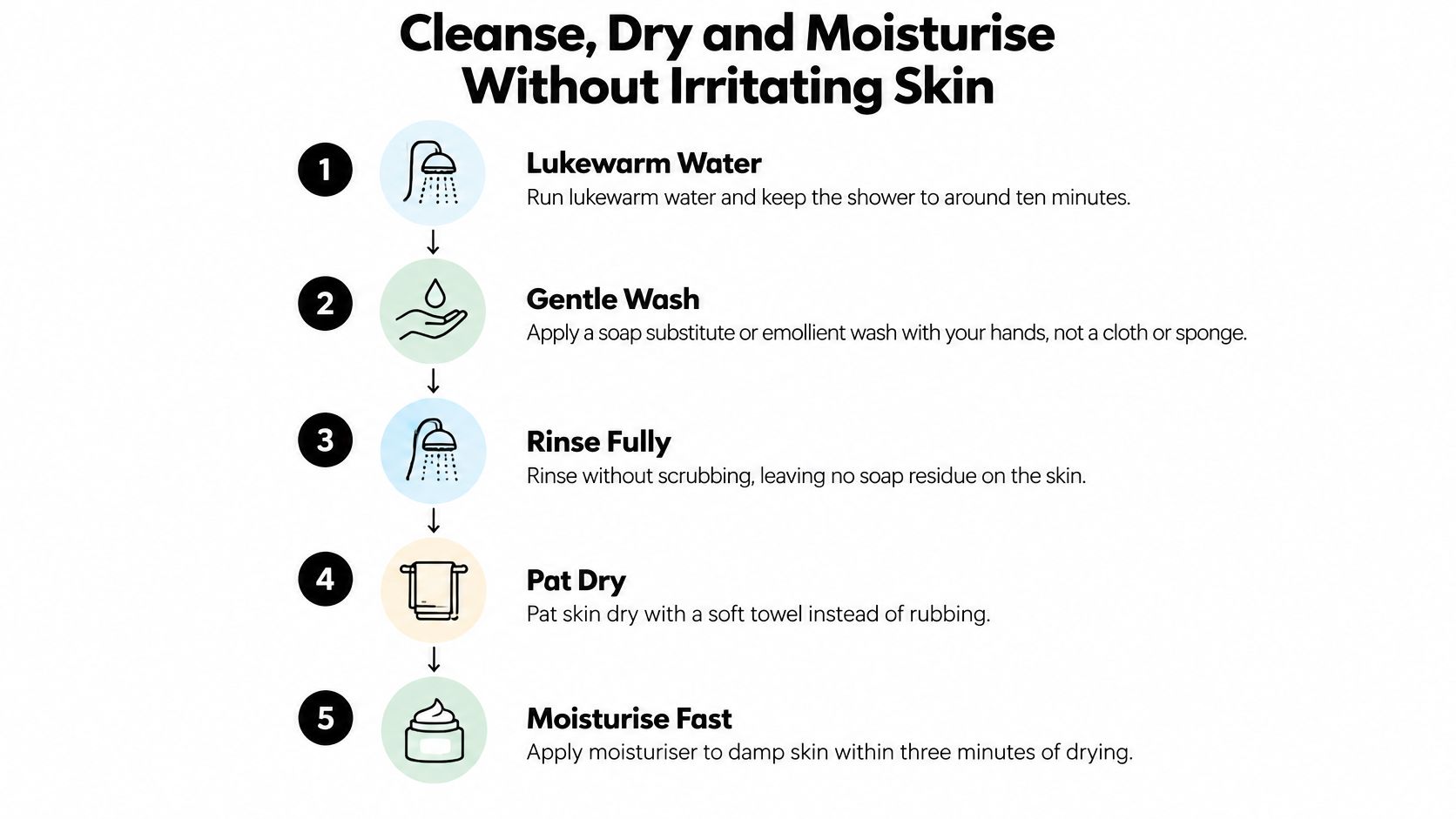
The Seven Steps in Order
- Run lukewarm water and keep the shower to around ten minutes. Hot water strips natural oils and can leave skin feeling tight before you've even washed. If your skin looks flushed when you step out, the water was probably too warm.
- Apply a soap substitute or emollient wash with your hands. Your hands give you control over pressure. A cloth or sponge adds friction and can hold residue from previous products.
- Rinse without scrubbing. Let the water do the work and check folds of skin where wash can sit. Residue left behind can irritate, especially under breasts or around a growing bump.
- Pat dry with a soft towel and leave skin slightly damp. Rubbing creates friction on sensitive skin. Patting feels slower, but it's gentler and leaves useful moisture on the surface.
- Within three minutes, apply a fragrance-free emollient or body butter. Use long, gentle strokes rather than circles with firm pressure. Cover the whole area instead of using a large amount in one spot.
- Add your targeted oil over stretch-prone areas. Spread it lightly over your abdomen, hips, breasts, and thighs. If skin's sore or broken, skip this layer and stick to plain moisturising.
- Wash your hands before applying anything to your face or breasts. This reduces transfer of body products to more sensitive areas. It also helps if you're handling a baby soon afterwards.
Why Quantity and Coverage Matter
For very dry or eczema-prone skin, NHS guidance on atopic eczema and emollient use recommends emollients at least twice daily and continuing after symptoms improve. The same guidance notes that generalised adult eczema may require approximately 600 g of emollient per week, which shows that adequate quantity matters.
You don't need to weigh your cream. The lesson is that a thin smear once in a while isn't the same as regular, generous coverage. Whole-area application, done consistently, is the foundation.
If moisturiser stings as soon as it goes on, don't push through and add another layer. Rinse it off, note the product name, and try a simpler fragrance-free option later.
Check your cleanser label too. Products containing sodium lauryl sulfate should be avoided when they irritate your skin, even if the front of the bottle uses the word gentle. Marketing language doesn't tell you how your skin will react.
If you use a paraffin-containing emollient, check the fire-safety guidance on the pack. Residue on clothing or bedding can increase flammability risk. Keep treated skin away from naked flames and follow washing instructions for fabrics.
A comfortable result is easy to recognise. There's no tightness after drying, no stinging when moisturiser goes on, and no need to keep scratching through your clothes. If that's not happening, simplify first before you buy anything else.
Checking Ingredients and Labels Before You Apply
A blacklist alone doesn't answer everyday questions. It doesn't tell you whether a rinse-off wash used briefly is the same as a leave-on cream used daily over your whole body. Judging by exposure gives you a calmer, more practical method.
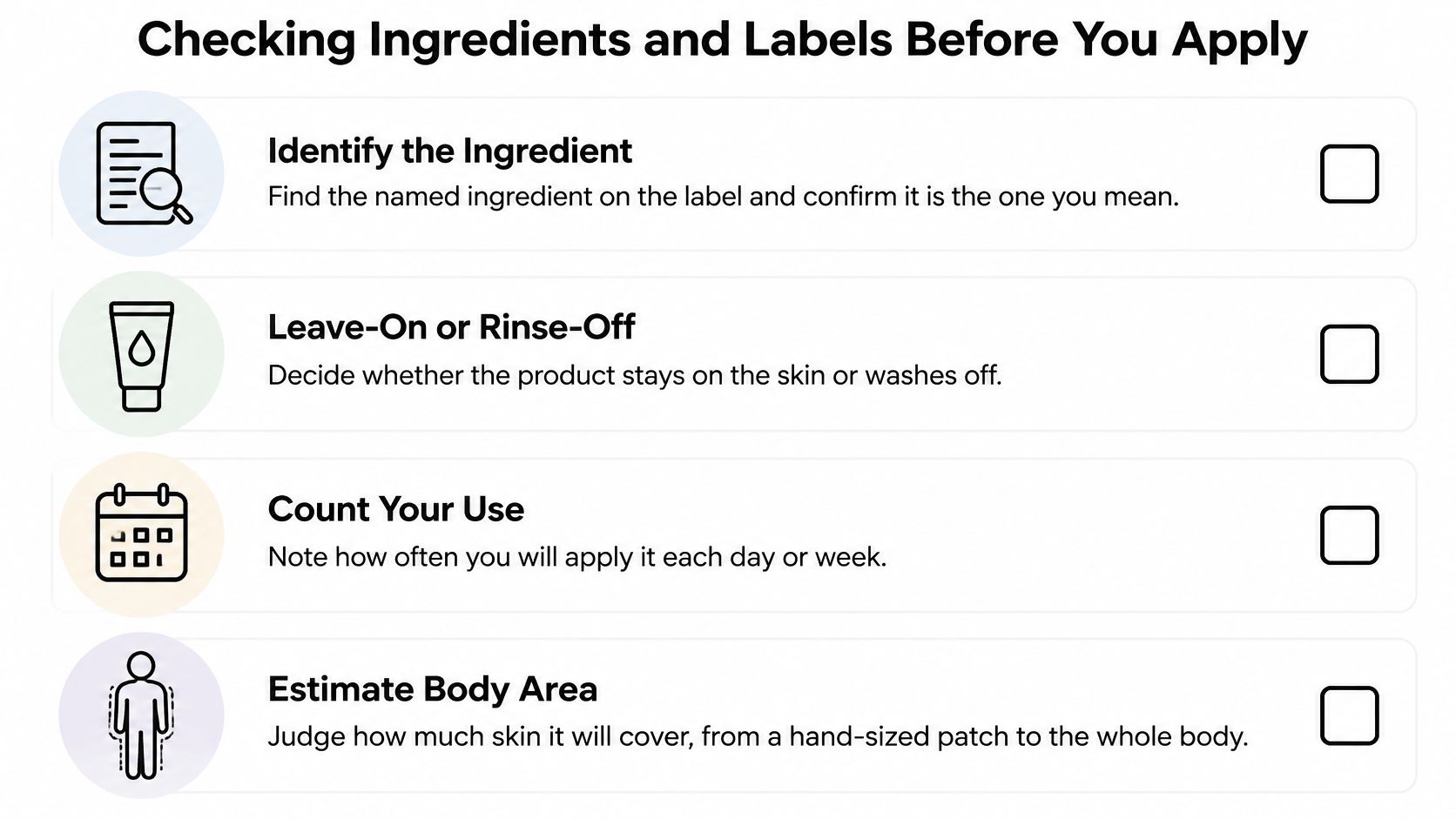
The Four-Part Exposure Check
First, identify the ingredient by its full name on the label. Similar names can mean different things, so don't guess from the front of the pack. If you can't find a full list, you can't complete the check.
Second, decide whether the product is leave-on or rinse-off. A body wash that's rinsed away in minutes exposes skin differently from an oil that stays on overnight. Leave-on products deserve closer attention because contact lasts longer.
Third, count how often you'll use it. Once a week on your legs isn't the same as twice a day, every day. Frequency turns a small exposure into a regular one.
Fourth, estimate how much body area it covers. A hand-sized patch differs from your whole bump, back, arms, and legs. Body products often cover large areas, which is why facial skincare advice doesn't always transfer neatly.
For broader context on choosing a daily product, this guide to pregnancy-safe moisturiser choices in the UK can help you compare labels in a structured way. Use it alongside the exposure check, not instead of reading the ingredient list.
Common Flags to Check
| Ingredient or label feature | Where you see it | Current guidance | Action |
|---|---|---|---|
| Topical retinoids (retinol, retinoic acid, adapalene) | Anti-ageing serums, acne gels | Should not be used in pregnancy | Stop, then ask GP, midwife or pharmacist |
| Sodium lauryl sulfate | Foaming body washes | Avoid if it irritates the skin | Choose a sulfate-free cleanser |
| Paraffin-based emollients | Greasy creams and ointments | Fire-safety guidance on clothing and bedding | Keep off clothing and sheets, wash fabrics separately |
| Fragrance and essential oils | Scented oils, body washes | Avoid on irritated skin, per National Eczema Society advice | Choose unperfumed and patch test first |
| Chemical exfoliants (glycolic or salicylic acid) | Acid scrubs, peel pads | Limited pregnancy data | Ask a pharmacist before any regular use |
| No full ingredient list shown | Some online listings | Exposure cannot be assessed | Do not buy until the brand supplies the list |
The retinoid row needs no complicated calculation. If a product contains a topical retinoid, set it aside during pregnancy and ask for professional advice. That includes anti-ageing and acne products you may have used for years.
For the other rows, use the exposure questions. A fragranced wash used once may be manageable for some people, while a fragranced leave-on oil used twice daily on irritated skin is a different decision. Your skin's current condition matters too.
If the list is missing: Don't fill the gap with a guess. No full ingredient list is a reason to skip the product until the brand supplies one.
Treat the phrase pregnancy-safe on packaging as a starting point only. It doesn't replace checking ingredients, area, and frequency for yourself. If a product is prescribed or marketed as an active treatment, check with a pharmacist, GP, or midwife first, consistent with NCT guidance on beauty treatments in pregnancy and breastfeeding.
For a product already in your bathroom, stop using it while you're unsure. Keep the packaging so the full list is available. A pharmacist can review that list with you far more easily than a product name from memory.
Treating Stretch Marks and Dry Patches Without Overclaiming
It helps to be honest about what stretch-mark products can do. They're best understood as moisturising and comfort support, not proven prevention. Keeping skin comfortable as it stretches is a worthwhile goal by itself.

In a survey of 773 pregnant women on stretch-mark product use, 78.2% reported using a product to prevent or reduce stretch marks and 36.5% used at least two products. In that same survey, 46.7% reported developing stretch marks during the current pregnancy. Those figures describe behaviour and prevalence, not product success rates.
A Practical Way to Use Targeted Products
Apply a fragrance-free emollient or pregnancy-suitable cream or oil once or twice daily. Cover your abdomen, hips, breasts, and thighs, because those areas often change quickly. Spread the product gently rather than massaging vigorously, especially if skin's already irritated.
For example, some women use a plain emollient in the morning and a richer butter at night. Others prefer one product they can apply without thinking. The Happy Bump Co's Belly Butter and Belly Oil are examples of bump-focused products designed for this targeted step, and they'd still be judged by label, fragrance, and how your skin responds.
If you're comparing options, this overview of stretch marks during pregnancy and daily bump care explains the areas to cover and how moisturising fits into a routine. Judge any product by its label rather than its marketing, using the exposure check from the previous section.
- Compare fragrance: Unperfumed products are usually easier to assess on sensitive skin.
- Compare area covered: A product for your whole bump and hips creates more exposure than one for a small patch.
- Compare frequency: Twice-daily leave-on use needs a fuller ingredient check than occasional use.
Set aside any topical retinoid creams or gels during pregnancy. That includes anti-ageing or acne products that might otherwise be marketed for marks or uneven skin. Don't use them on your bump to try to speed up cosmetic change.
Dry Patches Need a Simpler Response
For a dry patch, a thicker cream or balm at night usually does more than adding a second thin lotion. Apply it over slightly damp skin so the richer texture seals in moisture. Keep the area covered with soft clothing if friction from seams is making it worse.
Don't scrub a dry patch to make it absorb product faster. That can increase irritation and leave skin sorer. Gentle spreading, repeated regularly, is the quieter and safer approach.
Stop and seek maternity or medical advice if itching is severe, sudden, or widespread. Do the same if itching comes with a rash on your palms or soles. That's not a moment to add another cosmetic product or try a stronger scrub.
When Dry Skin Might Be a Flare
Start with the urgent rule. If you have itching in pregnancy with a rash on your palms or soles, or sudden widespread itch, contact maternity services or your GP the same day. Don't wait to see whether a new cream settles it.
Dry and sensitive skin is common, so ordinary tightness isn't a reason to panic. NHS Cheshire and Merseyside eczema self-care guidance states that eczema affects approximately one in five children and up to one in 10 adults in the UK. Pregnancy can also make skin feel more reactive through hormonal change, heat, sweating, stretching, and frequent washing.
Reading Symptoms Without Diagnosing Yourself
| Symptom | What it may indicate | First step | Get advice when |
|---|---|---|---|
| Tight, dry, flaky skin without redness | Ordinary dryness from heat, showers or hormonal change | Shorter lukewarm shower, emollient twice daily | Not improving after a week or two of consistent use |
| Itchy red patches on arms, legs or belly | Possible eczema flare or irritant reaction | Stop newly added products, switch to unperfumed emollient | Itch disrupts sleep or patches spread |
| Itch with rash on palms or soles, or sudden widespread itch | Could need prompt medical assessment in pregnancy | Stop all cosmetic treatments | Same day, contact maternity or GP |
| Weeping, crusting, spreading redness or pain | Possible infection | Apply nothing new to the area | Promptly, through GP, midwife or pharmacist |
| Stinging after moisturiser | Product irritant or fragrance | Wash off, switch to a fragrance-free product | Blistering or swelling develops |
Treat the middle column as possibilities, not diagnoses. Similar symptoms can have different causes, and a cosmetic routine can't tell them apart. Your job is to notice change, simplify care, and know when to ask for help.
If dry patches are mainly on your legs, this guide to dry skin patches on legs and gentle daily care may help you think through friction, shaving, and moisturising habits. It doesn't replace advice if patches are spreading, painful, or weeping.
What to Do in the First Two Weeks
Stop new products first. Go back to the basic cleanse and moisturise routine with unperfumed products you know your skin tolerates. Note what changed in the days before symptoms started, including washing products, laundry changes, heat, and new clothing.
Don't introduce an exfoliant, essential oil, or heavily fragranced oil to try to fix a flare. Removing irritants is often more useful than adding active steps. A shorter routine also makes it easier for a GP, midwife, or pharmacist to understand what you've been using.
A flare is information, not a failure of effort. Doing less, more consistently, gives irritated skin fewer new things to react to.
Self-care is no longer appropriate when redness spreads quickly or skin becomes painful. Oozing, crusting, swelling, or signs of infection also need prompt professional advice. Persistent severe itch belongs in that category too, even if your skin doesn't look dramatic.
Keep a brief record to take with you. Note when symptoms began, where they are, what you've applied, and whether sleep is affected. Clear notes help you get focused advice without having to remember everything in the appointment.
If you want a simple targeted step to sit alongside gentle cleansing and regular moisturising, The Happy Bump Co offers UK-made bump care including Belly Butter, Belly Oil, and a Pregnancy Tummy Scrub for your abdomen, hips, breasts, and thighs. Check each full ingredient list with the exposure method above, choose the texture you'll use consistently, and visit The Happy Bump Co to build a calm daily ritual around your changing skin.