

You catch sight of your stomach in the mirror while getting dressed. The baby's finally asleep, the house is quiet for once, and there they are. Fine red lines, pale silvery streaks, or both. Some days you feel proud of them. Other days you'd rather not look too long.
That mix of feelings is normal. Your body has done something enormous, and it's also okay to want your skin to feel more comfortable, supported, and cared for. Wanting a stretch mark cream for after pregnancy doesn't mean you're ungrateful for your body. It usually means you're trying to find your footing in a body that feels familiar and new at the same time.
If you've already spent time scrolling through oils, butters, and creams, you're not alone. A lot of the advice out there swings between two extremes: miracle promises or complete dismissal. The truth sits somewhere in the middle. If you want a more honest starting point, this guide to stretch mark prevention cream helps frame what topical products can and can't do.
Table of Contents
- A New Chapter for You and Your Skin
- Understanding Post-Pregnancy Stretch Marks
- How Stretch Mark Creams Actually Work
- Key Ingredients for Postpartum Skin Repair
- Your Postpartum Application Ritual
- Realistic Timelines and Professional Options
A New Chapter for You and Your Skin
The postpartum weeks can feel strangely practical and intensely emotional at the same time. You're learning feeds, naps, healing, clothes that fit differently, and how to get out the door with a tiny human. Then, in the middle of all that, your skin asks for attention too.
For many mums, stretch marks aren't the main concern until after birth. During pregnancy, the focus is often on getting through each trimester. Afterwards, there's finally space to notice texture changes, itching, dryness, or marks that look darker or more visible than before. That can feel unsettling, especially when your skin doesn't seem to “bounce back” on anyone else's timeline.
Your stretch marks are not a sign that you did anything wrong. They're a sign that your skin stretched, adapted, and healed as best it could.
Some women want to fade the look of the marks. Others just want their stomach, hips, or breasts to feel softer and less tight. Both goals are valid. Skin care after pregnancy doesn't have to be about erasing evidence of what happened. It can just be about support.
Why kindness matters here
Postpartum skin sits in a complicated place. It may be healing from stretching, dryness, hormonal shifts, or irritation. It may also be more sensitive than usual. That's one reason harsh promises can feel especially disappointing. A cream that claims it will make every mark vanish sets you up for frustration.
A better approach is to ask calmer questions:
- What's realistic: Can this cream improve texture, softness, and the look of newer marks?
- What's safe: Is it suitable if you're breastfeeding or dealing with sensitive skin?
- What's inside: Does it contain ingredients that do more than sit on the surface?
That middle path tends to feel more reassuring. You don't need false hope, and you don't need to give up on caring for your skin either.
Understanding Post-Pregnancy Stretch Marks
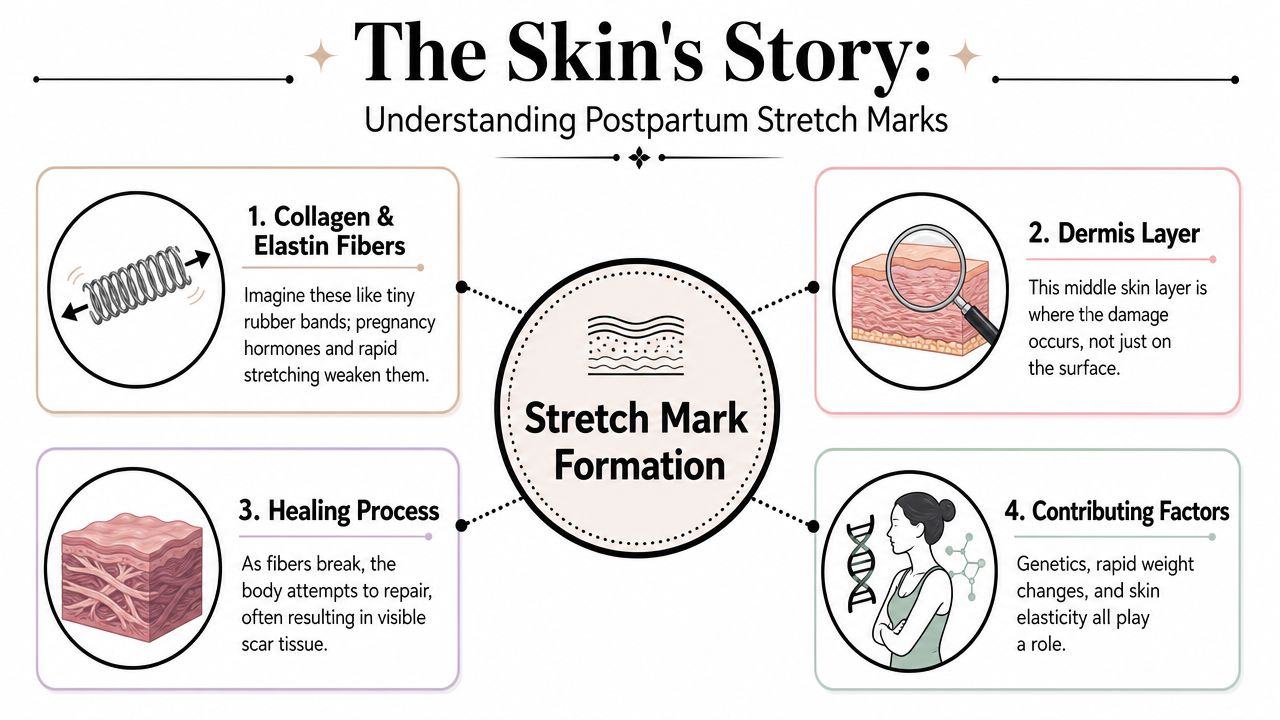
Stretch marks are a form of scarring that starts deeper in the skin than often understood. They're not just a dry-skin problem on the surface. A moisturiser may help the skin feel better, but the actual change begins lower down.
Why they happen under the surface
Think of your skin like fabric with built-in stretch. The outer layer is what you see, but underneath it sits a supportive mesh made from collagen and elastin. Those fibres help skin stay firm, springy, and resilient. During pregnancy, rapid stretching and hormonal changes can put that support system under strain.
When that deeper layer can't keep up, tiny tears form in the dermis. Your body repairs the area, but the healed skin doesn't look exactly the same as it did before. That's why stretch marks have their own texture and tone.
A lot of women try products during pregnancy and after birth, which makes sense. In a UK survey of 753 pregnant women, 78.2% used at least one product to prevent or reduce stretch marks, and Bio-Oil was the most frequently used at 60.9%. The same study noted a lack of high-quality evidence for how effective these products are, despite how common they are in real life, as reported in this BMC Pregnancy and Childbirth survey from Northern Ireland.
If you want a gentle explainer on what many women notice after delivery, this guide on stretch marks after birth is a useful companion read.
Red marks and white marks
Not all stretch marks are at the same stage.
- Striae rubrae: These are the newer marks. They often look red, pink, purple, or deeper brown depending on your skin tone. They can also feel slightly raised or itchy.
- Striae albae: These are older marks. They tend to look white, silver, or lighter than the surrounding skin and often feel flatter.
That difference matters because newer marks usually have more active blood flow and are often more responsive to treatment. Older marks are more settled and tend to be harder to shift.
Newer stretch marks usually respond better than older ones. That doesn't mean old marks can't improve, but it does mean expectations need to change.
Many people get confused. They assume one cream should work the same way on every mark. It won't. A fresh red line and a long-settled silver one are not the same skin situation.
How Stretch Mark Creams Actually Work
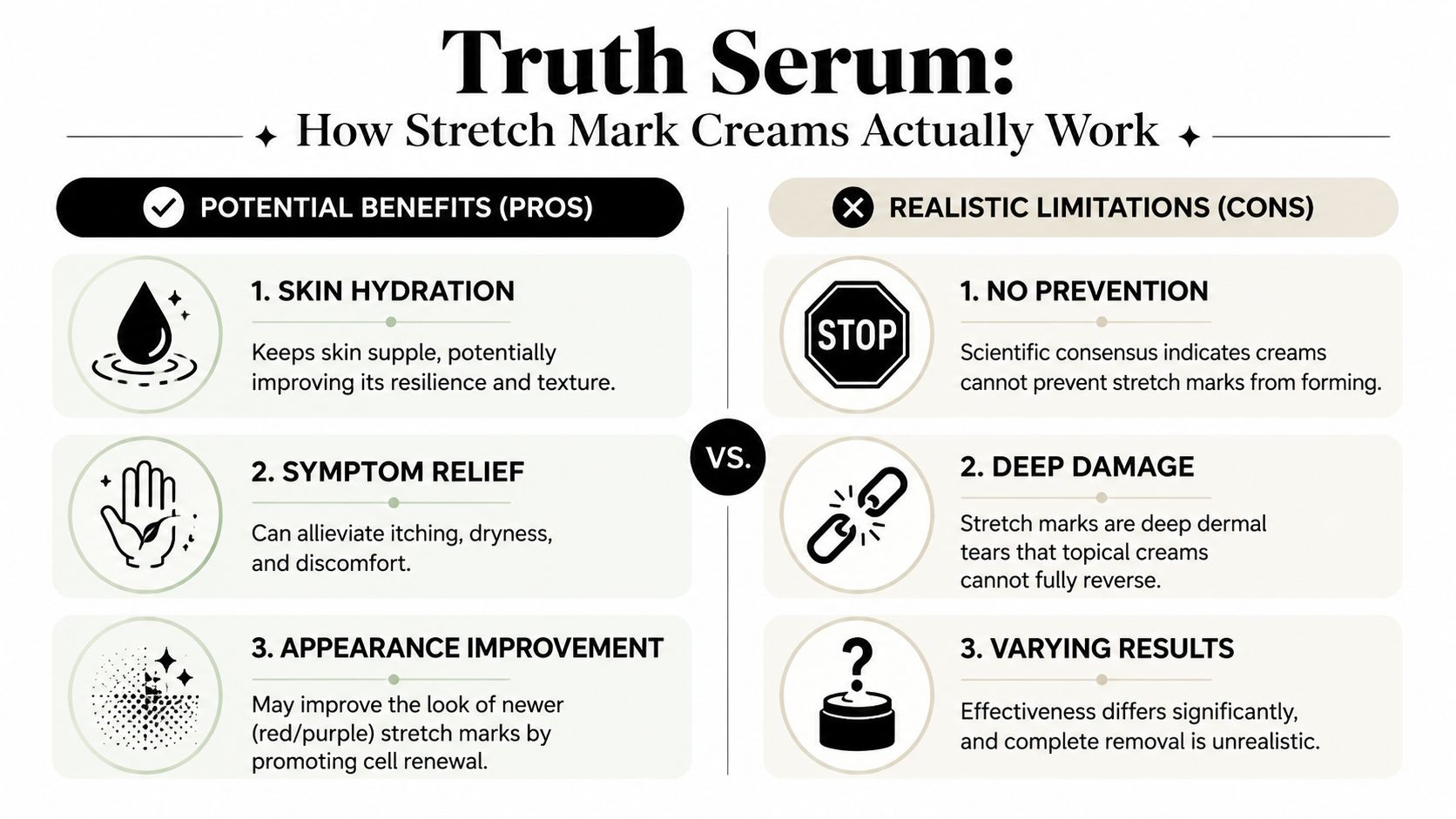
A lot of products are marketed as if all they need is patience and daily use. That's not how the science reads. A stretch mark cream for after pregnancy can be helpful, but not for the reasons many adverts suggest.
What creams can't do
The biggest myth is that any cream can prevent stretch marks if you start early enough or apply it often enough. The evidence doesn't support that broad claim. A systematic review of six clinical trials involving 800 pregnant women found no high-quality evidence to support the use of topical preparations for preventing stretch marks, with a pooled risk ratio of 0.74 (95% CI: 0.53 to 1.03) showing no statistically significant difference, according to this systematic review in PubMed Central.
That's worth sitting with for a moment. Moisturising may feel lovely. Massage may help you connect with your changing body. But prevention is not something any ordinary cream can promise.
What they can do after pregnancy
Once stretch marks already exist, the question changes. You're no longer trying to stop them forming. You're trying to support skin that has been stretched and scarred.
A good cream can help in several practical ways:
- Hydration and comfort: Dry postpartum skin often feels tight, itchy, or rough. A richer cream can soften that feeling and improve suppleness.
- Texture support: Well-formulated products can make the skin surface feel smoother, even when the deeper mark remains.
- Appearance improvement: Some active ingredients may help the look of newer marks and support the skin's repair processes.
What matters here is the difference between a basic moisturiser and a targeted treatment. A simple oil or butter mainly seals in moisture. That can be useful, especially if your skin feels dry. But if you want changes in elasticity or visible appearance, you usually need ingredients that do more than coat the skin.
Practical rule: If a product only offers “moisture” and “glow,” expect comfort benefits. If it includes studied bioactive ingredients, it may offer more support for the appearance of stretch marks.
That's the middle ground. No cream is a magic eraser. Some creams are still worth using because they help the skin feel better and, in the right formula, may improve how certain marks look over time.
Key Ingredients for Postpartum Skin Repair
Ingredient labels can look busy fast. The trick is to stop asking whether a product is “popular” and start asking what each ingredient is there to do.
What the science says to look for
One ingredient with meaningful promise is Centella asiatica. Clinical evidence shows creams containing Centella asiatica extract can have a significant effect, with one study showing 100% prevention of recurrence in a high-risk group. The same evidence review also notes that formulations with specific bioactive ingredients produced a 16% increase in skin elasticity within 12 weeks, as described in this evidence-based review of topical therapies.
Why does that matter after pregnancy? Because Centella asiatica is linked with support for fibroblast activity, collagen, and elastin. In plain language, it's one of the ingredients that seems to do more than moisturise.
Other names worth knowing are Regestril, Darutoside, Pro-Col-One, and Marine Elastin. These are the kinds of bioactive ingredients often discussed when the goal is structural skin support rather than surface softness alone. You may also see peptides in postpartum products. They aren't all identical, but they're often included to support the skin's repair environment. If you want a broader primer on this category, this guide to the best peptide for skin breaks down how peptides fit into a skincare routine.
Then there are the supportive basics. Ingredients like shea butter, hyaluronic acid, and gentle plant oils can be very helpful for comfort and hydration. They just shouldn't be mistaken for proven corrective actives.
Stretch Mark Ingredient Cheat Sheet
| Ingredient | What It Does | Evidence Level |
|---|---|---|
| Centella asiatica | Supports collagen and elastin processes and may help the appearance of stretch marks | Stronger support |
| Regestril | Included in targeted stretch mark formulas aimed at structural improvement | Promising bioactive |
| Darutoside | Used in formulas designed to support dermal repair | Promising bioactive |
| Pro-Col-One | Included for collagen-focused skin support | Promising bioactive |
| Marine Elastin | Used to support skin elasticity and resilience | Promising bioactive |
| Peptides | Help support the skin's repair environment | Supportive but formula-dependent |
| Hyaluronic acid | Draws water into the skin and improves surface plumpness | Good for hydration, not a stand-alone fix |
| Shea butter and nourishing oils | Reduce dryness and improve comfort | Helpful for moisture, limited corrective evidence |
A useful way to read a label is to separate products into two groups.
- Comfort-first creams: Great for dryness, itching, and softness.
- Treatment-leaning creams: Better if they combine moisturising ingredients with bioactives that aim to support elasticity and collagen.
That distinction saves a lot of disappointment.
Your Postpartum Application Ritual
A cream works best when it becomes part of a repeatable routine, not a burst of effort for three days and then forgotten in a drawer.

A simple routine that feels doable
The best time to apply a stretch mark cream for after pregnancy is when your skin is clean and slightly damp, often after a warm shower. That gives the product a better chance to spread evenly and helps lock in moisture.
A simple routine might look like this:
- Pat, don't rub: Leave the skin slightly damp after washing.
- Warm the cream in your hands: This helps thicker products spread more easily.
- Massage with slow circles: Focus on the stomach, hips, thighs, and anywhere the skin feels tight.
- Use enough product: A thin skim often isn't enough for dry, stretched skin.
- Stay consistent: Morning and evening tends to work well if your skin tolerates it.
Massage matters here, not because it can erase a stretch mark, but because it helps you apply the product properly and can turn a quick task into a small self-care pause. For many mums, that matters almost as much as the skincare itself.
Gentle, regular application usually beats aggressive rubbing. Postpartum skin often prefers patience.
A quick visual guide can help if you like following along with technique:
Breastfeeding and safety checks
Safety gets more important, not less, after birth. If you're breastfeeding, ingredient choice matters. Evidence on post-pregnancy treatment notes that effective remodelling formulas need specific bioactive ingredients, and that retinoid creams such as tretinoin can rebuild collagen but are strictly contraindicated for pregnant and breastfeeding women, making non-retinoid formulations the safer option in that period, as summarised in this review of striae distensae treatments.
That leads to a straightforward filter:
- Avoid retinoids if you're breastfeeding
- Choose non-retinoid formulas with supportive bioactives
- Keep products away from the nipple area unless the label states they're suitable
- Patch test if your skin has become more reactive postpartum
If your skin stings, burns, or becomes very irritated, stop and reassess. More active doesn't always mean better.
Realistic Timelines and Professional Options
Most postpartum skin care works slowly. That can be frustrating, especially when you're already tired and want something straightforward. But stretch marks change at skin speed, not marketing speed.
What improvement usually means
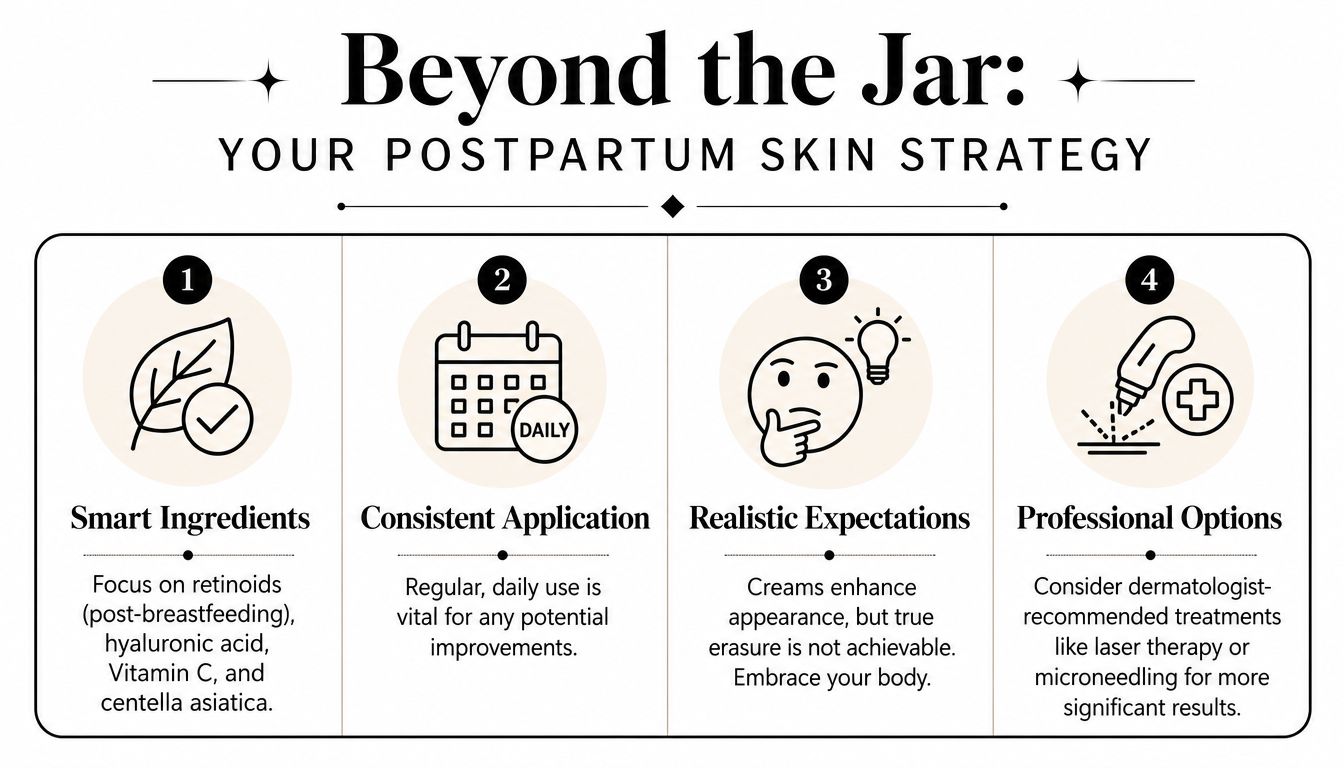
Improvement usually means softer texture, less dryness, and marks that look a bit less obvious over time. For newer marks, you might notice fading or a calmer colour first. For older ones, changes are often subtler and more about texture than disappearance.
That doesn't mean your effort is wasted. It means success needs a more realistic definition. If a cream helps your skin feel comfortable, supports elasticity, and improves the appearance of the marks a little, that still counts.
Some of the healthiest postpartum skin goals are quieter ones. More comfort. Less irritation. A softer relationship with the mirror.
When to think about professional treatment
If you want more improvement than a cream can realistically offer, that doesn't mean you picked the wrong cream or failed to use it properly. It means topical care has limits.
A dermatologist may discuss options such as:
- Laser treatments: Often used to target colour and texture
- Microneedling: Aims to support collagen remodelling
- Combination approaches: Sometimes used for marks that are older or more stubborn
These treatments are worth discussing if your stretch marks bother you a lot, especially once you're past the early postpartum stage and want a more intensive plan. The best option depends on your skin tone, how old the marks are, whether they're red or pale, and whether you're breastfeeding.
The kindest approach is usually a layered one. Use topical care to support your skin daily. Give it time. If you want further change later, ask a qualified professional what's suitable for your skin rather than chasing stronger home products.
If you want gentle, pregnancy-focused body care from a brand that understands changing skin, take a look at The Happy Bump Co. Their UK-made range is designed to nourish bump and postpartum skin with a calm, supportive approach that fits real life.