

The most popular advice about after pregnancy skin care products is to choose something natural and keep rubbing it into your bump. That misses the important questions: what's in it, where will you apply it, and can your baby touch or lick the residue?
You don't need a cupboard full of specialist products. You need a moisturiser that suits your skin, realistic expectations about stretch marks, and a clear distinction between caring for intact skin and treating nipples, rashes or healing wounds.
Table of Contents
- Which Product Type Fits Each Postpartum Concern
- What Changes in Your Skin After Birth
- How Each Product Type Works and What It Can Promise
- Ingredients to Avoid or Check While Breastfeeding
- Where Products Can Go While Breastfeeding
- How to Build a Simple Postpartum Skincare Routine
- Choose Your First Product and Patch Test It
Which Product Type Fits Each Postpartum Concern
Postpartum concern, product type and what to check
| Concern | Product type | Look for | Avoid or check first |
|---|---|---|---|
| Dry, tight skin on bump, hips and thighs | Body butter | Shea or cocoa butter, glycerin | Heavy fragrance if skin is sensitive |
| Itchy or irritated skin | Fragrance-free lotion or cream | Glycerin, ceramides, colloidal oat | A rash that spreads needs GP advice |
| Stretch marks, new or fading | Oil or cream for comfort | Vitamin E or rosehip oil, if tolerated | Claims to erase marks; retinoids while breastfeeding |
| Melasma or linea nigra | Daily sun protection plus gentle moisturiser | Broad-spectrum sunscreen suitable for sensitive skin | Bleaching agents without GP or pharmacist advice |
| Exfoliation of the body | Gentle body scrub | Fine particles and a light touch | Broken skin, irritation or unhealed wounds |
| Nipples while breastfeeding | Water-miscible cream or gel, selected with professional advice | A formula specifically suitable for nipple use | Paraffin-containing ointments; assuming lanolin-free means safe |
| Persistent rash or eczema-like patches | Emollient or other treatment recommended by a clinician | A formula matched to the diagnosis | Repeatedly trying cosmetic products instead of getting advice |
Use the concern that's bothering you most as your starting point. Dryness, pigmentation and wound healing need different approaches, even when they're happening on the same patch of belly.
Match the texture to the problem
For skin that feels tight after washing, a cream may be enough. A butter is useful when that comfortable feeling doesn't last, particularly over the hips and thighs, but its richness can be inconvenient when you're dressing quickly or holding your baby against your body.
Itch deserves a closer look before you buy anything. Dry skin may respond to a bland moisturiser; a spreading rash, weeping patch or intense itch needs assessment rather than a more expensive butter.
Stretch marks are another separate issue. Choose a texture you enjoy using rather than an ingredient with an impressive removal claim; the guide to stretch marks after birth can help you distinguish ordinary changes from expectations a cosmetic product can't meet.
Buying rule: Buy for the symptom you can improve, such as tightness or roughness, rather than a promise to restore your pre-pregnancy body.
You can also leave products out. A scrub isn't necessary for healthy skin, an oil isn't compulsory if your cream works, and nipples don't automatically need a cosmetic treatment because you're breastfeeding.
What Changes in Your Skin After Birth
Skin after pregnancy can feel like a jumper that's been stretched over a growing bump and hasn't quite returned to its previous shape. It's a useful comparison for texture and looseness, although living skin is more complex than knitted fibres: hormones, stretching and changes in the skin barrier all play a part.
This illustration puts the texture changes into a gentler perspective.
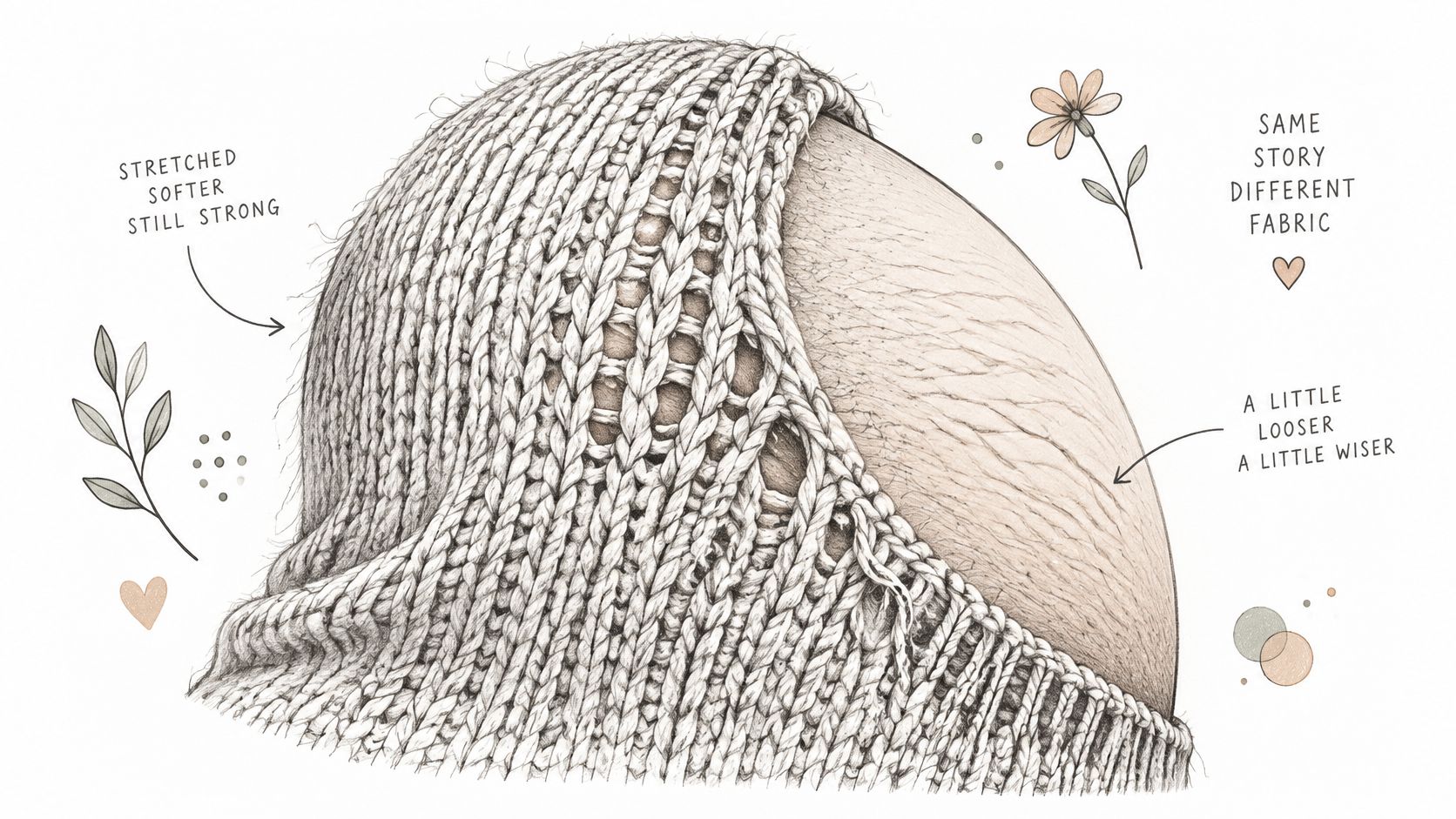
The NHS guidance on stretch marks says they affect approximately 8 in 10 pregnant women, commonly appearing on the abdomen, breasts, hips, thighs and buttocks, and usually become paler after birth without disappearing completely. They're harmless, but it's understandable to feel differently about them from day to day.
Dryness and sensitivity can accompany the hormonal changes after delivery. Pigmentation, including melasma and the linea nigra, may gradually fade, while stretch marks change colour and become less prominent.
Think in stages, not deadlines
- Early recovery: Prioritise comfortable washing, moisturising intact skin and following your maternity team's wound-care instructions.
- As healing progresses: You may notice less vivid marks and softer pigmentation, but the pace isn't predictable.
- Longer-term care: Keep the products that make your skin comfortable. Don't escalate treatment just because a mark remains visible.
If itch is your main problem, check whether there's a rash, a product trigger or another symptom alongside it. The practical guide to itching skin after pregnancy offers a useful starting point.
For a visual accompaniment, you can watch the following video.
The realistic goal is comfort, hydration and skin confidence, not erasing the fact that your body has changed.
How Each Product Type Works and What It Can Promise
Think of a lotion as a light base layer, body butter as a heavier coat and oil as a finishing layer. You don't have to wear every layer at once. Choose according to how dry your skin feels and how much residue you can comfortably manage.
Lotion, butter or oil
Lotions and creams combine water with moisturising ingredients. Glycerin attracts water, while ingredients such as ceramides help support the skin barrier; these products are practical for large areas and getting dressed afterwards.
A thin lotion can sting very irritated skin, especially if it contains fragrance. If that happens, stop using it rather than assuming the sensation means it's working.
Body butters are richer and usually leave a more substantial protective layer. They suit dry hips, thighs and belly skin, particularly when applied while the skin is still slightly damp.
The trade-off is greasiness. A thick layer may leave you sticky without improving comfort beyond what a smaller amount would achieve.
Body oils improve slip and soften the skin's surface. They're useful for a gentle massage, but oil alone doesn't supply the water found in a lotion or cream.
Some oils feel light; others remain greasy. Let the finish guide when you use them, and remember that residue can mark clothes and bedding.
Scar care is a different category
A caesarean scar isn't a stretch mark. Don't apply a cosmetic oil, butter or scrub to an open incision, and don't assume that a closed-looking surface is ready for massage.
Silicone gels and sheets are options a clinician may recommend for a raised scar. Ask your midwife or GP whether the wound is ready and which treatment fits the scar, rather than choosing a general stretch-mark product for it.
For ordinary dry skin, apply the lighter product before the richer one if you need both. If a cream keeps you comfortable, there's no requirement to add oil.
What the evidence can support
In a survey of pregnant women, 46.7% developed stretch marks during their current pregnancy, according to the BMC Pregnancy and Childbirth paper hosted by Queen's University Belfast. That finding doesn't measure whether your chosen postpartum product will help, and it shouldn't be turned into a product-success claim.
Choose a product for moisturisation, comfortable application and a routine you'll actually use. Guaranteed prevention or removal is a different promise, and not one a cosmetic cream should make.
Ingredients to Avoid or Check While Breastfeeding
A natural label isn't a safety test. Neither is clean, botanical or pregnancy-friendly: none tells you whether a formula belongs on a nipple or whether it contains an active ingredient that needs professional review.
Read the INCI, meaning the full ingredient list. Retinyl palmitate, for example, is a vitamin-A derivative even though its name may look less familiar than retinol.
Understand the retinoid precaution
Holland & Barrett's pregnancy and breastfeeding skincare guidance takes a precautionary approach to retinoids during pregnancy and breastfeeding. Oral retinoids are established teratogens, while topical exposure is much lower; that distinction matters, and avoiding a topical product doesn't mean ordinary cosmetic use has been shown to cause the same harms.
For a simple postpartum routine, leave retinoids out unless your clinician specifically advises otherwise. Don't stop or restart a prescribed treatment without discussing it with the prescriber.
Ingredient status while breastfeeding
| Ingredient or class | Status while breastfeeding | Reason | Action |
|---|---|---|---|
| Retinol, retinal, tretinoin, adapalene | Avoid unless a clinician advises | Precaution around the vitamin-A class; oral and topical exposure differ | Check the full ingredient list |
| Retinyl palmitate and other retinyl esters | Leave out of a conservative routine | They're also vitamin-A derivatives | Read the INCI rather than front-label claims |
| Mineral oil and petroleum jelly in paraffin ointments | Avoid self-selecting for nipple and areola use | Direct licking creates an ingestion route | Ask about a water-miscible alternative |
| Hydroquinone | Don't self-start | Pigment treatment needs an individual suitability check | Ask a GP or pharmacist |
| Strong salicylic acid or high-strength acid peels | Check with a pharmacist | Concentration, treatment area and residue matter | Take the actual product details to the pharmacist |
| Fragrance and essential oils | Prefer fragrance-free if sensitive | Either can irritate or sensitise skin | Stop if redness, burning or itch develops |
| Fragrance-free emollients | Often a sensible body-care starting point | Fewer fragrance-related triggers | Check the whole formula and intended application site |
Make the label check manageable
- Search the ingredient list: Look for retin-containing names, tretinoin and adapalene. Ask a pharmacist about anything you can't identify.
- Check the intended use: Body-safe doesn't mean nipple-safe. Look for breastfeeding guidance and any restrictions on application.
- Try a small area first: Use intact inner-forearm skin and watch for irritation before spreading the product over your body. A home patch test can't guarantee that an allergy won't develop later.
Persistent stinging isn't a normal adjustment you need to push through. Wash the product off and leave irritated skin alone.
Once breastfeeding has stopped, the breastfeeding-specific restrictions can be reassessed rather than continued indefinitely. Pregnancy plans, prescription treatment and your skin's condition still matter, so check before restarting high-potency actives.
Where Products Can Go While Breastfeeding
Location and infant contact matter as much as the ingredient list. A body butter used under clothing on your hips presents a different situation from the same butter applied where your baby latches.
The Breastfeeding Network's guidance on creams explains that most topical products have little absorption into breast milk, but babies should be kept from contacting treated skin and product should be removed from the nipple or areola before feeding. It also recommends water-miscible creams or gels rather than ointments on the nipple because licking ointment may expose an infant to mineral paraffins.
Use the body area to make the decision
Application rules by body area while breastfeeding
| Body area | Suitable product type | Before feeding or handling baby | Watch for |
|---|---|---|---|
| Abdomen and hips | Body butter, oil or lotion on intact skin | Wash product from hands; cover treated skin before contact | Greasy residue transferring through clothing |
| Outer breasts | Plain lotion or light cream | Remove any product that reaches the area your baby mouths | Cracked, painful or inflamed skin needing midwife advice |
| Nipples and areola | Water-miscible cream or gel selected for this use | Gently remove residue with warm water before feeding | Cracks, worsening pain or infection needing assessment |
| Hands | Moisturiser suited to your skin | Wash before handling baby, especially before contact with their mouth | Residue transferring to the baby's skin |
| Legs and buttocks | Body butter or oil | Keep treated areas away from the baby during skin-to-skin contact | A new rash or itch; stop the product |
You don't have to abandon skin-to-skin contact to moisturise. Apply richer products to covered areas afterwards, or choose another time when someone else is holding the baby.
Nor do you need to scrub your nipples before every feed when there's no product on them. If residue needs removing, use a gentle approach without soap or friction, which can worsen soreness.
Know when cosmetics aren't the answer
Nipple pain may involve attachment, trauma or infection. A thicker cream won't correct the cause, so ask your midwife or breastfeeding supporter to assess feeding as well as the skin.
Emollients are used in the management of diagnosed conditions such as eczema and psoriasis, but you can also buy plain moisturisers for ordinary dryness. Persistent rashes need a pharmacist or GP to help identify the problem rather than an endless sequence of product swaps.
Contact check: Before you pick your baby up, check your hands, the skin they'll rest against and any area they might mouth.
How to Build a Simple Postpartum Skincare Routine
Make the routine small enough to fit around feeding and recovery. Cleansing and moisturising are the foundation; extra layers, massage and exfoliation are optional.
A practical order of use
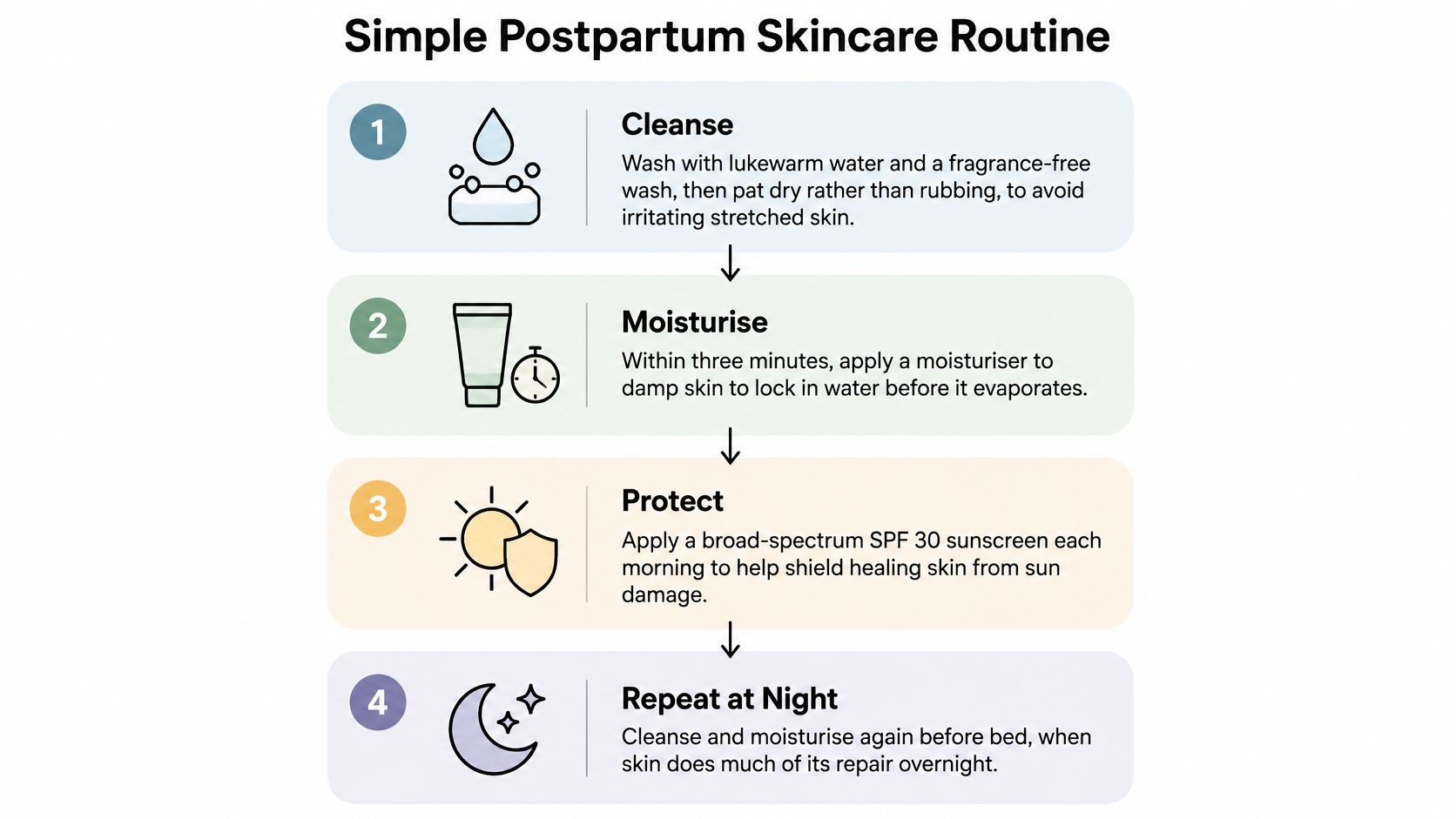
- Wash gently. Use lukewarm water and a fragrance-free wash where needed, then pat rather than rub. Keep cosmetic wash away from healing wounds and follow your discharge instructions for those areas.
- Moisturise while skin is slightly damp. Smooth cream or lotion over dry belly skin, hips and thighs without pulling. Damp-skin application helps retain water rather than letting the skin dry out completely first.
- Add butter only where needed. Once the lotion has settled, apply a thin layer to patches that still feel tight. You're looking for comfortable skin, not a thick coating that catches on clothing.
- Make oil massage optional. If you enjoy it, use slow, light strokes over intact skin when you're unlikely to have immediate skin-to-skin contact. Keep pressure away from tender areas and don't massage an incision without professional clearance.
- Leave exfoliation until skin is settled. Only consider a gentle scrub on healed, non-irritated skin, well away from an incision. Use light pressure and stop if the skin becomes sore; you don't need to scrub stretch marks.
- Protect exposed pigmented skin. Use broad-spectrum sunscreen alongside clothing and shade, especially on facial pigmentation. Follow the pack's application and reapplication directions rather than treating sunscreen as an all-day coating.
- Check for residue before feeding. Remove product from feeding-contact areas and clean your hands before handling your baby. Plan application around feeds where practical, rather than adding unnecessary washing to already sore skin.
The visual below summarises the basic routine; wound care and your maternity team's advice take priority over any cosmetic step.
Adapt it to recovery rather than the calendar
Say you're recovering from a caesarean and have dry hips plus an itchy belly. Start with a fragrance-free cream on intact skin and a little butter on the hips, leaving the incision and any dressing alone.
An oil can wait until you know your skin tolerates the basic routine. Scar massage needs separate clearance, and a wound that looks closed still isn't permission to scrub near it.
For help keeping abdominal care manageable, the postpartum belly skin-care guide offers a focused starting point. On a difficult day, washing where necessary and moisturising the uncomfortable patches is enough.
Choose Your First Product and Patch Test It
I would start with a plain, fragrance-free cream if dryness or itch is the main concern. It's easier to judge whether it helps when you're not introducing a scrub, butter and oil at the same time.
Pick the concern that bothers you most, choose the matching texture and read the entire ingredient list before opening the pack. Try a small amount on intact inner-forearm skin, then introduce it cautiously over the intended area if there's no reaction.
Give yourself a clear stopping point
Use the product on its own long enough to understand how your skin responds before adding another. Stop if it causes burning, a new rash or worsening itch; don't cover the reaction with a richer product.
- Spreading or intensely itchy rash: Contact a GP or pharmacist rather than repeatedly changing cosmetics.
- Wound redness, warmth, pus or increasing pain: Seek prompt advice from your maternity team or GP.
- Cracked or painful nipples: Ask a midwife or breastfeeding supporter to assess feeding, with medical review where infection is suspected.
- Any worrying change: Get it checked, even if it doesn't fit a product label's warning list.
Among supermarket moisturisers, pharmacy emollients and specialist body care, The Happy Bump Co offers Belly Butter for dry skin, Belly Oil for Stretch Marks for a massage routine, and Pregnancy Tummy Scrub for healed, settled skin away from wounds. Check the current pack ingredients and suitability before first use rather than assuming pregnancy positioning covers every postpartum application.
Your first purchase doesn't need to do everything. The practical goal is comfortable, hydrated skin, not erased marks.
The Happy Bump Co offers bump-focused body butters, oils and a scrub that you can consider according to your skin's needs and stage of healing. Visit The Happy Bump Co to explore the range, then check the ingredients and application guidance before choosing a product for your postpartum routine.